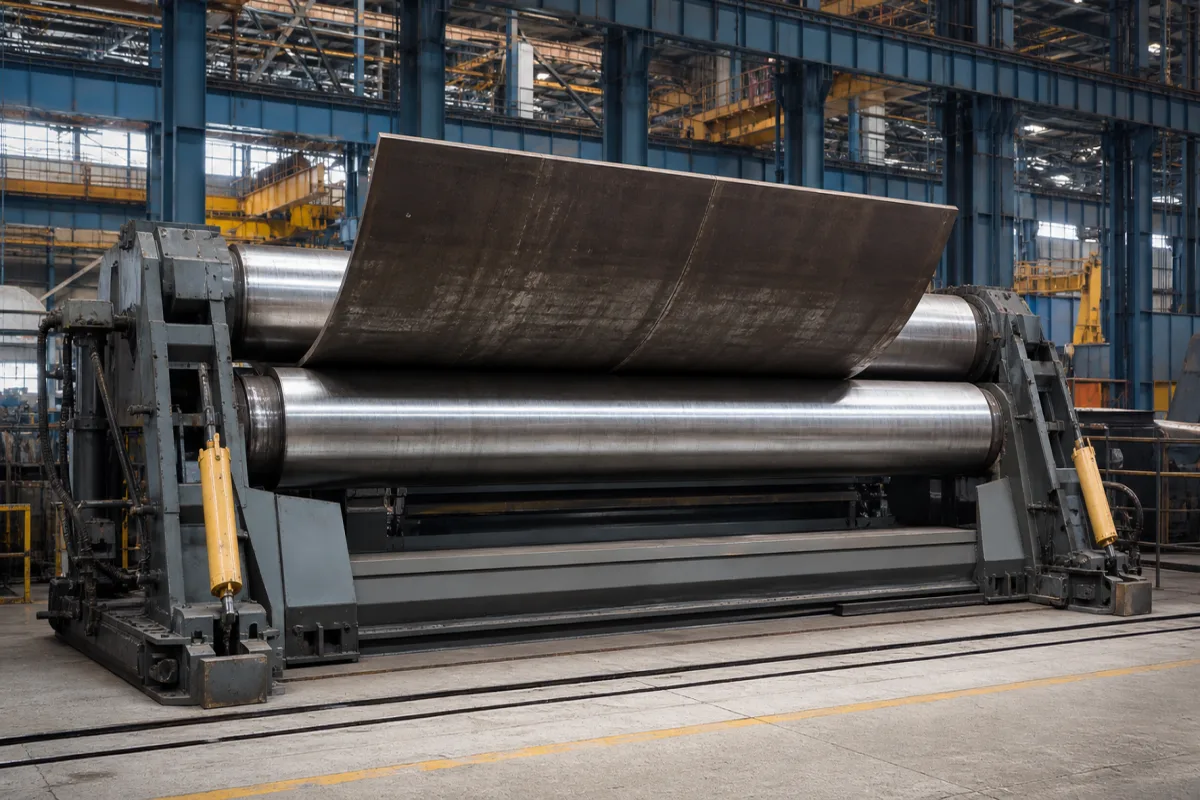
Main (top) bending roll for hull and heavy shell plates: roll diameter against minimum bend diameter, interchangeable smaller rolls and forged alloy steel
Hull and shell plate rolls · the roll the plate wraps around: its diameter caps the tightest cylinder, its length and the plate thickness push the diameter up, and smaller exchange rolls bring the load rating down
In a plate roll the plate is wrapped around one roll: the upper roll in a three- or four-roll machine, the main roller in a vertical press-bend machine. That roll drags or presses the plate, carries the full bending reaction between its bearings, and stands inside the cylinder as it closes. Its diameter therefore limits the smallest shell the machine can make, while the plate thickness and the length of the machine push the same diameter upwards. Exchange rolls, crowning and support systems exist to work around that conflict.
The main bending roll of plate bending machines, meaning the upper (top) roll of three- and four-roll machines and the main roller of vertical press-bend machines, specified for hull and heavy shell plates: diameter against minimum bend diameter, effect of roll length and plate thickness, smaller interchangeable rolls and how load is derated for them, crowning and anti-deflection support, roll changing and forged alloy steel with its section-size limits. Roll configurations, capacities and complete-machine selection are covered on the Plate rolling machine page; the lower (pinch) roll with its deflection, crowning and drive on the Bottom (lower pinch) roll of a plate rolling machine page; and the welded side frames and chassis on the Welded frame structure of a plate rolling machine page.
CNFX editorial research · Sources checked October 13, 2026 · 6 sources
Roll diameter against the smallest shell: what pushes the main roll larger and what lets a smaller one in
Davi's roll bending machine patent (assigned to Promau) states the conflict directly. The strictest working limit of a roll bending machine is the minimum bend radius; because the plate is rolled around the upper dragging roll, that roll's diameter is a limit below which the plate cannot be bent, and with springback the smallest diameter obtainable is greater than the upper roll diameter by a coefficient. [1] The same patent says the rolls must be sized for the loads of the thickest and largest plates and must not flex so far that the bent plate shows a barrel effect, and that on long machines the diameter has to be increased further to hold flexure within acceptable values. [1]
In that tender the main roller has two jobs: it is the central thrust surface of the three-point bend and the means of feeding the plate, gripped against it by vicing rams in the reciprocating beam and turned through helical spur and pinion gearing at its lower end. [2] Editorial calculation: 1,200 mm minimum inside diameter on 200 mm plate is a ratio of 6; the 680 mm roller is there for thinner plates, and the tender ties its use to an automatic reduction in load.
Horizontal machines use the same exchange principle. Haeusler offers interchangeable top rolls in different diameters so that smaller bending diameters can be reached, with a carriage placed on the side rolls that pulls a top roll out of its bearings or inserts it instead of handling it by crane. [3] Haeusler also explains why a larger diameter can help at the other end of the range: top and bottom rolls are crowned to compensate their deflection under load, the crowning can deform thin-walled work, and a larger roll diameter allows less crowning and extends the machine to thinner plates. [3] On large-diameter work it notes that cycle time is set by roll rotation speed rather than installed torque, and offers an increase to 8 m/min. [3] Editorial calculation: one turn of a 1,200 mm shell is about 3.8 m of plate, under half a minute at 8 m/min.
For ship hull plates the plate is long as well as thick. Faccin describes its RP roll-press benders for the shipbuilding and aerospace sectors as built for plates wider than 20 m, with independent tilting rolls for the conical and asymmetrical parts of ship hulls and an anti-deflection system to hold tolerances without reducing the maximum thickness. [4] A three-roll range listed by CKB in Japan for hull outer plates, bulkheads and tanks comes in roll lengths of 3,000 and 4,000 mm across 12 standard models. [5] Davi's patent itself answers the length problem by backing each roll with a longitudinal beam and rolling members between beam and roll, so that a smaller diameter can be used on a long machine. [1]
Requirement in BHEL's 4,000-ton vertical press-bend tender
One alloy forged steel roller of about 680 mm diameter, for bending full-length thinner plates [2]
Load with the smaller roller
To be reduced automatically to ratings that will not overstress it or cause unacceptable deflection [2]
Roller material
Surface-hardened alloy steel forgings, material details from the vendor [2]
State the smallest inside diameter wanted at each plate thickness and width, not only the machine's headline capacity; ask what main-roll diameter achieves it, whether an exchange roll is needed, and what load rating applies with the exchange roll fitted.
02
Forged roll steel: why a bigger main roll is not proportionally stronger
BHEL leaves the alloy to the vendor but requires surface-hardened alloy steel forgings. [2] A Cr-Mo quenching and tempering steel such as 42CrMo4 shows why the forging's diameter matters: the strength its maker lists after quenching and tempering drops step by step as the section gets larger.
SIJ Metal Ravne's disclaimer says the values on its SIQUAL 7225 (1.7225, 42CrMo4) sheet are not a guarantee of maximum or minimum values, and its table stops at 250 mm diameter. [6] Editorial reading: a main roll such as the 680 mm exchange roller in the BHEL tender [2], lies beyond that table, so its core properties have to come from the forging supplier's test report rather than a handbook value. The end-quench test on the same sheet shows how hardness falls with depth: the minimum band reads 53 HRC (typ.) at 1.5 mm from the quenched end and 30 HRC (typ.) at 40 mm. [6]
SIJ gives hardening from 820–850 or 830–860 °C with water or oil quench, tempering at 540–680 °C and hot forming between 1,050 and 850 °C, and notes that once quenched and tempered, machining is best limited to finish grinding. [6] For a roll that is surface hardened after tempering, the order of operations (rough machining, quench and temper, finish machining, surface hardening, grinding) and the depth of the hardened layer belong in the roll specification.
Diameter after quench and temper (SIJ data sheet, 42CrMo4)
Ask the roll maker for the forging steel grade, the forging ratio, ultrasonic inspection standard, core properties from a test piece at the roll's own section, surface hardness and hardened depth, and the crown ground into the barrel.
03
Data to send with a main bending roll enquiry
Paste it into your enquiry below or into an email to a maker, then replace every bracket.
Machine: [type: three-roll, four-roll or vertical press-bend; maker; model; roll length]
Work: [plate thickness and width range; steel grade and yield; smallest inside diameter per thickness]
Roll: [diameter; barrel length; journal and bearing sizes; drive end and gearing]
Crown: [crown amount; plate thickness and width it is ground for]
Material: [forging grade; core test at section; surface hardness and depth; inspection standard]
Exchange roll: [diameter; load rating with it fitted; change method]
Explore company information and manufacturing capabilities, then discuss the scope of your project with a relevant supplier.
Share this page
Compiled and source-reviewed by the CNFX editorial team.
Each manufacturer above links to the page on that company's own website where the product is listed, with the date we checked it. How we source and review
· Page last updated 13 October 2026
Buyer questions
Why does the top roll limit the smallest cylinder a plate roll can make?
Davi's patent explains that the plate is rolled around the upper roll, so its diameter is a limit below which the plate cannot be bent, and with springback the smallest obtainable diameter is greater than the roll diameter by a coefficient. [1]
What is an interchangeable top roll for?
Haeusler offers smaller exchange top rolls to reach smaller bending diameters; BHEL's 4,000-ton tender asks for a 680 mm exchange roller for thinner plates, with the load reduced automatically when it is fitted. [3][2]
Why not simply crown the top roll more?
Haeusler notes that crowning compensates roll deflection but can deform thin-walled workpieces, and that a larger roll diameter allows less crowning. [3]
Does a larger forged roll have the same strength as a small one?
Not after quench and temper: SIJ's 42CrMo4 sheet lists tensile strength of 1,000–1,200 N/mm² (typ.) for 17–40 mm diameters and 750–900 N/mm² (typ.) for 161–250 mm. [6]
Sources and what still needs a direct check
Sources checked 2026-10-13. A Davi (Promau) patent explains the link between upper-roll diameter, bend radius and machine length; a BHEL tender specifies a main roller and exchange roller for a 4,000-ton bender; Haeusler, Faccin and a Japanese shipbuilding range describe exchange rolls, crowning and hull-plate machines; an SIJ data sheet gives 42CrMo4 properties by section size.