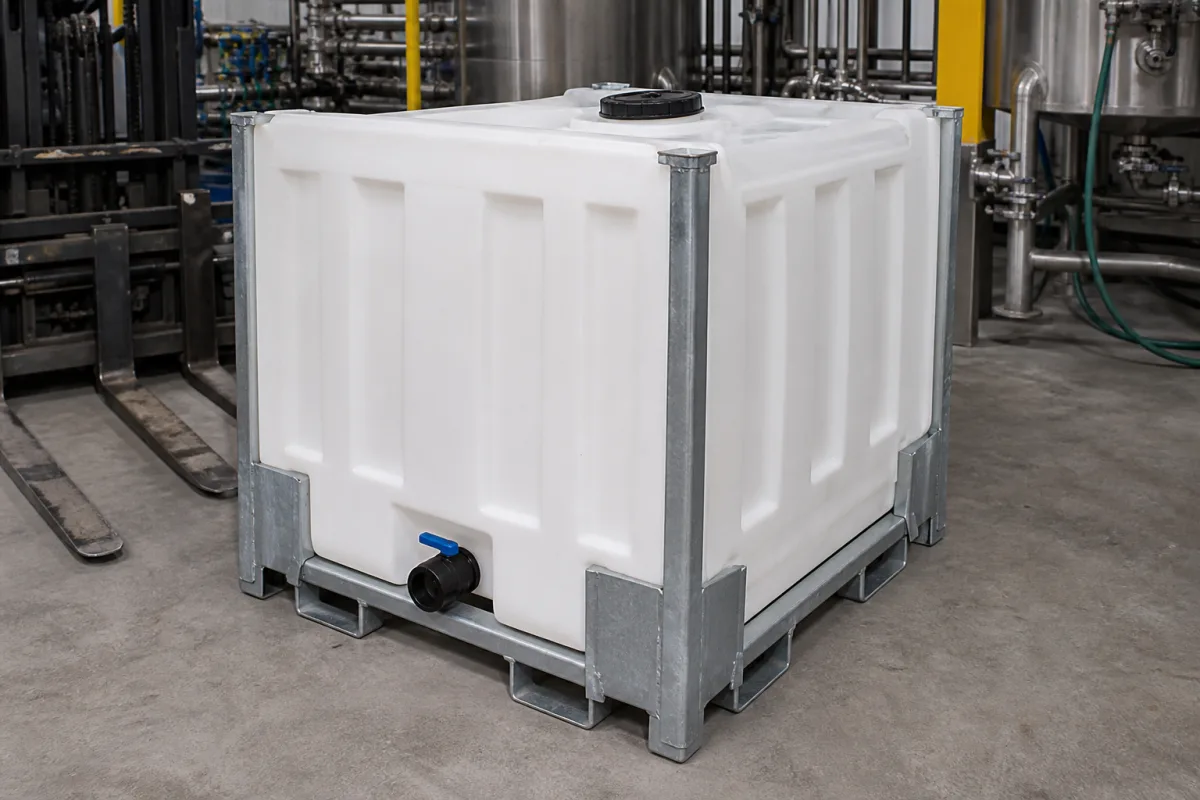
Industrial plastic IBCs · Composite intermediate bulk containers with a plastic inner bottle in a steel frame on a pallet: 450–3,000 L, UN design codes such as 31HA1, marking, outlet valves, filling openings, product density limits and Ex-zone versions
A plastic intermediate bulk container (IBC) stores and ships liquids or solids in a moulded plastic inner bottle held by a metal frame or cage on a pallet base, so a forklift can move it full and units can be stacked. Ask three things first: what capacity and product density it must carry, whether it must carry a UN mark for dangerous goods, and which outlet valve, filling opening, pallet and antistatic or food grade are needed.
Composite and rigid plastic intermediate bulk containers of 450 to 3,000 L with plastic inner receptacles, their frames, pallets, valves and closures. Stacking bins and crates for parts, storage tanks (see storage tank), steel drums and drum cleaning (see automated chemical drum cleaning and decontamination system) are outside this page.
CNFX editorial research · Sources checked October 11, 2026 · 5 sources
Under US rule 49 CFR 178.707, a composite IBC is a rigid outer packaging enclosing a plastic inner receptacle; the outer packaging bears the entire stacking load, and the two are filled, stored, transported and emptied as a unit. Composite IBCs may hold no more than 3,000 L (793 gallons) and no less than 450 L (119 gallons). Type 31HZ1 has a rigid plastic inner receptacle for liquids, and 11HZ1 and 21HZ1 are for solids discharged by gravity or under pressure; the Z is replaced by a letter for the outer packaging material. [1]
The rule requires the inner receptacle to be made of plastic of known specification, resistant to ageing and ultraviolet degradation, with no used material other than production residues or regrind from the same process unless approved. Liquid IBCs must be able to vent enough vapour to avoid rupture above their hydraulic test pressure, and any pallet base must handle the IBC at maximum permissible gross mass. [1] Structural equipment includes stacking members such as metal cages. [3]
49 CFR 178.703 requires the manufacturer to mark every IBC with the UN symbol, design code, a letter X, Y or Z for the packing groups passed, month and year of manufacture, the authorizing country, the manufacturer, the stacking test load in kg (0 if not designed for stacking) and the maximum permissible gross mass in kg, in characters at least 12 mm high. Rigid plastic and composite IBCs also carry rated capacity in litres of water at 20 °C, tare mass, gauge test pressure in kPa and dates of the last leakproofness test and inspection. [2]
Give the supplier the product, its density and hazard class, required UN design code and packing group, capacity, stacking needs, outlet valve and filling opening, pallet type, food, FDA or antistatic requirements, storage conditions and the number of units.
02
Choose the valve, filling opening, pallet and grade
SCHÜTZ lists its ECOBULK MX in 640, 820, 1,000 and 1,250 L, approved for products with a maximum density of 1.9, with a steel bottom plate to help minimise residual contents and optional FDA approval. Its 1,000 L version offers integrated butterfly valves DN 50 or DN 80, a screwable DN 150 butterfly valve or an integrated DN 50 ball valve; DN 150 or DN 225 screw caps or a DN 400 clamp-ring lid; and steel, plastic or full-plastic pallets. [4]
For hazardous areas, SCHÜTZ's ECOBULK MX-EX conductive has a conductive outer layer for Ex zones 1 and 2, earthed butterfly valves of DN 50 or DN 80, a steel pallet, and a maximum product density of 1.6. [5]
Editorial calculation: at the listed maximum density of 1.9, a full 1,000 L ECOBULK MX holds about 1,900 kg of product; at 1.6, a 1,000 L MX-EX conductive holds about 1,600 kg. [4][5]
Ask any supplier for capacity, UN design code and test certificate, maximum product density, stacking test load, maximum gross mass, tare mass, inner bottle material and layers, valve and opening options, pallet type, external dimensions, and reconditioning or take-back service.
04
Inner bottle, cage, pallet, valve and filling opening on an IBC
Gross mass, stacking load and the dimensions the maker has to supply
The CFR marking rules give the gross mass, stacking load and tare entries; external dimensions, wall thickness and impact data are not in the reviewed sources and have to come from the maker.
Field
What it means and published values
Ask the supplier for
External Length (mm)
Not stated in the reviewed sources.
Dimensions.
External Width (mm)
Not stated in the reviewed sources.
Dimensions.
External Height (mm)
Not stated in the reviewed sources.
Dimensions.
Wall Thickness (mm)
Not stated in the reviewed sources.
Bottle wall.
Maximum Load Capacity (kg)
Maximum permissible gross mass is marked in kg; e.g. density up to 1.9. [2][4]
Explore company information and manufacturing capabilities, then discuss the scope of your project with a relevant supplier.
Share this page
Compiled and source-reviewed by the CNFX editorial team.
Each manufacturer above links to the page on that company's own website where the product is listed, with the date we checked it. How we source and review
· Page last updated 13 October 2026
Buyer questions
What sizes can a composite IBC be?
49 CFR 178.707 limits composite IBCs to between 450 L and 3,000 L. [1]
What does the UN mark on an IBC show?
The UN symbol, design code, packing group letter, date, country, manufacturer, stacking test load and maximum gross mass. [2]
Can plastic IBCs be used in Ex zones?
SCHÜTZ offers an ECOBULK MX-EX conductive version for Ex zones 1 and 2. [5]
Sources and what still needs a direct check
Sources checked 2026-10-11. The US eCFR publishes the IBC packaging rules; SCHÜTZ makes ECOBULK composite IBCs.