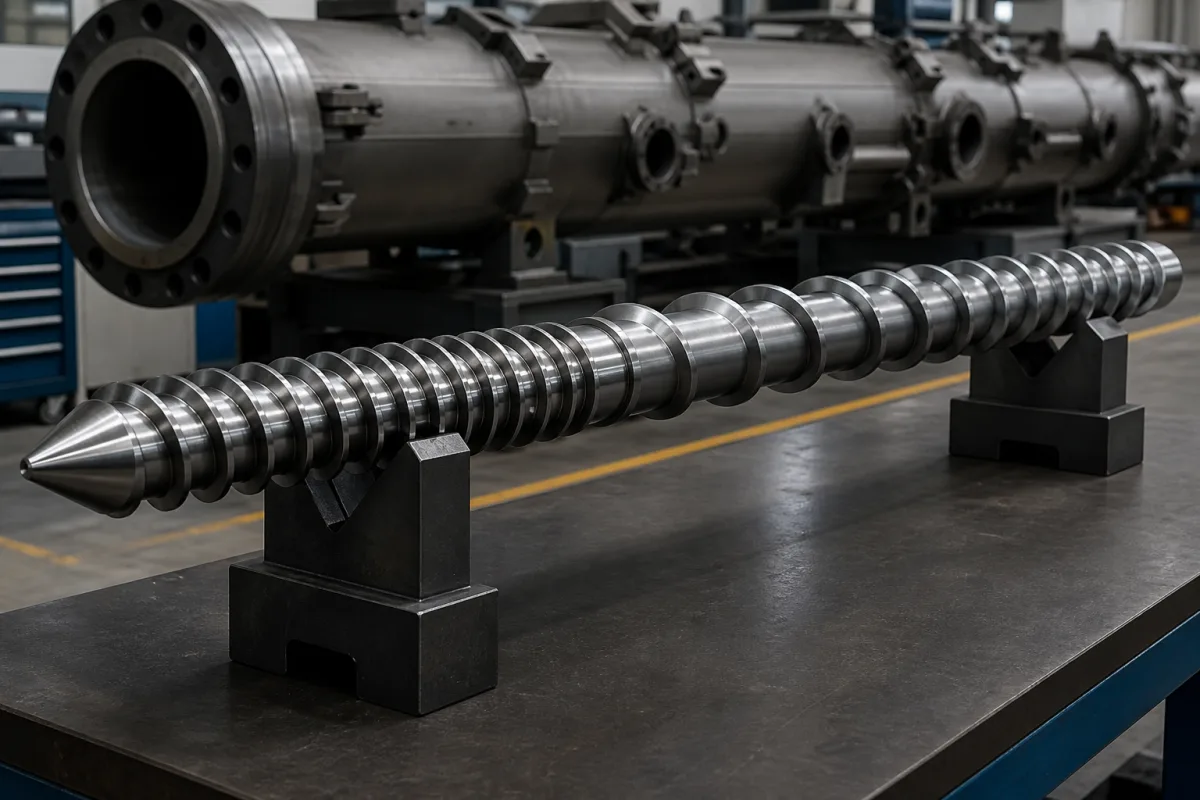
Single-screw extrusion · Feed, compression and metering geometry, L/D and compression ratio, wear measurement and replacement
A polymer extrusion screw is the flighted shaft that turns inside a heated barrel to convey plastic pellets, melt them and pump the melt to the die. Ask three things first: the geometry (diameter, L/D, section lengths, channel depths and compression ratio) for your polymer, the screw and flight-hardening materials for your fillers and output, and how flight clearance will be measured and when the screw or barrel is rebuilt.
Screws for single-screw plastics extruders, including standard metering screws and barrier or mixing designs, supplied alone or with their barrels. Twin-screw elements and shafts, injection-moulding screws, feed and food extruder screws, and complete extruders are outside this page.
CNFX editorial research · Sources checked October 12, 2026 · 4 sources
Polymer processing lecture notes from BIT Mesra describe the conventional single screw as three sections: a deep-flighted feed section near the hopper; a compression (transition) section in which channel depth reduces linearly, compressing the material; and a shallow metering section near the die. L/D, the flighted length divided by the screw's outside diameter, ranges from 20 to 30 in the notes, and compression ratio is feed depth divided by metering depth. [1]
The same notes give the general characteristics of a standard screw: total length 20–30D, feed section 4–8D, metering section 6–10D, one flight, pitch 1D (helix angle 17.66°), flight width 0.1D and feed channel depth 0.10–0.15D. They name 4140 steel as a screw material, with low-carbon, stainless, tool and nickel-base alternatives, and nitriding or bimetallic linings for wear-resistant barrels. [1]
Editorial calculation: for a 90 mm screw at L/D 24, the flighted length is 2.16 m; a feed depth of 0.10–0.15D is 9–13.5 mm, and at a compression ratio of 3 (an example value) the metering depth would be 3–4.5 mm. A pitch of 1D gives a helix angle of arctan(1/π) ≈ 17.66°, matching the notes. [1]
The notes' troubleshooting table lists metering depth that is too shallow or too deep among possible causes of melt fracture, and improper screw design among causes of bubbles and rough surfaces. [1]
Give the supplier the polymer and grade, fillers or reinforcements, output rate and screw speed, product (film, sheet, pipe, profile, compounding), barrel diameter and L/D, existing screw drawing if replacing, feed and venting arrangement, and the flight hardfacing and barrel lining you want.
02
Measure flight clearance and plan rebuilds
Davis-Standard explains that screw outside diameter decreases and barrel inside diameter increases with wear, and that the screw is designed to wear faster than the barrel because it is easier to replace. Its procedure is to remove the screw, clean it with brass tools and copper gauze (no steel wire brush), let it cool to room temperature, number the flights, measure each flight OD with a bar micrometer and plot OD against flight number versus the original dimensions. [2]
For barrels, Davis-Standard measures the cold, clean bore with an electronic micrometer on a sled, plots diameter against L/D, and states that a barrel worn to two times the original radial clearance between screw and barrel should be replaced. It notes that special high-work barrier screws limit wear to 75% of the barrier flight clearance. [3][2]
BIT Mesra's notes put the ratio of radial clearance to screw diameter at about 0.001. [1] Editorial calculation: a 90 mm screw would then start with about 0.09 mm radial clearance, so by Davis-Standard's barrel criterion the barrel would be due for replacement around 0.18 mm. Use the actual as-built clearance from your screw and barrel records. [1][3]
03
Nitrided, bimetallic and barrier screws on supplier listings
Listings include nitrided and bimetallic screws and barrels, film, pipe and pelletising screws, barrier and mixing designs, and custom screws for special processes; some listings also cover twin-screw parts or complete extruders.
04
Match flight armour and screw steel to the filler content
Reifenhäuser Reiloy's screw data sheet covers screws of 40–300 mm diameter and up to 9,000 mm long, with ion-nitrided, gas-nitrided, hard chrome-plated or PVD-coated surfaces, made to the buyer's drawing or to its own geometry. It grades flight protection by duty: nitriding steel with a surface hardness of 900–1,100 HV5; R331 and R341, martensitic iron-based alloys reinforced by vanadium carbide, at min. 56 HRc; and RS12, a cobalt-base alloy at min. 45 HRc for highest corrosion resistance, also at high temperatures. It recommends its Premium screws for plastics with more than 30 % filler. [4]
For screws of 50 mm and above, its matrix lists 34CrAlNi7-10 (1.8550) nitrided at the Smart level and 31CrMoV9 (1.8519) with R331 armour at the Advanced level. Where it marks a polymer for additional surface coating, the table below says so. [4]
Editorial calculation: a 300 mm screw at the 9,000 mm maximum length has L/D 9,000 ÷ 300 = 30, the top of BIT Mesra's 20–30 range. [4][1]
Polymer
Unfilled
Over 30 % filler
PP
Smart (depending on the material) or Advanced
Premium
PA
Advanced or Premium
Premium
PVC-U
Advanced or Premium, with additional surface coating
Premium, with additional surface coating
PVDF
Select
Not listed
05
Trace the screw features
Section names and their roles follow BIT Mesra's description of a conventional three-section screw.
7 companies list this product among what they make. Company figures are quoted from each
company's own website; every card states where the relationship came from.
Zhejiang Zhongyang Screw Manufacturing Co., Ltd.
Manufacturing site to be confirmed for the order
Lists single and twin extruder screws and barrels, including bimetallic types.
Explore company information and manufacturing capabilities, then discuss the scope of your project with a relevant supplier.
Share this page
Compiled and source-reviewed by the CNFX editorial team.
Each manufacturer above links to the page on that company's own website where the product is listed, with the date we checked it. How we source and review
· Page last updated 13 October 2026
Buyer questions
What L/D ratio do extrusion screws use?
BIT Mesra's notes give an L/D range of 20 to 30. [1]
How is compression ratio defined?
As feed-section channel depth divided by metering-section channel depth. [1]
When should an extruder barrel be replaced?
Davis-Standard says when the bore is worn to two times the original radial clearance between screw and barrel. [3]
What flight armour does a filled polymer need?
Reifenhäuser Reiloy recommends its Premium armoured screws for plastics with more than 30 % filler. [4]
Sources and what still needs a direct check
Sources checked 2026-10-12. BIT Mesra's notes are university teaching material summarising standard screw geometry; Davis-Standard is an extruder maker describing its own maintenance practice.