This page explains how Industrial Ultrasonic Vegetable Washer is classified within Processing and Preserving of Fruit and Vegetables. Technical values and manufacturer relationships are research references; confirm the current specification and supplier evidence for each order.
Industrial ultrasonic washing machine for vegetables, using cavitation to remove contaminants.
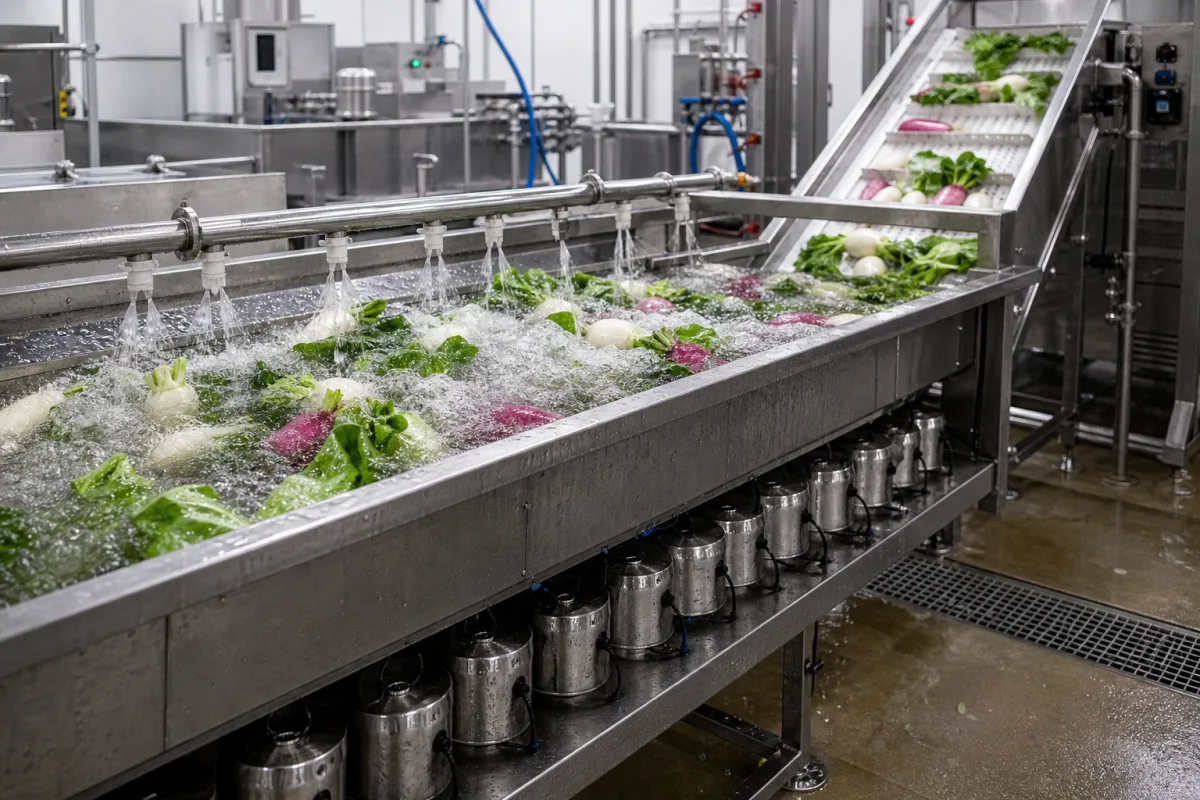
Technical details and manufacturing context for Industrial Ultrasonic Vegetable Washer
| Parameter | Typical range | Notes & selection driver |
|---|---|---|
| Processing CapacityRequired | 500–2000 kg/hour | Maximum vegetable throughput |
| Ultrasonic FrequencyRequired | 25–40 kHz | Operating frequency range |
| Power ConsumptionRequired | 10–30 kW | Maximum electrical power draw |
| Water ConsumptionRequired | 1–3 L/minute | Water flow rate during operation |
| Tank VolumeRequired | 500–3000 L | Washing chamber capacity |
| DimensionsRequired | 3000–8000 × 1200–2000 × 1500–2500 mm | Machine footprint (L×W×H) |
| Operating Temperature | 5–40 °C | Water temperature range for optimal cavitation |
| Operating Pressure | 0.2–0.5 MPa | Water supply pressure; higher pressure improves spray cleaning |
| Electrical Supply | 380 ±10% V AC, 3-phase, 50/60 Hz | Standard industrial power; other voltages on requestIEC 60038 |
| Material Grade | 304/316L SS | 316L for corrosive environmentsASTM A240 |
| IP Rating | IP54–IP65 | Higher rating for washdown areasIEC 60529 |
| Noise Level | ≤80 dB(A) | At operator positionISO 3746 |
| Weight | 800–3000 kg | Depends on configuration and material |
Ranges are indicative industry figures for RFQ preparation, not a supplier commitment. Confirm every value and standard with the legal manufacturer before ordering.
Commonly used trade names and technical identifiers for Industrial Ultrasonic Vegetable Washer.
| pressure: | Atmospheric to 2 bar (tank pressure) |
| flow rate: | Batch process (no continuous flow) |
| temperature: | 5-40°C (operating fluid temperature) |
| power density: | 0.5-2 W/cm² of transducer surface |
| slurry concentration: | Up to 30% solids by volume |
| ultrasonic frequency: | 20-40 kHz |
Indicative industry ranges for design and RFQ preparation. Confirm the exact figures and applicable standard with the manufacturer before specifying.
Quoted from the published standard.
2 companies list this product among what they make. Company figures are quoted from each company's own website; every card states where the relationship came from.
Manufacturer listings support early research and capability understanding. They are not certification, ranking, or transaction guarantees.
A practical evidence checklist for RFQ preparation and supplier evaluation.
CNFX does not score or rank suppliers. Buyers must verify all claims and documents with the legal manufacturer before ordering.
The washer is designed for a range of vegetables, but specific compatibility depends on the model and configuration. Consult the manufacturer for details on vegetable types and sizes.
Ultrasonic cleaning uses cavitation to remove contaminants from surfaces and crevices, which can be more effective than high-pressure spraying alone. However, effectiveness varies with produce type and settings.
Regular maintenance includes cleaning the tank and transducers, checking water quality, and inspecting seals and electrical connections. Follow the manufacturer's maintenance schedule.
Yes, it is designed for integration with sorting and packaging lines. However, integration requires careful planning of space, utilities, and controls. Consult the supplier for engineering support.
Editorial classification, named public sources where available, and source-reviewed manufacturer records.
Ask for use case, specification boundaries, supplier type, and RFQ preparation information for this product.
Compare manufacturer profiles with relevant product and process capability.