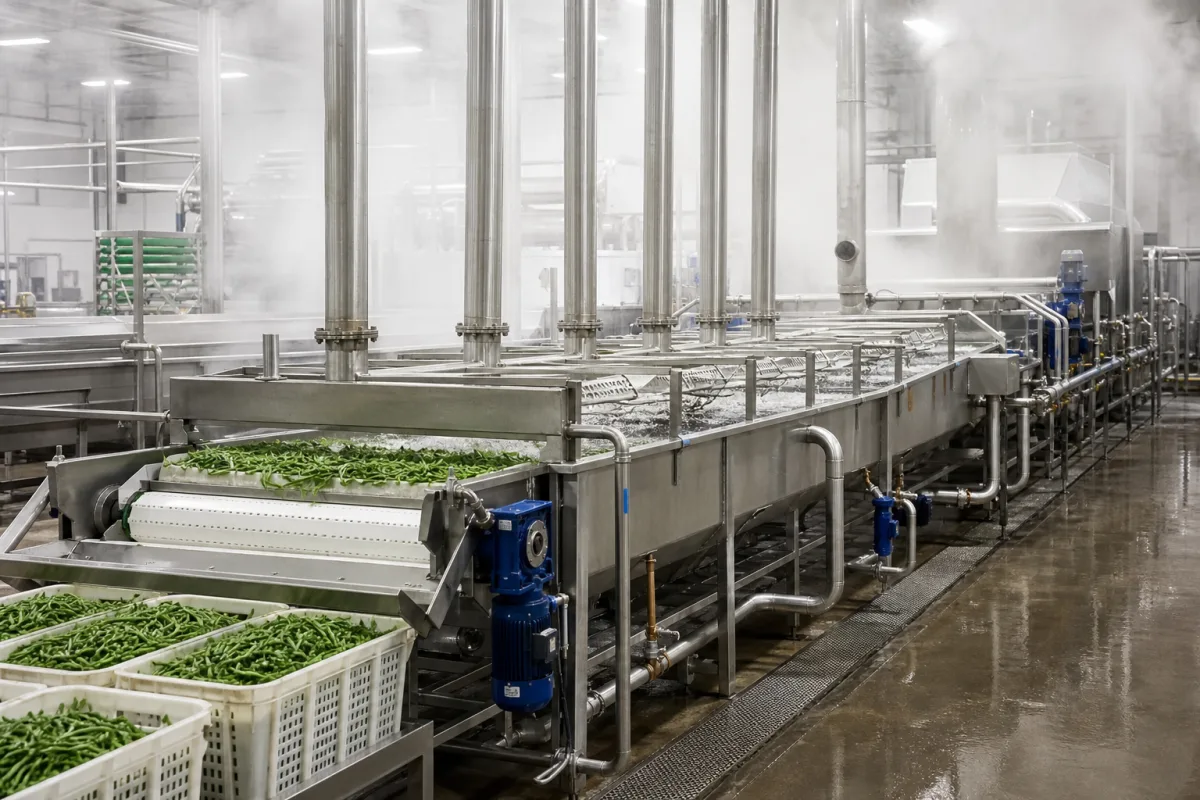
Hydrostatic immersion belt blancher: a level-controlled hot-water bath in sections, steam-water injection and belt speed set to the enzyme target
Belt blancher with a level-controlled hot-water bath · peas, green beans and cut vegetables carried under water on a belt through steam-heated sections, with pumped recirculation and a settling sump at the discharge
In an immersion belt blancher the product does not tumble in a drum or sit under steam: it lies in a thin layer on a conveyor that runs through a bath of hot water kept at an exact level, and the bath is divided under the belt into sections. Steam is injected with recirculated water in some sections and drawn off in others, so the water circulates through the product layer and moves along with it. Three numbers define a machine for a given product: the length of the bath under water, the belt speed that gives the needed residence time, and the steam needed to hold the bath temperature while cold product comes in.
Continuous immersion belt blanchers with a level-controlled hot-water bath for peas, green beans, sweet corn and cut vegetables: sectioned baths, steam or steam-water injection, recirculation pumps, settling sumps, belt drives and the hand-over to a cooler belt. Rotary drum blanchers and drum cooker-coolers are covered on the Rotary fruit and vegetable blanching drum page; the pumps that recirculate blanch water on the Water circulation pump for hot-water blanchers page; steam blanchers, spray belt blanchers, fryers and steam peelers are outside this page.
CNFX editorial research · Sources checked October 12, 2026 · 3 sources
Sections under the belt: steam-water injection, return pumps and how fast the water moves
European patent EP0508238B1 (ROBA B.V.) describes an immersion belt blancher whose bath is divided under the belt into six sections. Steam-water injection nozzles across the belt width enter the first, third and fifth sections, inclined in the direction of travel; the second, fourth and sixth sections each have a pumped suction line feeding back to the nozzles of the section before. [1]
The patent sizes the return pumps so that the returned water has dropped 3 °C after the first section and 2 °C after the later ones, and arranges the injection so that the water above the product flows in the direction of travel at about the belt speed. [1] Under the last belt section, where the belt rises out of the bath, the floor is a recessed settling tank from which sediment and blanch water are pumped to waste water treatment; water from the last suction line also feeds a cleaning device that washes the returning blancher belt and the cooler belt below it. [1]
Editorial calculation: 404 kg/h of steam for 3,000 kg/h of peas is about 0.13 t of steam per tonne of product for the blancher alone in the patent's example. [1]
20 °C in; 80 °C blanching temperature; blanching time about 90 s [1]
Steam
3 bar direct injection; 296 kg/h to heat the product plus 83 kg/h for evaporation at the open infeed and discharge; about 404 kg/h with radiation and conduction losses [1]
50 m³/h first, 30 m³/h second, 15 m³/h for the last suction section and belt-cleaning line [1]
Water speed; belt speed
0.12 m/s at first, then 0.07 m/s; peas travel at about 0.09 m/s [1]
Ask the supplier for the number of bath sections, which ones are injected and which are drawn off, the flow of each return pump, and the water speed this gives over the product.
02
Belt speed and bath length against the enzyme target for green beans and peas
The EU reference document for the food, drink and milk industries gives the general frame: direct blanching is done by immersion in hot water at 80–100 °C or by live steam, with residence times of approximately 1 to 5 minutes depending on the fruit or vegetable. [3]
For green beans destined for frozen storage, Bahçeci and co-authors used two blanching conditions: 70 °C for 2 min, which gave more than 90% lipoxygenase (LOX) inactivation, and 90 °C for 3 min, which gave more than 90% peroxidase (POD) inactivation. [2] The half-life of ascorbic acid rose from 1.89 months unblanched to 2.15 months after the LOX blanch and 3.48 months after the POD blanch; chlorophyll a and b half-lives fell to 5.05 and 10.09 months after the LOX blanch but rose to 8.26 and 16.70 months after the POD blanch, and the authors concluded that blanching to inactivate POD retains green bean quality better in frozen storage. [2]
Editorial calculation: at the patent's belt speed of 0.09 m/s, the 8 m bath gives 8 / 0.09 ≈ 89 s, matching its 90 s for peas. [1] Holding green beans for 3 min (180 s) at that speed would need 0.09 × 180 ≈ 16 m of bath; on the same 8 m bath the belt would have to slow to 8 / 180 ≈ 0.044 m/s, and if the 2 cm layer is kept, throughput would fall roughly in proportion, to about 3,000 × 0.044 / 0.09 ≈ 1,500 kg/h. This assumes green beans load the belt like peas, which the sources do not state. [1][2]
State the product, piece size, enzyme target (LOX or POD) and the time-temperature the test showed, and ask the supplier for the bath length and belt speed range that deliver it at the required throughput.
03
Steam and electricity per tonne: reading the EU reference figures for belt blanching
The EU reference document reports consumption per tonne of frozen vegetables for whole blanch-and-cool lines, citing a 2006 Commission source. [3]
The document attributes the lower figure for belt blanching with water cooling to heat recovery: warm water from the first cooling compartment is reused in a preheating section held at 60 °C, and fresh cooling water at, for example, 2–15 °C enters the last compartment and moves forward. [3] It also states that hot water blanching produces waste water with high BOD levels. [3] The belt blanchers it describes spray water from above and below rather than immersing the product. [3]
Editorial note: the patent's 0.13 t/t is for an immersion blancher without a preheating section, at 80 °C, per tonne of raw peas; the reference figures are per tonne of frozen product for spray belt lines with or without heat recovery. The table and text ranges also differ, so ask the supplier to state steam per tonne for the blancher alone and for the whole line, at your product and bath temperature. [1][3]
Explore company information and manufacturing capabilities, then discuss the scope of your project with a relevant supplier.
Share this page
Compiled and source-reviewed by the CNFX editorial team.
Each manufacturer above links to the page on that company's own website where the product is listed, with the date we checked it. How we source and review
· Page last updated 13 October 2026
Buyer questions
How long is the product under water in an immersion belt blancher?
In the patent's example, about 90 s on an 8 m bath at 0.09 m/s; the EU reference document gives about 1 to 5 minutes depending on the vegetable. [1][3]
What blanch did green beans need for POD inactivation?
Bahçeci and co-authors used 90 °C for 3 min for more than 90% POD inactivation. [2]
How much steam does an immersion belt blancher use?
About 404 kg/h for 3,000 kg/h of peas at 80 °C in the patent's example. [1]
Sources and what still needs a direct check
Sources checked 2026-10-12. The machine design figures come from a granted European patent; the enzyme targets from a peer-reviewed study on green beans; the line consumption figures from the EU Best Available Techniques reference document.