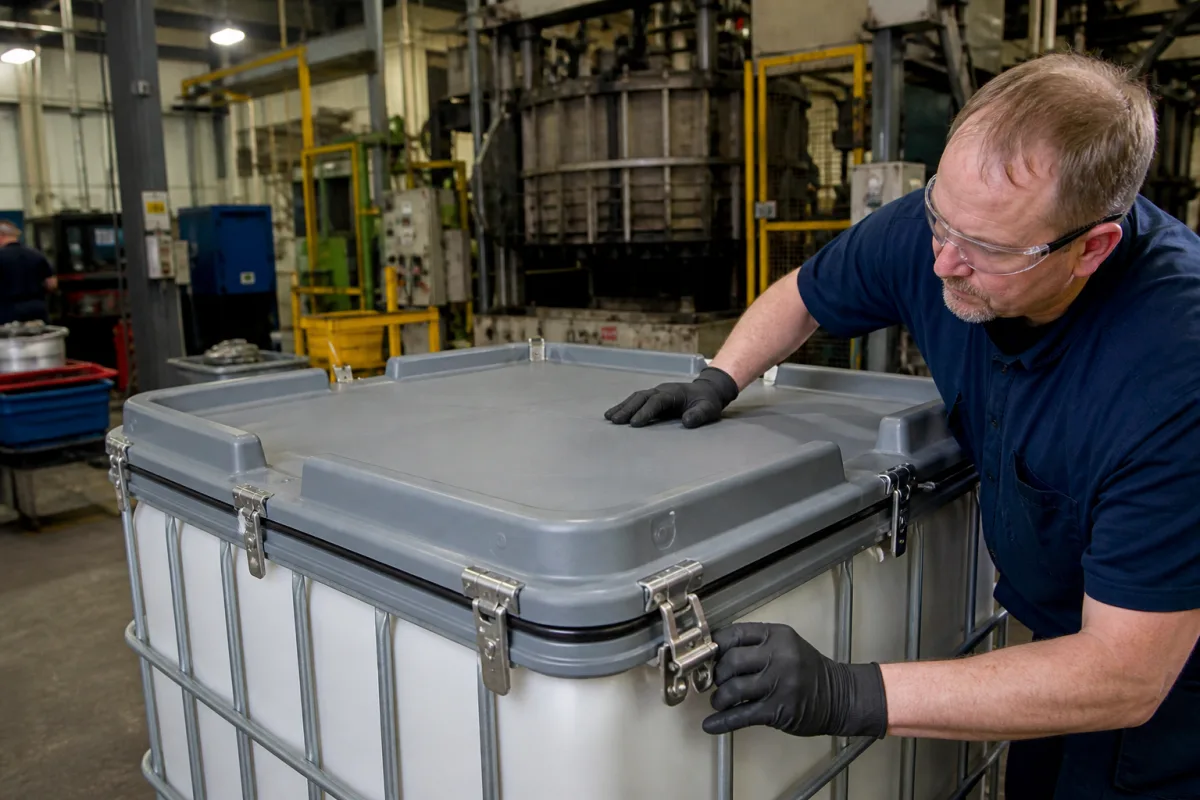
Lid assembly for an open-top plastic container: the gasketed lid, its toggle latches and how hard they squeeze the seal
Full-width removable lids for open-top plastic bulk containers and boxes · over-centre toggle latches by holding force and pull-in stroke, gasket squeeze by rubber type and hardness, and compression set
Where a container has to be opened fully — for loading parts, scooping powder or cleaning — it gets a removable lid rather than a screw cap: a moulded plastic lid that sits over the rim, a gasket in a groove or on a flange, and latches round the edge that pull the lid down. This page deals with that lid as an assembly: which latch, how many, how far the gasket should be squeezed, and which rubber keeps sealing after months closed.
Removable and hinged full-width lids for open-top plastic containers — pallet boxes, bulk bins, open-top tanks and caged containers — with their gaskets and over-centre toggle or draw latches. Composite IBCs of 450 to 3,000 L with their filling openings, valves and screw closures are covered on the Industrial-grade plastic storage container page; rotomoulded water and liquid tanks with top manways on the Rotomoulded polyethylene storage tank page; hatches on vessels and ducts on the Inspection hatches and access ports page; gasketed doors of electrical enclosures on the Enclosure door assembly page.
CNFX editorial research · Sources checked October 12, 2026 · 4 sources
Over-centre toggle latches: 550 N or 1,100 N of static hold, and how far they pull the lid down
Ganter describes its stainless toggle latches GN 831.1 and GN 832.4 as made for holding flaps and container lids; both lock beyond the dead-centre point, which Ganter says makes them vibration proof. Its holding forces are guideline values for a nominal static pull, and vibration or shock loads can reduce them. [1][2]
Editorial calculation: four GN 832.4-55 latches give 4 × 550 = 2,200 N of static hold on a lid; four GN 831.1-110 latches give 4,400 N. Those totals have to exceed the force needed to squeeze the gasket to its target plus any lift from the contents, and the figures are static, so a container that is forklifted or shipped needs margin for shock.
The U-bolt latch holds by its own spring, so the gasket squeeze depends on how well latch and catch are positioned; the GN 831.1's 12 mm adjustment range lets the squeeze be reset after the gasket has taken a set. [2][1]
Tell the lid maker the container size and rim, the number of latch positions, whether the container is lifted or stacked with the lid on, and whether latches must be stainless for wash-down.
02
How far to squeeze the lid gasket: 20–35% for solid rubber, 30–40% for closed-cell sponge
Elasto Proxy, a gasket fabricator, ties the squeeze of a solid rubber gasket to its hardness: 20–25% at 40–50 Shore A, 25–30% at 60 Shore A, 30–35% at 70 Shore A and 35% at most at 80 Shore A, with at least 15% to seal and a risk of permanent deformation above 35%. For sponge it puts closed-cell sponge, the better choice for water sealing, at 30–40% and open-cell sponge for air and dust at 40–60%, with cells crushed above 60%. [3]
Rogers Corporation, which makes foam sealing materials, gives a wider band of 30–50% compression as general guidance for foam gaskets, varying with material and application, and recommends compression force testing under the expected conditions. It shows how much the force differs between foams: a 4 pcf cross-linked polyethylene foam needs 10 psi for 25% compression, a 15 pcf polyurethane foam 3.1 psi. [4]
Editorial calculation: an 8 mm closed-cell EPDM sponge strip squeezed 30–40% closes by 2.4–3.2 mm, so the lid must come down that far onto the rim once latched — a small fraction of the 15 mm the GN 831.1 can pull the parts together, but the latch catch must be set within its 12 mm adjustment so the full squeeze is reached and not exceeded. A 4 mm solid EPDM gasket at 20–30% closes by only 0.8–1.2 mm, so rim flatness tolerances matter more. [3][1]
Gasket material (Elasto Proxy)
Hardness
Recommended compression
Note given
EPDM, solid
40–70 Shore A
20–30%
Weathering and ozone resistance; good compression set [3]
Silicone, solid
40–60 Shore A
20–25%
High/low temperature; very low compression set [3]
Nitrile (NBR), solid
50–70 Shore A
25–35%
Oils and fuels; higher compression set than EPDM [3]
Specify the gasket material, hardness or sponge type, section, and the squeeze the lid and latches are designed to give; ask for the rim and lid flatness that squeeze assumes.
03
Keeping the seal after months closed: compression set by material and temperature
A lid gasket that stays compressed for weeks in a warm store can flatten and stop pushing back. Rogers explains compression set with an example: a sample of 1.00 inch that recovers only to 0.75 inch has a 25% set. It reports that neoprene, rubber blends, polyethylene and EPDM can reach compression set values as high as 50% at high temperature, while its PORON polyurethane and BISCO silicone materials can have values below 5%. [4]
Rogers gives its BISCO silicones an operating range of −55 °C to 200 °C and says neoprene may become brittle or degrade above 121 °C (250 °F). [4] Elasto Proxy rates silicone as having very low compression set and EPDM as good, which is why it pairs silicone with lower squeeze (20–25%) than EPDM (20–30%). [3]
Editorial note: for a container lid the trade-off is cost and food or chemical compatibility against how long the lid stays shut and how hot the store or wash gets; ask for a compression-set figure measured at your storage temperature and duration, not a room-temperature value.
04
Data for quoting a container lid assembly
Paste it into your enquiry below or into an email to a maker, then replace every bracket.
Container: [type; outside rim size; material; open-top or hinged lid]
Use: [contents; storage time closed; temperature; wash-down]
Latches: [number; static holding force; stainless or zinc-plated steel; padlockable]
Gasket: [material; hardness or sponge type; section; squeeze]
Seal target: [dust, splash or water-tight; test]
Handling: [lifting, stacking or shipping with lid on]
Explore company information and manufacturing capabilities, then discuss the scope of your project with a relevant supplier.
Share this page
Compiled and source-reviewed by the CNFX editorial team.
Each manufacturer above links to the page on that company's own website where the product is listed, with the date we checked it. How we source and review
· Page last updated 13 October 2026
Buyer questions
How strong are toggle latches for container lids?
Ganter lists stainless toggle latches for container lids at 550 N (GN 832.4-55) and 1,100 N (GN 831.1-110) of static holding force, which vibration or shock can reduce. [2][1]
How much should a lid gasket be compressed?
Elasto Proxy gives 20–35% for solid rubber depending on hardness and 30–40% for closed-cell sponge used for water sealing; Rogers gives 30–50% as general guidance for foam. [3][4]
Why do container lid gaskets stop sealing?
Compression set: Rogers says EPDM and neoprene can reach values as high as 50% at high temperature, while some of its silicone and polyurethane foams can stay below 5%. [4]
Sources and what still needs a direct check
Sources checked 2026-10-12. Latch data come from Ganter's product records for GN 831.1 and GN 832.4 stainless toggle latches, as listed by a German distributor; gasket squeeze by material and hardness from gasket fabricator Elasto Proxy; foam compression, compression set and temperature limits from Rogers Corporation.