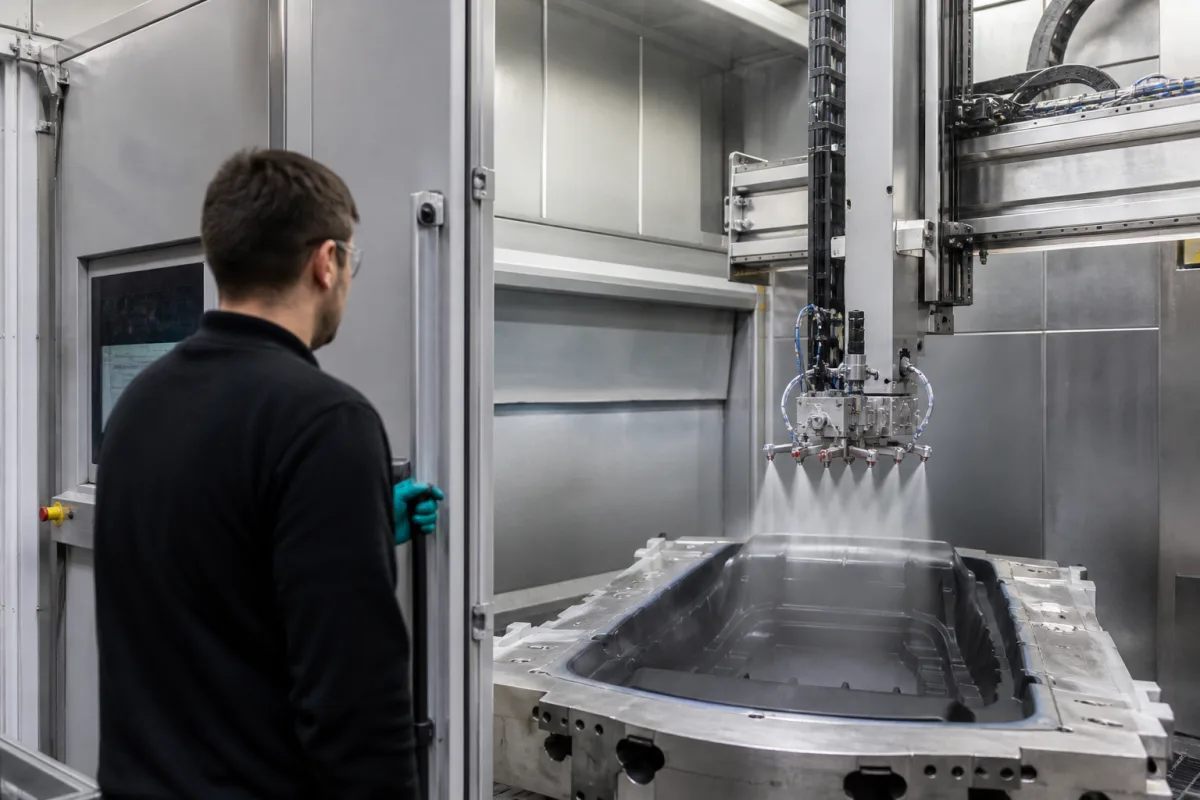
Spray manipulator (servo-driven arm that sprays water-based graphite lubricant onto hot forging dies between strokes)
Graphite spray manipulators for hot forging presses · servo-driven spray arm over the open dies, water-based graphite die lubricant diluted 1:3 to 1:15, adjustable nozzles and air-fluid ratio, stirred supply, weekly flushing
A spray manipulator here is the servo-driven arm on a hot forging press that swings or travels a spray head into the open dies after each part and sprays diluted water-based graphite lubricant over the die cavities, both to release the next forging and to cool the die surface. Ask three things first: which lubricant and dilution the forging needs, how the spray head and nozzles are matched to each die cavity and distance, and how the arm's travel and timing fit the press cycle.
Spray manipulators, spray stations and their spray heads, nozzles and lubricant supply for applying graphite or other die lubricants on hot and warm forging presses and hammers. Automatic die spray units for high-pressure die casting are covered on the Automated mold spraying and cooling system (die spray system) page; mould cooling units for plastics and rubber moulding on the Mould cooling unit page; the lubricant chemistry itself is outside this page except where it sets spray requirements.
CNFX editorial research · Sources checked October 12, 2026 · 3 sources
What the lubricant asks of the spray system: dilution, jet and stirring
FUCHS describes its LUBRODAL W 27 F as a concentrate for die lubrication in precision forging that "must be diluted with water before application" and applied by spraying systems or spray pistols; it requires "a strong spray jet with adjustable throughputs of the nozzles as well as an adjustable air-fluid ratio", and says the mixture "is to be stirred continuously to avoid settling out of graphite". Its "common values for the mixing with water" are 1:3-5 for extrusions and hot forging of complex parts, 1:5-10 for die forging of medium difficulty and 1:10-15 for standard forging with easier parts, with the optimum to be found in practice, and it recommends flushing the spraying system with water once a week and before longer downtimes. [1]
Henkel's BONDERITE L-FG 31 ACHESON, "previously known as Deltaforge 31", is a water-based graphite die lubricant for hot, warm and precision forging presses with very fine graphite in a stabiliser and binder system; ChemPoint lists it as a black, medium-viscous fluid with water as carrier and diluent, density 1,100 kg/m³ and 18% solids. [2]
Editorial calculation: diluting an 18% solids concentrate 1:10 with water (an assumed ratio, 1 part concentrate to 10 parts water) leaves about 18 ÷ 11 ≈ 1.6% solids in the sprayed mix; at 1:4 it is about 3.6%. Ask the lubricant supplier which way its ratios are stated before setting the mixing unit. [2]
02
Servo arm, tailor-made spray tooling and spray distance
Nanjing Descaling Technology describes its automatic graphite spray manipulator as driven by servo motors for fast, accurate travel with "arbitrary setting of spraying trajectory", with non-standard travel customised to fit "any press equipment". Its spray tooling is tailor-made so the die cavity is covered "without dead angles", using angle-adjustable 304 stainless nozzles; spray distance is set by a hand-cranked lifting mechanism, the rails are lubricated automatically, and the unit is built for the high temperature and humidity around forging presses. It also builds spray stations for forging lines. [3]
Editorial note: the lubricant makers' requirements (adjustable nozzle throughput, adjustable air-fluid ratio, continuous stirring) and the manipulator maker's features (programmable trajectory, adjustable nozzles and distance) describe the two halves of one specification; write both into the order. [1][3]
03
Lubricant, mixing and manipulator data to fix in the order
1 company lists this product among what they make. Company figures are quoted from each
company's own website; every card states where the relationship came from.
Nanjing Descaling Technology Co., Ltd.
Manufacturing site to be confirmed for the order
Publishes an automatic graphite spray manipulator with servo drive and tailor-made spray tooling, and graphite spray stations for forging lines.
Explore company information and manufacturing capabilities, then discuss the scope of your project with a relevant supplier.
Share this page
Compiled and source-reviewed by the CNFX editorial team.
Each manufacturer above links to the page on that company's own website where the product is listed, with the date we checked it. How we source and review
· Page last updated 13 October 2026
Buyer questions
How is this different from a die casting die spray unit?
This page covers graphite spraying on hot forging dies; spray units for high-pressure die casting are on the Automated mold spraying and cooling system page. [1][3]
How far is forging graphite diluted?
FUCHS gives 1:3-5 for complex hot forgings, 1:5-10 for medium difficulty and 1:10-15 for easier parts, with the optimum found in practice. [1]
Why must the mix be stirred?
FUCHS says the mixture is to be stirred continuously to avoid the graphite settling out. [1]
How is the spray matched to each die?
Nanjing Descaling makes tailor-made spray tooling with angle-adjustable nozzles and a programmable spray trajectory. [3]
Sources and what still needs a direct check
Sources checked 2026-10-12. FUCHS and Henkel (via ChemPoint) publish their water-based graphite forging lubricants; Nanjing Descaling Technology describes its graphite spray manipulator.