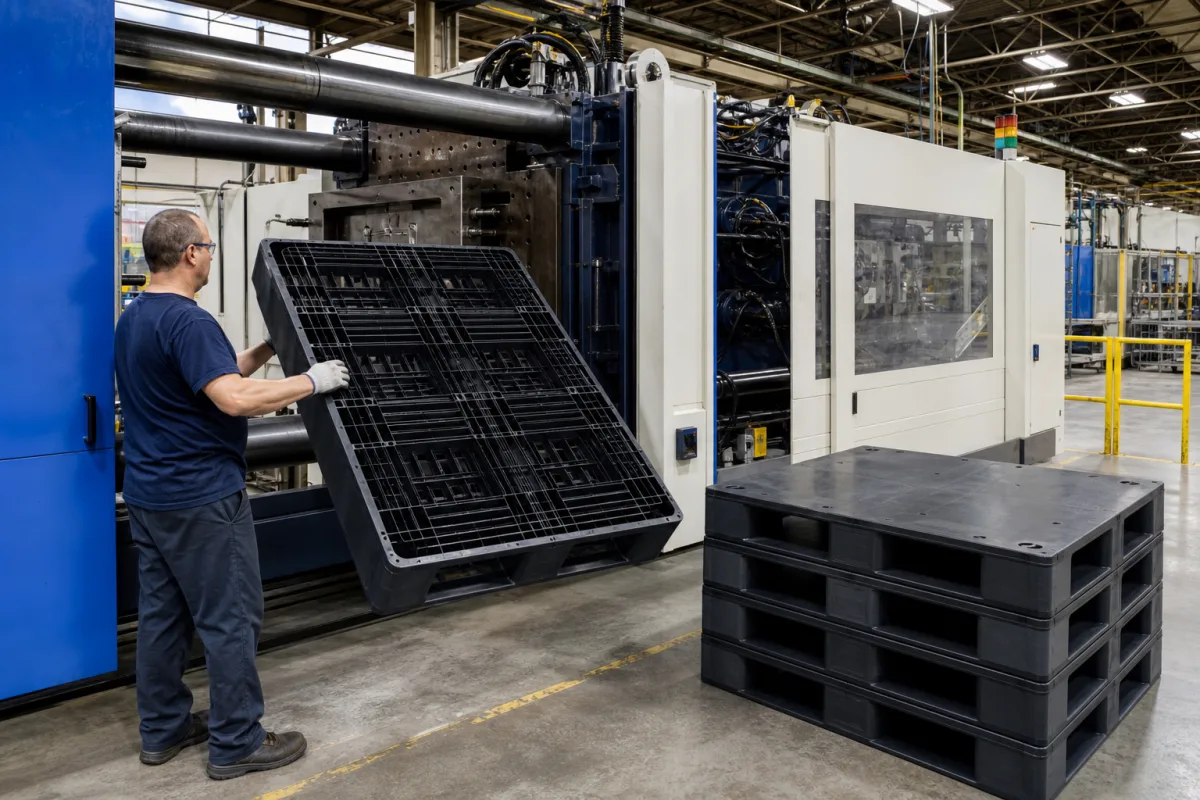
Injection-moulded plastic pallets (PE, HDPE, PP) · 1200 × 800, 1200 × 1000 and 48 × 40 in sizes, static, dynamic and racking loads, runner and nine-foot designs, two-piece snap-lock builds, weight, ISO 8611 and ISO 6780 tests and dimensions, ISPM 15 export
An injection-moulded plastic pallet is a flat load base moulded from polyethylene or polypropylene, on three or five runners or on nine feet, sometimes with steel reinforcement profiles or a two-piece snap-lock construction, used in place of a wooden pallet in warehouses, conveyors, racking and export shipping. Ask three things first: which size your racking, trucks and partners use; the static, dynamic and racking loads you need and the conditions they were measured under; and whether the pallet must be racked, nested, conveyed or exported.
Injection-moulded plastic flat pallets in PE, HDPE and PP: one-piece runner pallets, nestable nine-foot pallets, reinforced rackable pallets and two-piece snap-lock (leg-in-leg) builds, in 1200 × 800, 1200 × 1000, 48 × 40 in and half-pallet sizes. Wooden and presswood pallets, pallet boxes and collars, slip sheets and pallet-moulding machinery are outside this page except where compared.
CNFX editorial research · Sources checked October 11, 2026 · 6 sources
Craemer's 2025 pallet brochure defines three ratings: static load is pressure on a flat floor with an evenly distributed load; dynamic load is carried on a forklift with an evenly distributed load; racking load is an evenly distributed load along the long sides with the pallet resting on two supports for over 100 h — all at a room temperature of approx. 20 °C. Its TC1 pallet (1200 × 800 × 160 mm, PE) lists 7500 kg static, 1250–1750 kg dynamic and 1000–1750 kg high-rack load, with the spread depending on reinforcement profiles, welded runners and number of runners. [1]
Rehrig Pacific's 40 × 48 Rackable Pallet GMA lists a static load rating of 12,000 lb (5,450 kg), a dynamic rating of 4,800–6,400 lb (2,180–2,900 kg) and a rack load rating of 2,400–3,200 lb (1,090–1,450 kg), with metal reinforcements for edge racking. [2] A lighter Transoplast 1210HB3 export pallet (1200 × 1000 × 160 mm, regrind) lists 4000 kg static, 1250 kg dynamic and 1000 kg in racks. [3]
ISO 8611-1 specifies test methods for new flat pallets in three groups — nominal load testing, maximum working load testing and durability comparison testing — and notes that load-capacity tests do not replace field tests on specific pallet designs; ISO 8611-3 covers maximum working loads. [4]
Editorial calculation: in Craemer's TC1 data the static rating of 7500 kg is 7500 ÷ 1250 = 6 times the lowest dynamic rating, and in Rehrig's GMA data 12,000 lb static is 12,000 ÷ 3,200 = 3.75 to 12,000 ÷ 2,400 = 5 times the rack rating — so a pallet bought on its static figure alone can be overloaded in a rack. [1][2]
Give the supplier the size and height, the load per pallet and how it sits (evenly spread, point loads, bags or boxes), whether the pallet goes on a forklift, conveyor or beam racking and the beam spacing, the storage time under load and the temperature range, whether nesting or stacking is needed, rim and anti-slip options, hygiene or food-contact needs, and quantity. Ask for the test method and conditions behind each load rating.
02
Match the size, construction, material and export rules
ISO 6780:2003 specifies principal dimensions and tolerances for new single-deck and double-deck, reversible and non-reversible flat pallets of all entry types and made of any material, related to handling by pallet trucks and fork-lift trucks, including openings, clearances, chamfers and wings. [5] In the US, the MH1 committee's scope covers nomenclature, types, sizes, materials and components of pallets, slip sheets and other unit load bases, with sampling, inspection and test methods; the current standard is ANSI MH1-2021. [6]
Craemer lists Euro format 1200 × 800 mm, industrial format 1200 × 1000 mm, an inch-size 48 × 40 in (1219 × 1016 × 150 mm) CR4 pallet and 800 × 600 mm half pallets, injection-moulded in one piece with 3 or 5 runners, plus a nestable 9-feet NP1 pallet (1200 × 800 × 146 mm, tare weight 8.5 kg, 2500 kg static, 1000 kg dynamic, no high-rack rating). Its pallets are PE except the PP D2 half pallet. [1]
Rehrig's 48 × 40 in GMA pallet (1,219 × 1,016 × 142.8 mm, 20.4 kg non-reinforced) is injection-moulded from PP or HDPE, uses a two-piece snap-lock leg-in-leg design described as allowing quick repair, and has a cruciform bottom structure for conveyors; 570 fit in a 53 ft trailer. [2]
Transoplast states that its plastic export pallet does not absorb moisture or develop mould, needs no treatment against insects and other pests, and can be exported to IPPC countries in accordance with ISPM 15; it lists a temperature range of −20 °C to +40 °C. [3]
Editorial calculation: a 1200 × 800 mm deck is 0.96 m², 1200 × 1000 mm is 1.2 m² and 1219 × 1016 mm is about 1.24 m²; at 7500 kg static, Craemer's industrial-format rating spreads to about 7500 ÷ 1.2 = 6,250 kg per m² of deck. [1]
03
Runner, closed-deck, nestable and snap-lock rackable designs in published ranges
Published ranges include one-piece 3-runner and 5-runner pallets with or without steel profiles, closed-deck hygienic pallets, nestable 9-feet pallets and two-piece snap-lock rackable pallets. [1][2] When requesting quotations, ask each supplier for the load ratings with test conditions, weight, material grade, drawings and samples.
04
Top deck, runners or feet, steel profiles, snap-lock joints and fork openings of a plastic pallet
Part
Role
Fix in the order
Top deck
Open, closed or anti-slip deck; rims of 5, 7 or 22 mm. [1][3]
Dynamic, static and racking loads, size, weight, material and temperature values for a pallet quotation
Published values in this table come from Craemer, Rehrig Pacific, Transoplast and the ISO 6780 summary; where none states a value, the row says what to obtain from the supplier.
Field
What it means and published values
Ask the supplier for
Dynamic load capacity (kg)
On a forklift; 1000–2000 kg in one maker's Euro and industrial sizes. [1]
Rating and test conditions.
Static load capacity (kg)
On a flat floor; 2000–7500 kg in one maker's Euro and industrial sizes; 5,450 kg in a 48 × 40 in pallet. [1][2]
Rating and test conditions.
Rack load capacity (kg)
On two supports for over 100 h; up to 2000 kg; 1,090–1,450 kg. [1][2]
2 companies list this product among what they make. Company figures are quoted from each
company's own website; every card states where the relationship came from.
Jiangsu Xuansheng Plastic Technology Co., Ltd
Manufacturing site to be confirmed for the order
Its website lists “Heavy Duty Injection Molded Plastic Pallets”.
Explore company information and manufacturing capabilities, then discuss the scope of your project with a relevant supplier.
Share this page
Compiled and source-reviewed by the CNFX editorial team.
Each manufacturer above links to the page on that company's own website where the product is listed, with the date we checked it. How we source and review
· Page last updated 13 October 2026
Buyer questions
What is the difference between static, dynamic and racking load?
Craemer defines static as on a flat floor, dynamic as on a forklift, and racking as along the long sides on two supports for over 100 h, all at about 20 °C. [1]
Do plastic pallets need ISPM 15 treatment for export?
Transoplast states its plastic export pallet needs no pest treatment and can be exported to IPPC countries in accordance with ISPM 15. [3]
Which standard covers pallet load tests?
ISO 8611-1 specifies test methods for new flat pallets: nominal load, maximum working load and durability comparison testing. [4]
Sources and what still needs a direct check
Sources checked 2026-10-11. Craemer, Rehrig Pacific and Transoplast publish their own pallet data; the ISO and MH1 entries are public summaries, not the standards' full text.