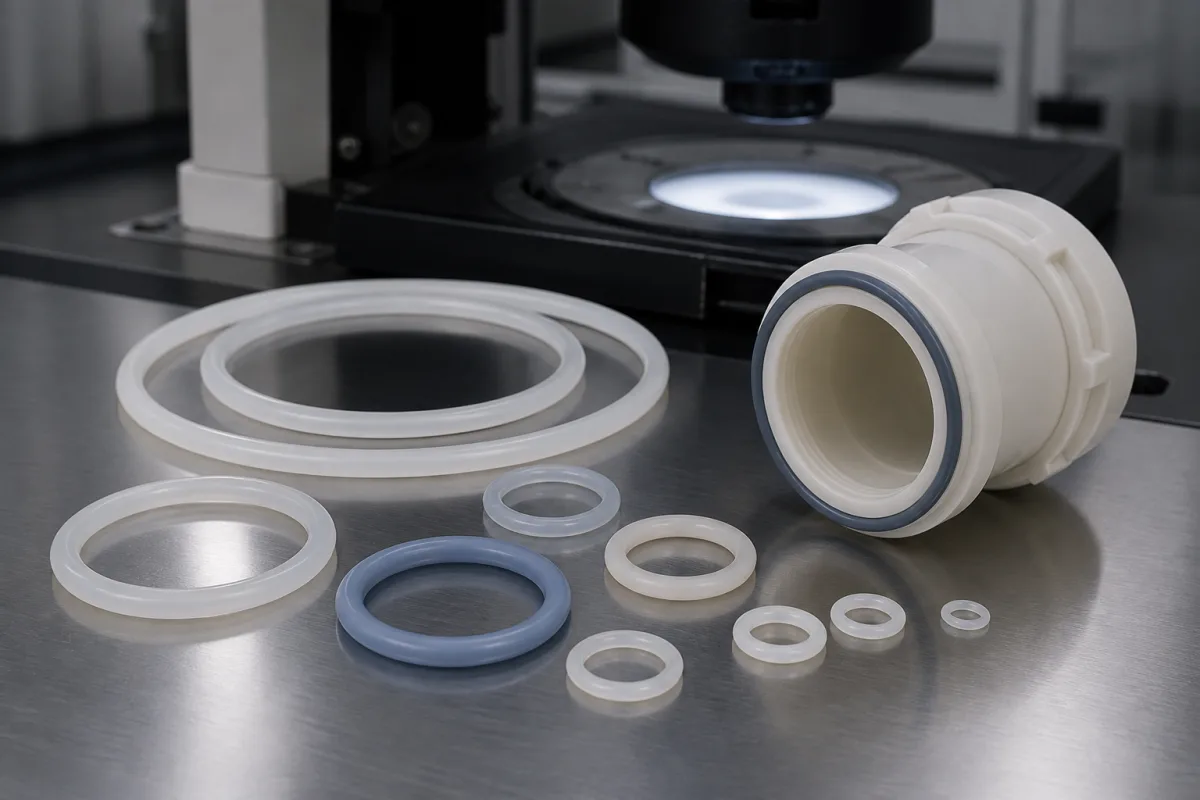
Silicone O-rings (VMQ) · static duty, temperature and media limits, moulded or joined rings, compound datasheet and approvals
A silicone seal ring is an O-ring of round cross-section moulded or joined from VMQ (vinyl methyl silicone) rubber, fitted in a groove and squeezed to seal a static joint where wide temperature range, ozone resistance or a neutral taste and odour matter. Ask three things first: whether the seal is truly static, which temperatures and media it will see, and which compound datasheet and approvals cover the rings you will receive.
Round-section O-rings of silicone rubber (VMQ), moulded or joined from cord, for static sealing. Flat, profiled and overmoulded silicone gaskets are covered on the High-precision silicone gasket page. Silicone raw materials, extruded cord sold by length, O-ring moulding machines and O-rings of other elastomers are outside this page.
CNFX editorial research · Sources checked October 12, 2026 · 3 sources
Confirm the seal is static before choosing silicone
Polymax's datasheet for its FDA silicone O-ring compound states that silicone rubber has poor mechanical properties compared with other elastomers and that, for this reason, silicone O-rings are not the usual choice for dynamic applications. [1] Angst+Pfister (APSOparts) gives the reason as the high coefficient of friction and relatively low tensile strength, and offers its VMQ O-rings for static sealing in pumps, valves, dosing systems, electrical enclosures and beverage equipment. [2]
Barnwell describes the same trade-off: lower tensile strength and weaker tear and wear resistance than other elastomers, against cold flexibility and resistance to weathering, ozone and UV. [3] Polymax adds a fitting note: the compound "is not suitable for use with silicone O-ring lubrication", and PTFE alternatives should be used instead. [1]
Editorial note: if the joint rotates, reciprocates or is assembled by sliding the ring over threads or edges, raise it with the supplier before ordering; the sources above point to another elastomer or a different seal design for moving duty.
Give the supplier the inner diameter and cross-section (or AS/BS size number), groove dimensions, static or moving duty, medium, temperature range including cleaning, pressure, hardness, colour, approvals needed, moulded or joined construction, quantity and inspection requirements.
02
Check the temperature and media limits stated for the compound
Published operating ranges for silicone O-rings differ by supplier and compound: −60 to 200 °C for the Polymax FDA 70 Shore A grade, −55 to 200 °C for Angst+Pfister's VMQ (with higher or lower temperatures from special materials), and −60 to +250 °C from Barnwell. [1][2][3]
Water and steam set lower limits. Barnwell states silicone can endure water up to 100 °C and is ill-suited to superheated steam above 121 °C, acids and alkalis, some chlorinated hydrocarbons, mineral oil, hydrocarbon fuels and aromatic hydrocarbons; it lists good resistance to engine and transmission oil, animal and vegetable oil, non-petroleum brake fluids and fire-resistant hydraulic fluids. [3] Angst+Pfister lists resistance to heat, ozone, ageing, animal and vegetable fats and oils. [2]
Polymax's air-ageing result shows what heat does to its compound: after 70 hours at 225 °C (ASTM D573), hardness changed by +8 points, tensile strength by −25% and elongation by −30%. [1] Editorial note: if the ring will be steam-sterilised or cleaned in place, give the supplier the steam temperature and cycle count, since the Barnwell limit of 121 °C falls well below the dry-heat ratings.
03
Compare published silicone O-ring grades and constructions
Silicone lubricant not suitable for this compound. [1]
Approved lubricant or none.
05
Hardness, FDA grade, temperature range and tensile values for a VMQ O-ring
Tensile strength and elongation are given only on the Polymax datasheet (7.1 MPa, 212%); dielectric strength and volume resistivity are not stated in the reviewed sources.
9 companies list this product among what they make. Company figures are quoted from each
company's own website; every card states where the relationship came from.
Shijiazhuang Beike Sealing Technology Co.,Ltd.
Manufacturing site to be confirmed for the order
Lists silicone O-rings and food-grade silicone O-rings among O-rings and seals.
Explore company information and manufacturing capabilities, then discuss the scope of your project with a relevant supplier.
Share this page
Compiled and source-reviewed by the CNFX editorial team.
Each manufacturer above links to the page on that company's own website where the product is listed, with the date we checked it. How we source and review
· Page last updated 13 October 2026
Buyer questions
Can silicone O-rings be used in moving seals?
Angst+Pfister does not recommend dynamic use because of high friction and relatively low tensile strength; Polymax cites silicone's poor mechanical properties against dynamic use. [2][1]
What temperature can a silicone O-ring take?
Published ranges include −60 to 200 °C (Polymax), −55 to 200 °C (Angst+Pfister) and −60 to +250 °C (Barnwell), with water to 100 °C and no superheated steam above 121 °C per Barnwell. [1][2][3]
Are silicone O-rings moulded or joined?
Barnwell supplies both: rings joined from stock cord, or moulded rings for a minor tooling cost where joining is unsuitable. [3]
Sources and what still needs a direct check
Sources checked 2026-10-12. Polymax, Angst+Pfister (APSOparts) and Barnwell are seal suppliers describing their own compounds and offers; values apply to the grades named.