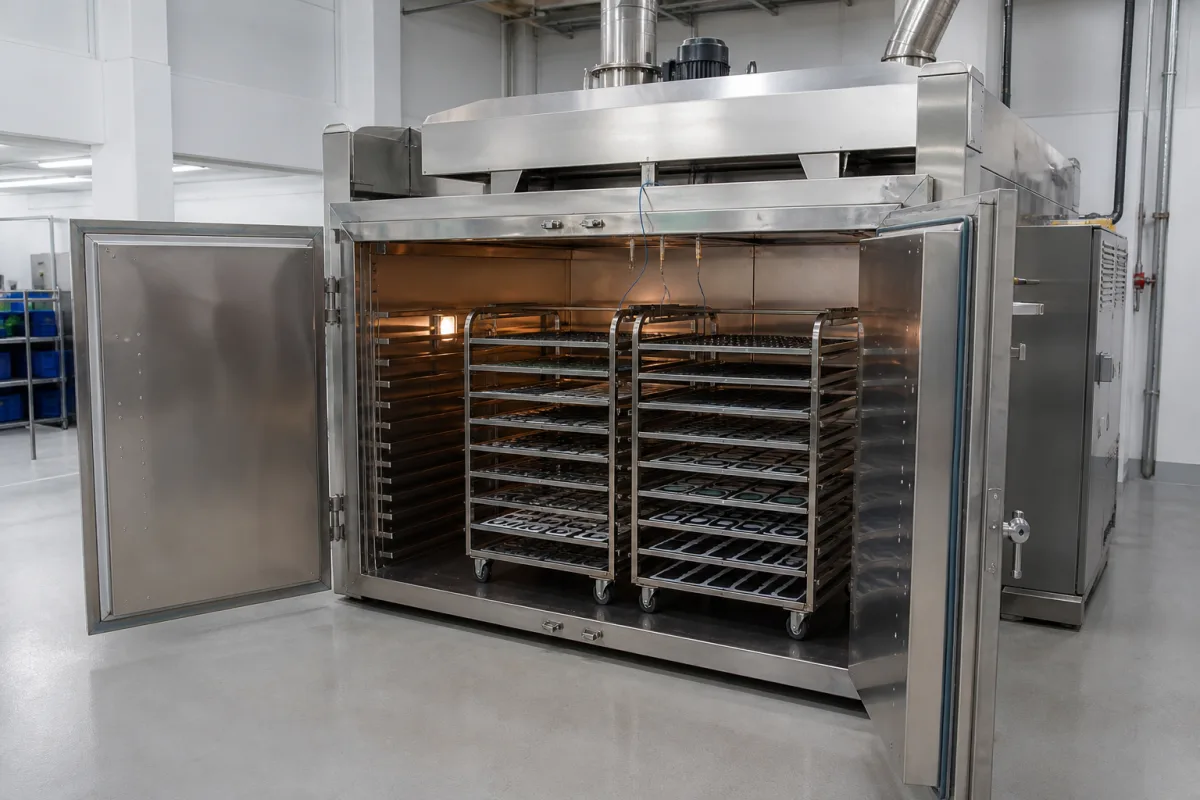
Silicone post-curing ovens · Why parts are post-cured, circulating air with fresh-air supply sized per kg of silicone, flammable siloxane volatiles and explosion limits, 4 h at 200 °C and the 225 °C / 8 h ceiling, loading on racks, and food-contact extractives tests
A silicone curing oven is a circulating-air oven used to post-cure moulded or extruded silicone rubber parts after vulcanisation: holding them at high temperature with a continuous fresh-air purge drives out volatile siloxanes and curing by-products and improves properties such as compression set. Ask three things first: what post-cure the silicone grade and end use require, how much fresh air and exhaust the oven provides for the load, and how temperature, uniformity, loading and records are controlled.
Batch and continuous circulating-air ovens for post-curing silicone rubber parts (HTV, LSR, extrusions, tubes, cables), with fresh-air supply and exhaust. Primary vulcanising equipment such as moulding presses and hot-air extrusion tunnels, general forced-air ovens (see industrial ovens) and room-temperature-curing silicone processes are outside this page except where compared.
CNFX editorial research · Sources checked October 12, 2026 · 4 sources
Wacker Chemie's silicone rubber material and processing guidelines explain that post-curing — heating at a high temperature for a defined time — improves mechanical properties (for example a particularly low compression set) and removes volatiles, namely by-products of the crosslinker chemicals and low-molecular polymer components. For peroxide-curing rubber Wacker names peroxide by-products among what it removes; these can bloom as white crystals or leave an odour; for addition-curing platinum grades it is still recommended for sensitive uses such as food contact or medical applications, where the relevant FDA, BfR or European Pharmacopoeia requirements apply. [1]
The guidelines say the required time increases with layer thickness — Wacker gives 4 hours at 200 °C as the guide figure for sheets 2 mm thick — thicker parts start at a lower temperature and heat more slowly, and after heat-up post-curing should run at least 4 hours at 200 °C. They warn never to exceed 225 °C or 8 hours, which can cause thermal ageing and embrittlement, and that an oxygen deficiency can cause reversion and formaldehyde formation. Volatiles content is checked by weight loss. For one grade, non-post-cured parts had 60–70% compression set, which post-curing improves. [1]
Some grades are sold to reduce post-curing. Shin-Etsu's data sheet for KEG-2003H-60 A/B, a 1:1 liquid silicone rubber for injection moulding, says its low content of volatile cyclics can cut post-curing costs significantly and lists conformity with EN 14350 for volatile compounds marked "npc". Its listed properties include Shore A 60, specific gravity 1.13, a press cure of 15 minutes at 150 °C and a compression set of 19% after 22 hours at 120 °C; the sheet notes the values are not for specification purposes. [3]
Editorial note: before sizing an oven, ask your silicone supplier whether each grade needs post-cure for your application test, and at what time and temperature; a low-volatile grade can change the oven load and air demand. [3][1]
21 CFR 177.2600 requires rubber articles for repeated use in contact with aqueous food to yield total extractives of no more than 20 mg per square inch in the first 7 hours of reflux extraction with distilled water and 1 mg per square inch in the following 2 hours, and for fatty foods no more than 175 and 4 mg per square inch with n-hexane. [2]
Give the supplier the silicone types (peroxide or platinum cure, HTV, LSR), part types, wall thicknesses and load mass per batch, post-cure profile (heat-up rate, time, temperature), required temperature uniformity, fresh-air and exhaust arrangement, rack or trolley sizes, heating type and power, safety interlocks, data recording, cleanroom or hygiene needs, and site utilities.
02
Size fresh air, temperature control and loading
The guidelines require post-curing in a circulating-air oven with fresh-air supply; Wacker identifies flammable low-molecular siloxanes, and possibly peroxide by-products, among the volatiles that must be removed during post-curing, and fresh air must be supplied at 100–120 L/min per kg of silicone to prevent deflagration (observing explosion limits). Wacker asks for good ventilation during the first 2 hours. Parts should sit on perforated plates or mesh without touching or nesting, tubes and profiles coiled, and cable drums wound loosely with spacers for airflow. [1]
They add that oven conditions should be checked regularly for constant temperature, that platinum-curing grades must never be post-cured in contact with peroxides or their by-products, that contact with volatiles from organic rubber should be avoided to prevent cross-contamination, and that ovens and exhaust systems should be cleaned regularly with pipes replaced at intervals. [1]
Editorial calculation: a 60 kg batch of silicone parts at 100–120 L/min per kg needs 6,000–7,200 L/min of fresh air, about 360–432 m³/h, at the oven inlet; ask the supplier to state the fresh-air and exhaust flow at full load and how it is proven, separate from the internal recirculation flow. [1]
03
Find silicone post-cure oven manufacturers
Henan Sined, listed below, shows ovens for silicone rubber post-curing on its own website.
04
Check the oven's flammable-vapour limit and fresh-air interlocks
Oven maker WKM explains DIN EN 1539, the European safety standard for dryers and furnaces that release combustible substances. Below 3% of the lower explosive limit (LEL) there is no explosion hazard as the standard defines it; above it the full requirements apply, including solvent concentration monitoring, temperature control and exhaust design. Type A dryers run in air, with area 1 kept up to approx. 40% LEL and area 2 up to approx. 60% LEL under continuous solvent monitoring; from 65% LEL, inerting and a type B dryer are needed. [4]
Its type A safety measures include a fail-safe, electrically monitored fresh-air supply, minimum exhaust-flow monitoring, heating shutdown on a fault and purging before heating. Each system's maximum combustible mass is stated on the type plate: for one type A, range 1 chamber dryer it is 34.9 g per batch at 200 °C. An unknown release can be measured by weighing the batch before and after; if it cannot be determined, an ATEX design is required. [4]
Editorial note: Wacker's weight-loss check for volatiles gives that mass. Ask the oven supplier for the permitted combustible mass per batch at your post-cure temperature and compare it with your batch weight loss. [4][1]
05
Beyond heat: fresh air, racks and interlocks in a post-cure oven
Every row except the safety interlocks comes from Wacker's guidelines; airflow proving follows the DIN EN 1539 measures described above.
Explore company information and manufacturing capabilities, then discuss the scope of your project with a relevant supplier.
Share this page
Compiled and source-reviewed by the CNFX editorial team.
Ask Sined for the fresh-air rate per kg of silicone and the DIN EN 1539 dryer type behind its oven. How we source and review
· Page last updated 13 October 2026
Buyer questions
Why do silicone parts need post-curing?
To remove volatiles from crosslinker by-products and low-molecular polymer and to improve properties such as compression set. [1]
How much fresh air does a silicone post-cure oven need?
Wacker specifies 100–120 L/min per kg of silicone to remove flammable siloxane volatiles and prevent deflagration. [1]
What temperature and time are used for post-curing silicone?
At least 4 hours at 200 °C after heat-up, never exceeding 225 °C or 8 hours. [1]
Can a low-volatile silicone grade avoid post-curing?
Shin-Etsu says its KEG-2003H-60 A/B liquid silicone can cut post-curing costs significantly because of low volatile cyclics, and lists EN 14350 volatile conformity marked npc. [3]
What safety standard applies to an oven that releases flammable vapours?
WKM explains that DIN EN 1539 covers dryers and furnaces releasing combustible substances; below 3% of the LEL it is not required, above that it calls for monitored fresh air, minimum exhaust flow monitoring and a type-plate limit on combustible mass per batch. [4]
Sources and what still needs a direct check
Sources checked 2026-10-12. Wacker's guidelines are a material maker's processing advice for its own grades; 21 CFR 177.2600 is a US food-contact rule. Post-cure conditions for your parts must come from your material supplier, your tests and the oven maker's safety design.