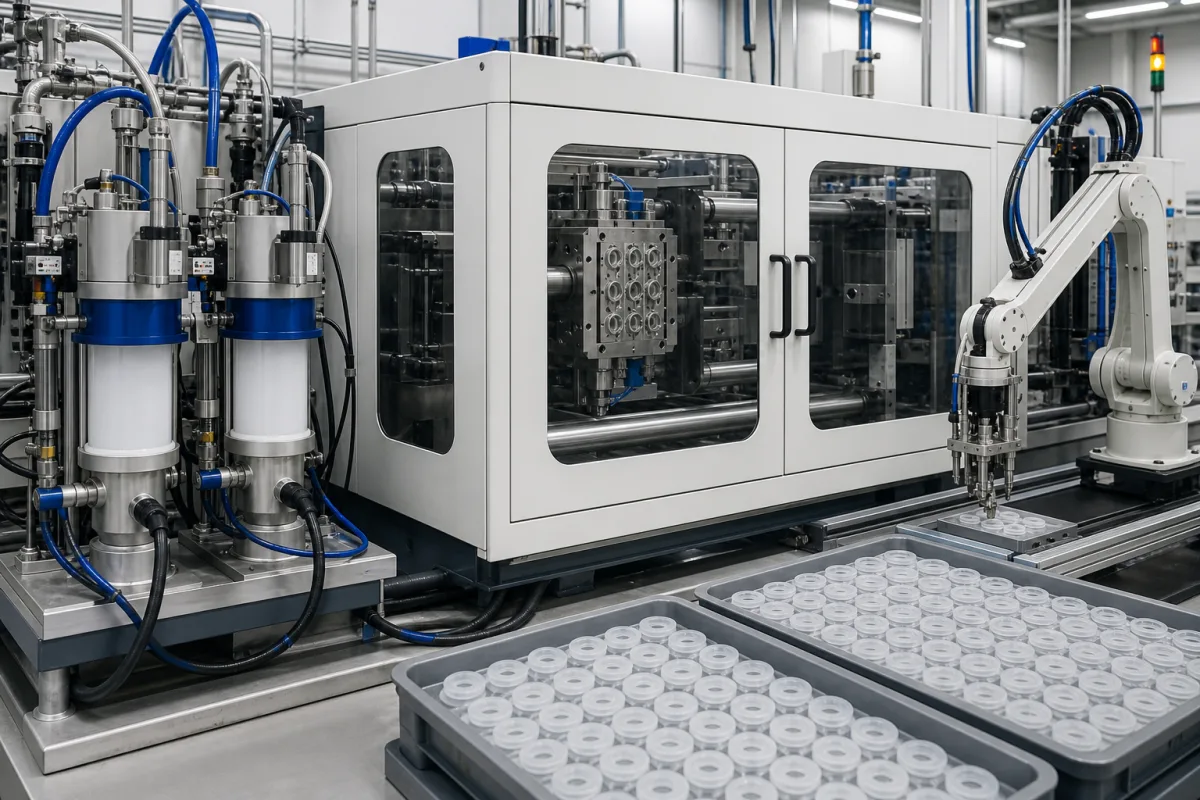
LSR metering and mixing unit for silicone injection moulding (A/B drum pumps, 1:1 dosing, pigment stream and static mixer)
LSR metering and mixing units · Drum or pail pumps, gear or plunger metering of A and B at 1:1, pigment streams, static mixer and ratio monitoring ahead of the injection unit
An LSR metering and mixing unit is the station that stands beside a silicone injection moulding machine and feeds it: follower plates press components A and B out of their drums or pails, a gear meter or a pair of plungers delivers them in a 1:1 ratio, a third stream adds pigment, and the combined stream passes a static mixer into the machine's injection unit. Whether parts cure evenly depends on how tightly this unit holds the ratio, how it warns before a drum runs empty, and how cool the mixed material stays on its way to the screw.
Metering, mixing and feeding units for two-part liquid silicone rubber (LSR): drum or pail pumps with follower plates, gear or plunger metering of components A and B at 1:1, pigment and additive streams, static mixers, ratio monitoring, refill alarms and the hoses and manifold to the injection unit. Complete LSR moulding machines and cells, with the injection unit, clamp, heated mould with cold runner and part removal, are covered on the Silicone molding machine (liquid silicone rubber injection moulding) page; general thermoplastic machines on the Injection molding machine page. Gear metering pumps and valves for resins, adhesives and sealants are covered on the Metering pump/valve set for resin page. Feeding and pressing equipment for solid (HCR) silicone is outside this page.
CNFX editorial research · Sources checked October 12, 2026 · 6 sources
Wacker describes LSR processing as metering devices pumping a 1:1 mixture of the A and B components into a static or dynamic mixer and from there into the metering cylinder of the injection moulding machine, with a separate metering device adding colourants or additives. [1]
Graco's Model 633 drives two double-acting plungers from a single shared cylinder so that material is delivered at a fixed 1:1 ratio; the ratio is tied to transducers on the A and B sides, and an audible and visible refill alarm is meant to keep the pumps from drawing a vacuum and wasting material. Its F4-5 unit for 20 litre pails meters instead with a helical gear whose multiple gear teeth measure flow in small increments, with individual pump drives. [4][3]
Yizumi's LSR Series uses a pneumatic liquid silicone feeder with a secondary metering system and manual correction of the A/B ratio, and states a ratio error of less than 3%. [2]
Editorial note: a stated ratio error is only comparable between suppliers if the test is the same; ask how it was measured (weighed A and B shots, or transducer readings) and over how many cycles.
Give the supplier the LSR grade and its datasheet viscosities for A and B, drum or pail size, the shot volume and shots per hour of the moulding machine, the number and ratio of pigment or additive streams, the distance and hose route to the injection unit, the interface to the machine control, and whether the unit runs in a cleanroom.
02
Keep the mixed material below 40 °C on its way to the screw
Wacker recommends temperature control so that the metering cylinder and mixer do not rise above 40 °C, and notes that machines designed for standard LSR have an injection cylinder jacket that can be cooled. [1] Graco's F4-5 lists a maximum fluid temperature of 50 °C, a maximum fluid working pressure of 207 bar (3,000 psi) and a fluid viscosity window of 50,000 to 5,000,000 cP. [3]
Editorial note: the pump's 50 °C limit is a rating for the hardware; Wacker's 40 °C applies to the mixed material in the cylinder and mixer, so plan hose routing and any cooling against the lower figure. [3][1]
Graco's Model 633 refills in three seconds at 1,700 psi pump pressure and feeds at up to 3,000 psi. [4] Editorial calculation: 1,700 psi is about 117 bar and 3,000 psi about 207 bar (1 psi = 0.0689 bar).
03
Gear-metered pail unit, plunger unit and barrel feeders side by side
Editorial calculation: 1,000 g per minute is 60 kg per hour and 5,000 g per minute 300 kg per hour, before allowing for the viscosity dependence both pages state. [5][6]
Send the material, container and machine data together
Paste it into your enquiry below or into an email to a maker, then replace every bracket.
Material: [LSR grade; A and B viscosity; datasheet]
Containers: [pail or drum size; changes per shift]
Metering: [ratio accuracy; output or shot volume]
Colour: [pigment streams; ratio range]
Mixer: [static or dynamic; element count]
Machine: [injection unit; distance; control interface]
Room: [cleanroom or general shop]
Explore company information and manufacturing capabilities, then discuss the scope of your project with a relevant supplier.
Share this page
Compiled and source-reviewed by the CNFX editorial team.
Each manufacturer above links to the page on that company's own website where the product is listed, with the date we checked it. How we source and review
· Page last updated 13 October 2026
Buyer questions
How are the two LSR components metered?
Pumps feed A and B at 1:1 into a static or dynamic mixer; Graco uses either a helical gear meter or two plungers on one cylinder. [1][3][4]
How cool must the mix stay?
Wacker recommends keeping the metering cylinder and mixer below 40 °C; one Graco unit is rated for fluid up to 50 °C. [1][3]
How much pigment can be added?
Graco's F4-5 mixes two additive streams at 0.5 to 6%. [3]
Sources and what still needs a direct check
Sources checked 2026-10-12. Graco is a maker of LSR metering equipment publishing data for two of its units; the Guangyu figures are from a Chinese maker's product pages; Wacker is a silicone maker describing LSR processing; Yizumi describes the feeder on its own LSR machine.