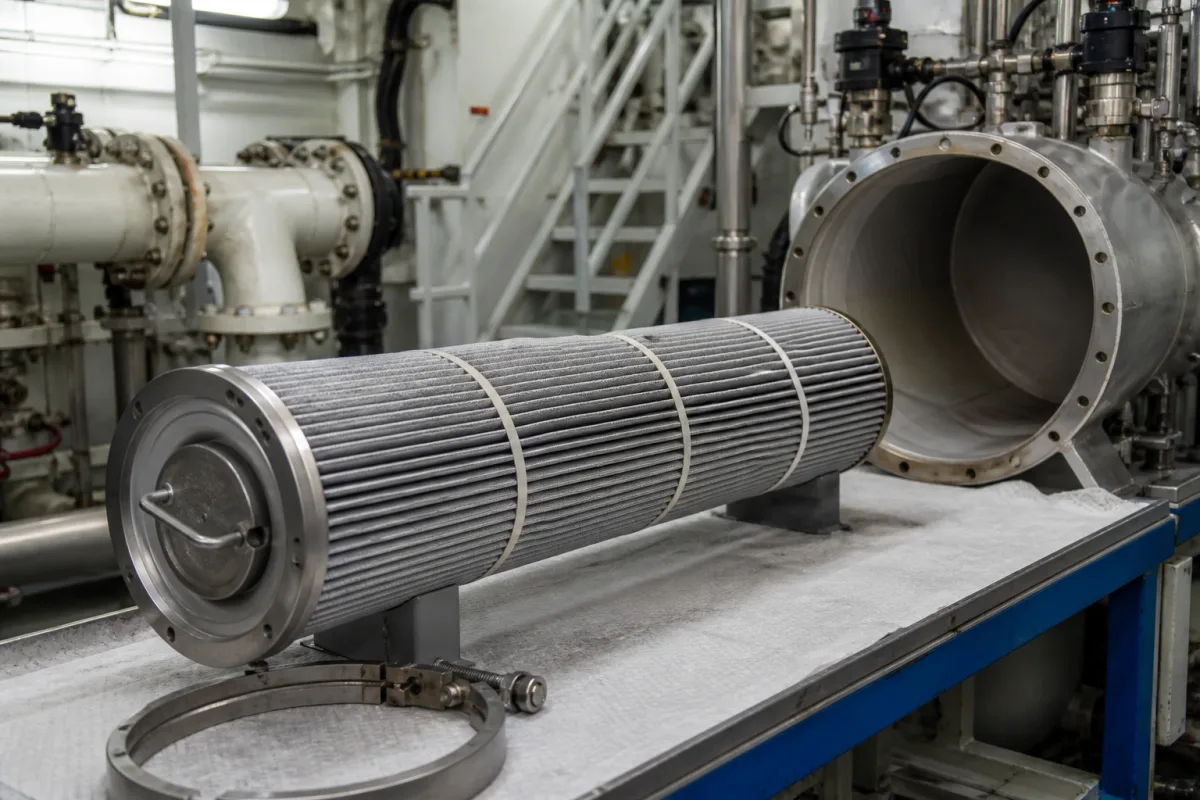
Ballast water treatment filter element: the 10–50 µm screen, sintered mesh or candle inside a BWMS self-cleaning filter
Replaceable filter element of a ship's ballast water management system · screen, multi-layer sintered mesh, candle or fibre elements of 10 to 50 µm in the self-cleaning pre-filter ahead of UV or oxidant treatment
In a ballast water management system that combines filtration with a second treatment such as ultraviolet light or an oxidant, the water passes a fine automatic filter first, which takes out zooplankton and sediment before the second stage. The part that does the work is the filter element: a cylinder of woven or wedge-wire screen, of layered sintered stainless mesh, of a bundle of candles, or of polymer fibre, cleaned in place by suction nozzles or reverse flow and replaced when worn or damaged. The element is bought by its nominal pore size, the flow and pressure it is built for, how it is cleaned and how much water each cleaning throws away.
Replaceable filter elements for the automatic self-cleaning pre-filters of ships' ballast water management systems: screen, multi-layer sintered mesh, candle and polymer fibre elements from 10 to 50 µm, with their cleaning mechanism, pressure and flow ratings and backflush loss. Packaged process-water systems with multimedia filtration, softening, cartridge filtration and brackish-water reverse osmosis are covered on the Water treatment system page; seawater desalination skids on the Seawater reverse osmosis (SWRO) unit page. The UV or oxidant treatment stage, ballast pumps and the complete BWMS type approval are outside this page.
CNFX editorial research · Sources checked October 12, 2026 · 3 sources
Nominal pore size of the element against the 50 µm and 10 µm organism classes
The US Coast Guard ballast water discharge standard, the limit a type-approved BWMS has to meet, counts organisms in two size classes: fewer than 10 organisms per cubic metre of 50 micrometres or more in minimum dimension, and fewer than 10 organisms per millilitre between 10 and 50 micrometres, with further limits for indicator microbes such as fewer than 250 cfu of E. coli per 100 mL. [2]
The Great Ships Initiative, a programme run with US EPA and US Maritime Administration funding, tested eight commercial ballast filter units in Duluth-Superior Harbor freshwater in 2013, with nominal pore sizes from 10 to 40 µm. Removal of total organisms in the 50 µm class ranged from 31.2 to 99.9%, and removal of protists between 10 and 50 µm from 22 to 89%. The report found a statistically significant, large negative relationship between nominal pore size and removal of microzooplankton and protists: the smaller the pore size, the greater the reduction. Larger zooplankton were removed consistently well at every pore size. [1]
GSI frames the filter as one treatment step whose role depends on the secondary treatment, and says developers of that secondary stage need to know the post-filtration treatment burden. It did not set out to rank the units, and the nominal pore sizes are as stated by each filter developer, not verified by GSI. [1] Editorial note: because the pore size sets how much of the load reaches the second stage, order the element rating the BWMS was type-approved with rather than a coarser substitute.
Quote the BWMS make and model, its type-approval filter rating, the element part number and the rated flow of the filter housing when ordering a replacement element.
02
Differential pressure across the element and water lost to backflush, as measured
In GSI's non-augmented test water, average differential pressure across the seven units with a valid reading ran from 0.24 bar (Filtersafe 25 µm) to 0.59 bar (Filter A, 40 µm candle), and the share of water lost to backflush from undetectable to 12.8% (GEA 20 µm). All eight units ran without mechanical failure or manual servicing during the tests. [1]
Editorial calculation from the same table: the Amiad 40 µm unit averaged 375 m³/h before the filter and 348 m³/h after it, so (375 − 348) / 348 ≈ 7.8% of the treated flow went to backflush, matching the reported ratio. At that rate a ballasting operation that delivers 1,000 m³ to the tanks sends roughly 78 m³ overboard as filter reject, which the ballast pump has to supply on top. [1]
GSI found no strong correlation between operational and biological performance, and noted that the volume lost to backflush was not necessarily greater for filters that removed more organisms. Values reported as 0% mean the backflush volume fell below GSI's detection limit, not that no water was used. [1]
Ask the supplier for the element's clean differential pressure at rated flow, the differential at which cleaning starts, and the backflush volume per cycle or as a share of flow, measured on water like yours.
03
How elements are built and cleaned: sintered mesh with suction nozzles, double-open candles, replaceable fibre elements
The filter makers' own descriptions in the GSI report show three ways the element is cleaned. GEA's element is five layers of sintered stainless mesh with a nominal depth of 20 µm, cleaned by a motor-driven suction tube with four overlapping nozzles that draw water from the inner screen surface into a concentrate pump. Amiad's Omega screens are cleaned by suction scanners, across eight models from 100 to 3,000 m³/h per filter. Kuraray's MF-250 has two housings backwashed in turn so the rated 250 m³/h continues while one cleans, and its fine elements are replaced after a designated number of filtration hours. [1]
Boll & Kirch lists its BOLLFILTER Automatic Type 6.18.3C for ballast water: a candle element with precision filter candles open at both ends for a dual backflushing effect, a hydrodynamic element that adds cross-flow turbulence during backflushing, and regeneration without interrupting filtration. It is offered from DN 200 to DN 900, actuated by differential pressure, with housings of nodular cast iron up to DN 400 and carbon steel from DN 500, PN 10 up to DN 600 and PN 6 from DN 700, and filtration grades of 30, 40 or 50 µm. In a candle element, the candles are assembled into a holder that stays in the housing during automatic cleaning. [3]
For a replacement, confirm the element construction, the seal and end-cap arrangement, the housing nominal diameter and pressure stage, and whether the maker supplies the element alone or only as an exchange unit.
04
What to send for a ballast filter element
Paste it into your enquiry below or into an email to a maker, then replace every bracket.
System: [BWMS make and model; type-approval certificate; filter make and model]
Element: [part number; nominal pore size; construction: screen, sintered mesh, candle or fibre]
Housing: [nominal diameter; pressure stage; material]
Duty: [rated flow m³/h; inlet pressure; fresh, brackish or sea water]
Cleaning: [suction nozzle, scanner or reverse-flow; trigger differential]
Condition: [hours run; reason for replacement; damaged area]
Documents: [class or maker certificate for the element]
Explore company information and manufacturing capabilities, then discuss the scope of your project with a relevant supplier.
Share this page
Compiled and source-reviewed by the CNFX editorial team.
Each manufacturer above links to the page on that company's own website where the product is listed, with the date we checked it. How we source and review
· Page last updated 13 October 2026
Buyer questions
What pore size is a ballast water filter element?
The eight commercial units tested by the Great Ships Initiative had nominal pore sizes from 10 to 40 µm; Boll & Kirch offers its ballast filter at 30, 40 or 50 µm. [1][3]
How much of the 50 µm organism class does the filter remove?
Across the eight units GSI tested, removal of organisms of 50 µm and above ranged from 31.2 to 99.9%; the US discharge standard allows fewer than 10 such organisms per cubic metre after the whole system. [1][2]
How much water does backflushing waste?
In GSI's tests the backflush flow ratio ranged from undetectable to 12.8% of the water processed. [1]
What pressure drop does a ballast filter element run at?
GSI measured averages of 0.24 to 0.59 bar across seven units in non-augmented water. [1]
Sources and what still needs a direct check
Sources checked 2026-10-12. Measured filter performance is from the Great Ships Initiative's 2014 technical report on eight commercial units; the discharge standard is the US Coast Guard's in 33 CFR 151.2030; element and housing options are from Boll & Kirch's product overview.