Editorial Technical Reference

Marine Hull Plate Bending Roller

This page explains how Marine Hull Plate Bending Roller is classified within Shipbuilding. Technical values and manufacturer relationships are research references; confirm the current specification and supplier evidence for each order.

Technical Definition & Core Assembly

The Marine Hull Plate Bending Roller is a heavy-duty industrial machine used in shipbuilding to precisely bend and form thick steel plates into curved hull sections through controlled rolling pressure.
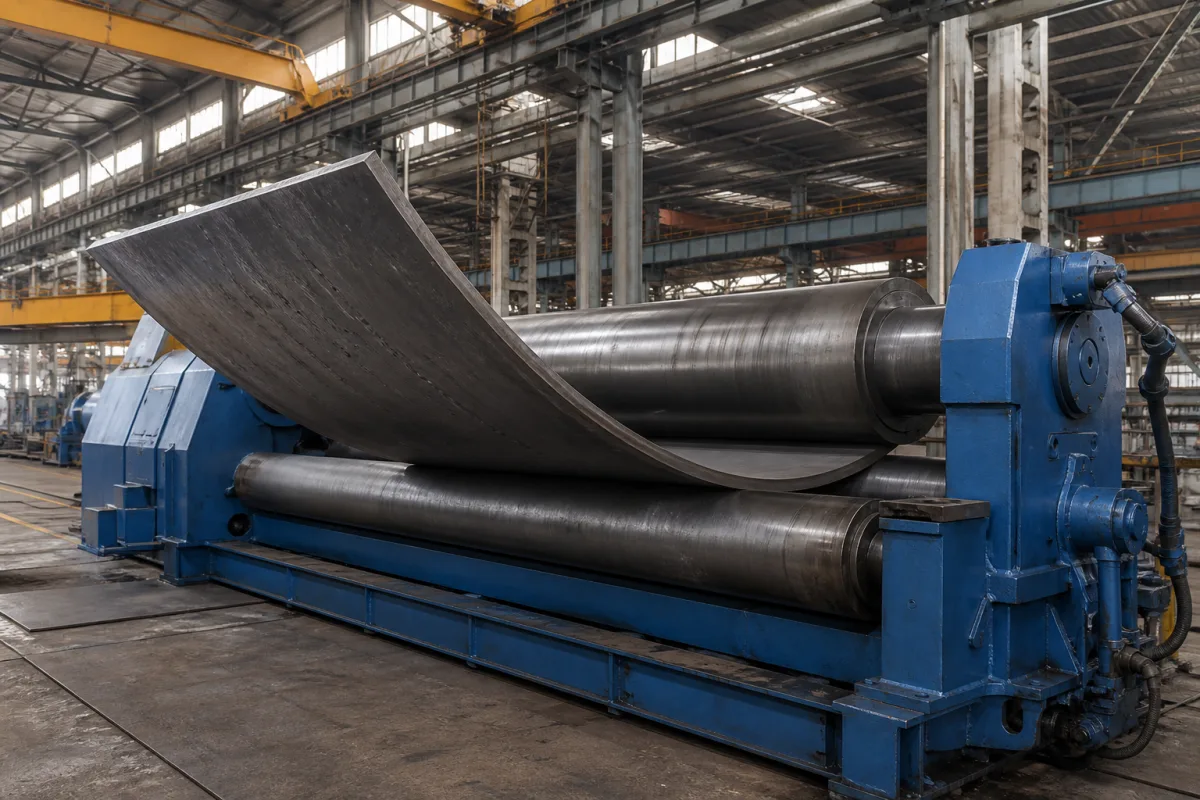
Representative product image. Confirm appearance and specifications with the manufacturer.

Product Specifications

Technical details and manufacturing context for Marine Hull Plate Bending Roller

Definition
The Marine Hull Plate Bending Roller is a heavy-duty industrial machine used in shipbuilding to precisely bend and form thick steel plates into curved hull sections through controlled rolling pressure. It employs three or four synchronized rollers that apply progressive deformation to metal plates without heating, maintaining material integrity. This equipment is essential for creating the complex curvatures of ship bows, sterns, and bilge areas with high dimensional accuracy. Automated versions incorporate CNC controls for repeatable production of identical curved components across multiple ship units.

The machine operates by feeding steel plates between rollers that exert controlled pressure, causing plastic deformation. The rollers are driven by hydraulic or electric motors, and the plate is passed through multiple times to achieve the desired curvature. The process is cold-forming, meaning no heat is applied, which preserves the material's original properties. The equipment is designed to handle high-strength alloy steel and hardened tool steel, with a maximum plate width ranging from 2000 to 6000 mm, a minimum bend radius of 300 to 1000 mm, and a maximum plate thickness of 10 to 40 mm. The roller diameter ranges from 200 to 500 mm, and the motor power is between 15 and 90 kW. The machine weight is 10 to 50 tons, and its dimensions vary from 5000×2000×2500 mm to 12000×4000×5000 mm. Bending speed is 1 to 5 m/min, and bending precision is ±0.5 to ±2 mm. The control system is PLC + HMI, and the power supply is 380 V AC ±10%. The hydraulic system pressure is 20 to 31.5 MPa, and the operating temperature range is 0 to 45°C.

These specifications are typical ranges; actual values must be confirmed with the manufacturer for specific models and applications. The machine is a capital investment for shipyards, and its selection depends on the required plate dimensions, thickness, and curvature. Proper maintenance and operator training are essential for safe and accurate operation. Always verify model-specific parameters and compliance with applicable standards before procurement.
Working Principle
Hydraulic or electric motors drive synchronized rollers that apply controlled pressure to steel plates, progressively bending them through plastic deformation as they pass between the rollers in multiple passes. The plate is fed between the rollers, and the gap between the rollers is adjusted to achieve the desired curvature. The process is repeated until the required shape is obtained. The rollers are typically arranged in a pyramid or pinch configuration, with the top roller applying downward force and the bottom rollers providing support. The bending force is generated by the hydraulic system, which operates at a pressure of 20 to 31.5 MPa. The control system (PLC + HMI) allows precise adjustment of roller positions and speed, ensuring repeatability and accuracy.
Common Materials
High-Strength Alloy Steel, Hardened Tool Steel
Technical Parameters
ParameterTypical rangeNotes & selection driver
Maximum Plate WidthRequired2000–6000 mmMaximum width of steel plate that can be processed
Minimum Bend RadiusRequired300–1000 mmSmallest achievable curvature radius
Roller DiameterRequired200–500 mmDiameter of main bending rollers
Motor PowerRequired15–90 kWTotal drive system power
Machine Weight10–50 tonsTotal equipment mass for installation planning
Maximum Plate Thickness10–40 mmThicker plates require higher bending force and may reduce width capacity.
Bending Speed1–5 m/minAffects productivity and surface quality.
Bending Precision±0.5–±2 mmCritical for hull plate fit-up and welding.
Control SystemPLC + HMIAutomated control for repeatability and ease of operation.
Operating Temperature0–45 °COutside this range, hydraulic oil viscosity and electronic components may be affected.
Power Supply380 ±10% V ACThree-phase; other voltages available on request.
Hydraulic System Pressure20–31.5 MPaDetermines bending force; higher pressure for thicker plates.
Machine Dimensions (L×W×H)5000×2000×2500–12000×4000×5000 mmRequired for workshop layout and shipping.

Ranges are indicative industry figures for RFQ preparation, not a supplier commitment. Confirm every value and standard with the legal manufacturer before ordering.

Components / BOM
  • Main Bending Roller
    Primary component applying bending force to plates
    Material: Hardened alloy steel with surface treatment
  • Hydraulic Pressure System
    Provides controlled force application through cylinders
    Material: Steel components with hydraulic seals
  • CNC Control Panel Optional
    Digital interface for programming bending parameters and sequences
    Material: Industrial-grade electronics enclosure
  • Plate Support Table
    Stabilizes and guides plates during feeding and bending operations
    Material: Reinforced structural steel
  • Synchronized Rollers
    Driven in synchronization with the main roller to progressively bend the plate.

Industry Taxonomies & Aliases

Commonly used trade names and technical identifiers for Marine Hull Plate Bending Roller.

Industrial Ecosystem & Supply Chain Structure

Complementary Systems
Downstream Applications
Specialized Tooling

Application Fit & Sizing Matrix

Operational Limits
pressure: Hydraulic system: 10-25 MPa, Roll contact pressure: 50-300 MPa (plate dependent)
other spec: Plate thickness: 5-100 mm, Plate width: 1-4 m, Minimum bend radius: 1.5x plate thickness, Roll diameter: 300-800 mm, Motor power: 15-150 kW
temperature: Ambient to 50°C (operating environment)
Media Compatibility
✓ Marine-grade steel plates (AH36/DH36/EH36) ✓ High-strength low-alloy (HSLA) steel ✓ Stainless steel (304/316 grades)
Unsuitable: Hot rolling applications (requires cold-forming only)
Sizing Data Required
  • Maximum plate thickness (mm)
  • Required bend radius (mm)
  • Plate material yield strength (MPa)

Reliability & Engineering Risk Analysis

Failure Mode & Root Cause
Roller bearing seizure
Cause: Inadequate lubrication leading to metal-on-metal contact, contamination from marine environment (saltwater, debris), or improper alignment causing uneven load distribution.
Roll surface fatigue cracking
Cause: Cyclic overloading beyond design limits during plate bending operations, material defects in roll construction, or corrosion-assisted fatigue from saltwater exposure.
Maintenance Indicators
  • Unusual grinding or screeching noises during operation indicating bearing failure or metal-to-metal contact
  • Visible cracks or spalling on roll surfaces, especially at stress concentration points like edges or weld seams
Engineering Tips
  • Implement a strict lubrication schedule using marine-grade, corrosion-resistant greases specifically formulated for heavy-load roller applications in saltwater environments
  • Establish regular dimensional inspections and alignment checks using laser alignment tools to ensure proper roller parallelism and prevent uneven loading that accelerates wear

Indicative industry ranges for design and RFQ preparation. Confirm the exact figures and applicable standard with the manufacturer before specifying.

Compliance & Manufacturing Standards

Applicable Standards
ASTM A6/A6M - Standard Specification for General Requirements for Rolled Structural Steel Bars, Plates, Shapes, and Sheet Piling CE Marking - Machinery Directive 2006/42/EC

Quoted from the published standard.

Manufacturing Precision
  • Roller Alignment: +/- 0.05mm per meter
  • Surface Roughness: Ra ≤ 3.2 μm
Quality Inspection
  • Ultrasonic Testing (UT) for internal defects
  • Hardness Testing (Brinell/Rockwell) for material properties

Manufacturers of Marine Hull Plate Bending Roller

Manufacturer profiles associated with Marine Hull Plate Bending Roller.

Sourcing Marine Hull Plate Bending Roller from China?
Tell us your specification and target quantity — we will match it against manufacturer records and come back with the factories that fit.
Request manufacturers We manufacture this

Manufacturer listings support early research and capability understanding. They are not certification, ranking, or transaction guarantees.

Technical documentation
Request current drawings, revision history, and a signed specification sheet.
Manufacturing capability
Verify equipment lists, process limits, capacity, and representative production evidence.
Inspection readiness
Confirm test methods, calibrated equipment, sampling plans, and traceable reports.
Supplier transparency
Check the legal entity, factory address, ownership, certifications, and direct contacts.

CNFX does not score or rank suppliers. Buyers must verify all claims and documents with the legal manufacturer before ordering.

Frequently Asked Questions

What is the maximum plate thickness this machine can handle?

According to the directory data, the maximum plate thickness is 10 to 40 mm. However, thicker plates require higher bending force and may reduce width capacity. Always confirm the exact capability with the manufacturer for your specific model.

Can this machine bend plates without heating?

Yes, it uses cold-forming process, applying controlled pressure to deform the plate plastically without heating. This preserves the material's integrity and is suitable for high-strength alloy steel and hardened tool steel.

What control system does the machine use?

The machine is equipped with a PLC + HMI control system, allowing automated and repeatable bending operations. This facilitates precise adjustment of roller positions and speed for consistent results.

What are the power supply requirements?

The standard power supply is three-phase 380 V AC ±10%. Other voltages may be available on request. Verify the electrical specifications with the manufacturer to ensure compatibility with your facility.

Data Basis

Editorial classification, named public sources where available, and source-reviewed manufacturer records.

Preliminary Technical Classification
This page supports structured research, RFQ preparation, and supplier evaluation. It does not replace buyer-led supplier qualification, standards review, or technical approval.
Buyer enquiry

Request manufacturing insight for Marine Hull Plate Bending Roller

Ask for use case, specification boundaries, supplier type, and RFQ preparation information for this product.

Where it goes
Straight to the CNFX editorial desk, and to the manufacturer if this product is linked to a claimed profile. Nothing is broadcast to a supplier list.
Your details stay here
We do not sell or rent enquiry data, and we do not add you to a mailing list. Used only to answer this request.
No commission, no middleman
CNFX is a directory. We take no cut of any order and never negotiate on a supplier's behalf.
What we don't claim
A listing is not an endorsement. Qualify every supplier and verify every figure yourself before ordering.

Your business information is used only to process this request.

Thank you! Your message has been sent. We'll respond within 1–3 business days.
Sorry, we couldn't send your message. Please try again, or email us at contact@cnfx.com.

Need to Manufacture Marine Hull Plate Bending Roller?

Compare manufacturer profiles with relevant product and process capability.

Previous Product
Marine Ballast Water Treatment System Filter Cartridge
Next Product
Marine Hull Plate Shot Blasting Machine
Get QuotesChat