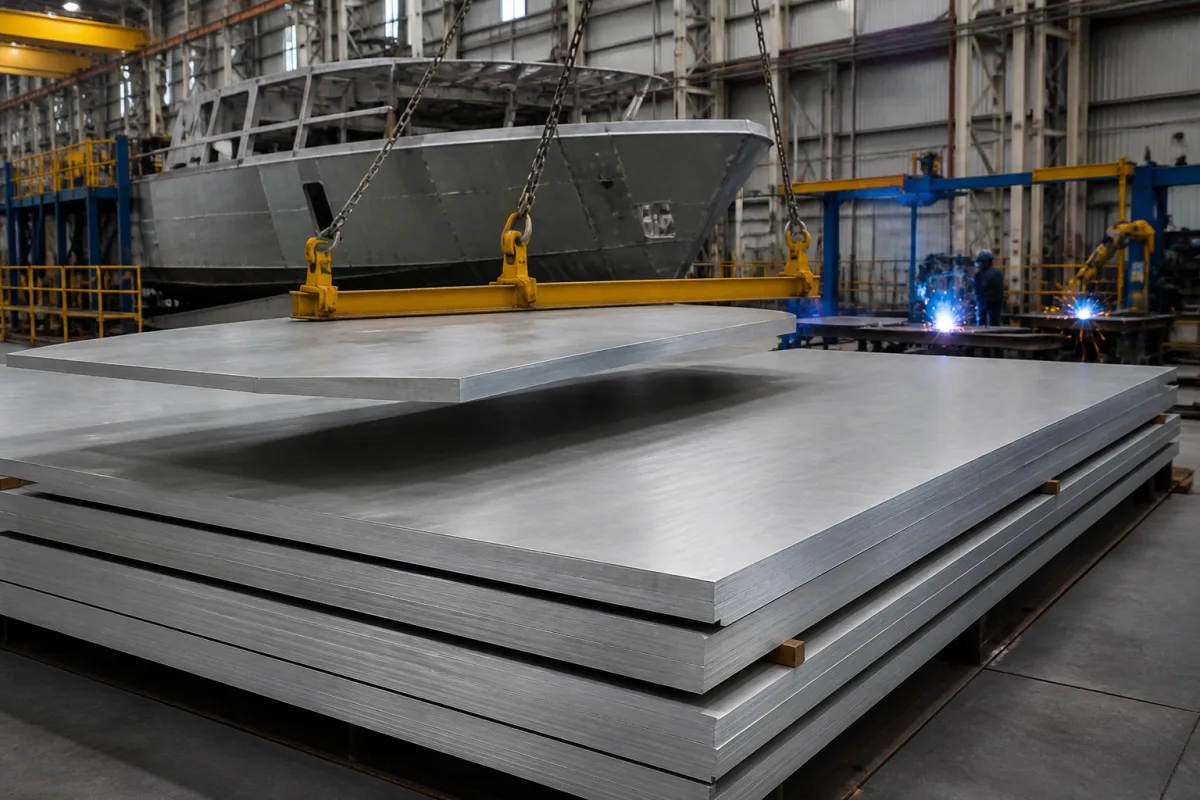
Marine grade aluminium alloy plate (5083 and 5383, H116 and H321)
Ship and boat building plate · 5083 and 5383 in H116 and H321, ASTM B928M, G66 and G67 corrosion tests, sensitisation in service, class certificates
Marine grade aluminium plate is rolled high-magnesium 5xxx alloy plate, such as 5083 or 5383, supplied in tempers certified for marine service under standards that reference exfoliation and intergranular corrosion tests, for hulls, decks and superstructures of ships and boats. Ask three things first: which alloy, temper and thickness meet your design strength, which standard and corrosion tests the temper is certified to and by which classification society, and how the structure will avoid long exposure to warm temperatures that sensitise the alloy in service.
Rolled 5xxx (Al-Mg) sheet and plate for ship and boat structures, certified to ASTM B928M and classification society rules. Extrusions, castings, 6xxx alloys, tread plate as a separate product and welding consumables are outside this page, except where compared.
CNFX editorial research · Sources checked October 12, 2026 · 4 sources
BlueScope Distribution's 5083 data sheet states that 5083 H321 or H116, when certified under ASTM B928M, can be sold to marine customers for ship and boat building, and that its plate is ordered to both AS/NZS 1734:1997 and ASTM B928M. For 3–40 mm plate it lists minimum tensile strength of 305 MPa and minimum yield of 215 MPa for both 5083-H321 (with maxima of 385 and 295 MPa) and 5083-H116, with 10% minimum elongation; 5383-H321 and H116 are listed for 3–50 mm at 305 MPa tensile and 220 MPa yield. [1]
The same data sheet gives 5083 chemistry of 4.0–4.9% Mg, 0.40–1.0% Mn and 0.05–0.25% Cr, and lists minimum 90° bend radii for H321 sheet rising from 1t at 1.6 mm to 2½t at 12 mm, with no bend radii given for H116. It names filler alloy 5356, with the choice dependent on the alloys being joined. [1]
Editorial calculation: the data sheet's mass factor of 2.66 kg per millimetre of thickness per square metre means a 6 mm × 2,000 × 6,000 mm plate (12 m²) weighs about 12 × 6 × 2.66 ≈ 192 kg; use it to check quoted weights and lifting plans. [1]
Give the supplier the alloy and temper, thickness, width, length and quantity, the standard (for example ASTM B928M), the classification society and survey required, corrosion test reporting (G66 and G67), flatness and surface requirements, forming and welding plans, protective film and packing, and the mill certificate type.
02
Check corrosion tests and control sensitisation in service
BlueScope's data sheet lists ASTM G66 (ASSET, visual assessment of exfoliation corrosion susceptibility of 5xxx alloys) and ASTM G67 (NAMLT, intergranular corrosion susceptibility by mass loss in nitric acid) among the standards referenced for its B928M plate. [1] A US patent filed through the US Naval Research Laboratory explains why: heat exposure forms magnesium-rich beta phase (Mg₂Al₃) on grain boundaries, which is anodic to the surrounding alloy and raises the risk of intergranular corrosion, stress-corrosion cracking and corrosion fatigue in ship structures; G67 measures the degree of sensitisation by the mass lost when acid attacks the grain boundaries, and is destructive. [2]
Zhang and co-authors (Monash University and others, Scientific Reports 2017) state that AA5083 is susceptible to intergranular corrosion and intergranular stress corrosion cracking after prolonged exposure between 40 °C and 220 °C, and that the driving force for beta-phase precipitation becomes appreciable when Mg exceeds 3.5 wt.%. In their tests, 30 days at 100 °C produced a NAMLT value of about 32.9 mg/cm², and 8 days at 150 °C about 50.8 mg/cm². [3]
The patent notes that hardness falls rapidly with sensitisation but that comparison needs an unsensitised reference sample, and describes etching and image analysis of grain-boundary beta as a non-destructive alternative calibrated against G67. [2] Editorial note: ask the designer and supplier which areas of the vessel may run warm (engine rooms, exhausts, sun-heated decks) and whether in-service sensitisation checks are planned.
03
Class-certified marine plate on the listed site
The supplier reviewed lists marine grade sheet and plate under more than one classification society; for each order ask for the class certificate, the mill test report with G66 and G67 results and the standard the plate is certified to.
04
Read the G67 mass-loss result against ASTM's ranges
ASTM International's summary of G67-18 (NAMLT) says the nitric acid dissolves the aluminium-magnesium intermetallic (β Al-Mg) in preference to the magnesium solid solution in the matrix. Where that phase forms a relatively continuous network along grain boundaries, grains fall out and mass losses are of the order of 25 to 75 mg/cm² (160 to 480 mg/in.²), whereas intergranular-resistant material loses only about 1 to 15 mg/cm² (10 to 100 mg/in.²). Randomly distributed β gives intermediate losses, and metallographic examination is then required to establish whether the loss comes from intergranular attack. The method applies only to wrought 5XXX products, and ASTM links the same grain-boundary precipitate to intergranular corrosion in seacoast atmospheres or sea water, seen as pitting, exfoliation or stress-corrosion cracking. [4]
Editorial comparison: the 32.9 mg/cm² after 30 days at 100 °C and 50.8 mg/cm² after 8 days at 150 °C reported by Zhang and co-authors both fall inside ASTM's 25 to 75 mg/cm² range for a continuous grain-boundary network. [3][4] Editorial note: ask the mill to state the G67 mass loss on the certificate, and for a result between the two ASTM ranges, the metallographic examination the method calls for.
05
From chemistry to G67: what each certificate line proves
Explore company information and manufacturing capabilities, then discuss the scope of your project with a relevant supplier.
Share this page
Compiled and source-reviewed by the CNFX editorial team.
Each manufacturer above links to the page on that company's own website where the product is listed, with the date we checked it. How we source and review
· Page last updated 13 October 2026
Buyer questions
Which aluminium tempers are used for marine plate?
BlueScope's data sheet names 5083 H321 and H116, certified under ASTM B928M, for ship and boat building. [1]
What corrosion tests apply to marine aluminium plate?
ASTM G66 (exfoliation, ASSET) and ASTM G67 (intergranular, NAMLT) are referenced for B928M plate. [1]
Why does marine aluminium sensitise in service?
Long exposure to warm temperatures forms Mg₂Al₃ beta phase on grain boundaries, which is anodic and raises intergranular corrosion and cracking risk. [2][3]
What NAMLT mass loss indicates sensitised marine aluminium?
ASTM International's G67 summary gives mass losses of the order of 25 to 75 mg/cm² when β phase forms a continuous grain-boundary network, against about 1 to 15 mg/cm² for intergranular-resistant material. [4]
Sources and what still needs a direct check
Sources checked 2026-10-12. BlueScope Distribution's data sheet summarises the standards it orders plate to; the US patent and the Scientific Reports article explain sensitisation. Certified values for your plate must come from the standard, the mill certificate and the classification society.