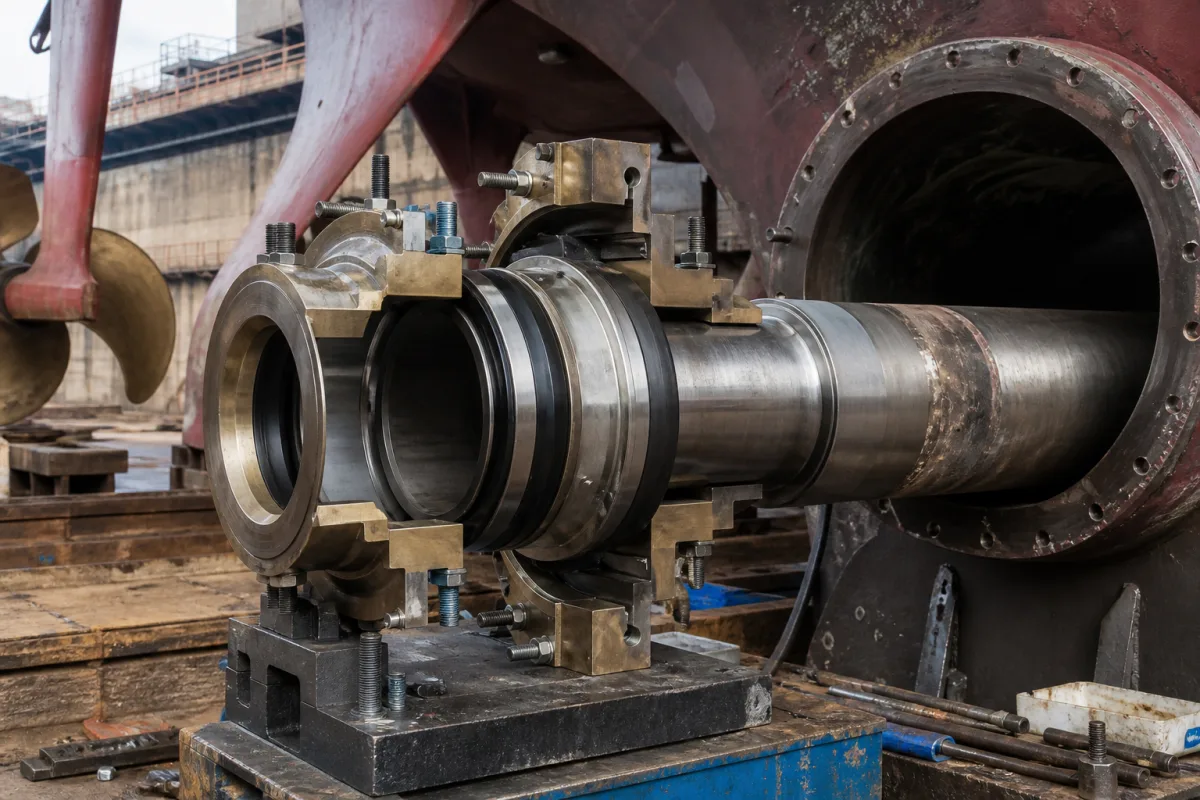
Stern tube propeller shaft seals · Oil-lubricated lip and face seals at the outboard and inboard ends of the stern tube: Viton seal rings on a wear liner, split designs for retrofit, air-pressurised anti-pollution seals, sand protection, in-water service and lubricant choice
A propeller shaft seal closes the stern tube where the rotating shaft leaves the hull, keeping seawater out and stern tube lubricant in; oil-lubricated stern tubes carry an outboard seal at the propeller end and an inboard seal in the engine room. Ask three things first: which shaft size, vessel type and operating water the seal must suit, whether lip or face type and what pollution protection is required, and how it will be installed and serviced.
Outboard and inboard seals for oil-lubricated stern tubes and similar shaft lines on ships, tugs, ferries and offshore vessels, with their liners, seal rings and air or water supply systems. Stern tube bearings, water-lubricated shaft bearings, pump mechanical seals (see mechanical seal) and small-craft dripless shaft seals are outside this page.
CNFX editorial research · Sources checked October 11, 2026 · 5 sources
Wärtsilä's Sternguard OLS is an oil-lubricated lip seal in outboard (OLS3-P, OLS4-P) and inboard (OLS2-P) versions for merchant, cruise and ferry, offshore, inland waterway vessels and thrusters. Its seal rings are Viton rubber running on a wear-resistant liner that protects the propeller shaft; it is supplied partially split, or fully split so it can be retrofitted without removing shaft-line components. [1]
For tugs, trawlers and coasters, Wärtsilä's Sternguard E Series uses flexible elastomer bodies with integral face inserts that accommodate vibration and axial and radial movement, in a non-split outboard (EK), non-split inboard (EJ) and partially split inboard (EL) version, with oil or grease, and meets classification society requirements for wear and corrosion protection in silty or abrasive water. [2]
Its Sternguard IWSS is a face seal in which pressure springs hold the lapped surfaces together while allowing axial movement; fully split versions can be overhauled in the water without dry-docking, shaft withdrawal or draining stern tube oil. [3]
Give the supplier the vessel type and class society, shaft and liner diameter, shaft speed, draught at the seal (seawater head), stern tube lubricant (mineral oil or EAL), seal type and position (outboard, inboard), split requirement, operating waters (clean, silty, sandy), air or fresh-water supply available, and the planned docking and service interval.
02
Set pollution protection, abrasion protection and service interval
Wärtsilä's Airguard is a lip seal that feeds compressed air into the void between seal rings, automatically kept above seawater pressure so a small amount of air escapes outboard; any seawater or oil entering the void drains to an inboard collection system, preventing oil leaking out or seawater entering the stern tube. Wärtsilä says this removes the oil-to-sea interface, so the seal can run on mineral oil in accordance with the 2013 Vessel General Permit. [5]
For abrasive or polluted waters, Wärtsilä's Sandguard adds a face seal and protection ring with fresh water purged into the aft seal chamber to keep muddy or sandy water out, combined with air, automatic drain collection and automatic pressure control. [4] Its IWSS accepts environmentally acceptable lubricants (EALs) and mineral oil and is stated to comply with the 2013 US EPA Vessel General Permit when used with EALs. [3]
Wärtsilä offers a Bio Seal ring for OLS seals with a service interval of at least 5 years when used with EALs, against a recommended change every 2.5 years for conventional seal rings. [1]
Editorial calculation: a 5-year interval is twice the 2.5-year interval, so over 10 years the ring set would be changed about twice instead of four times. [1]
03
Shaft size, speed, class approval and in-water service: questions for a seal maker
Ask any supplier for seal type and model for your shaft and liner diameter, maximum shaft speed and seawater head, seal ring and liner materials, split options, lubricant compatibility (mineral oil, EAL), air or water supply requirements, class approval, service interval and spare kits, and in-water service capability.
04
Seal rings, liner, face springs, air void, drain tank and fresh-water purge
The rows draw on four different Wärtsilä seals: Viton rings and the liner from Sternguard OLS, spring-loaded faces from IWSS and the E Series, the air void and inboard drain from Airguard, and the fresh-water purge from Sandguard. [1][3][2][5][4]
Shaft diameter, speed, seawater head, leakage and seal materials for a stern tube seal
Wärtsilä's product pages give no numeric values for shaft diameter range, speed, temperature, face hardness or weight; take these from the maker's drawing for your shaft line.
Field
What it means and published values
Ask the supplier for
Shaft Diameter Range (mm)
Not stated in the reviewed sources.
Range for model.
Maximum Pressure Rating (bar)
Air kept above seawater pressure in one design. [5]
1 company lists this product among what they make. Company figures are quoted from each
company's own website; every card states where the relationship came from.
Jiangsu Huaqing Fluid Technology Co., Ltd.
Manufacturing site to be confirmed for the order
Its website has a product page for marine propeller shaft seals.
Explore company information and manufacturing capabilities, then discuss the scope of your project with a relevant supplier.
Share this page
Compiled and source-reviewed by the CNFX editorial team.
Each manufacturer above links to the page on that company's own website where the product is listed, with the date we checked it. How we source and review
· Page last updated 13 October 2026
Buyer questions
How do anti-pollution stern tube seals stop oil leaks?
Wärtsilä's Airguard keeps compressed air between seal rings above seawater pressure and drains any leakage inboard. [5]
Can a stern tube seal be replaced without drawing the shaft?
Wärtsilä offers fully split lip seals for retrofit and an IWSS face seal that can be overhauled in water. [1][3]
How often are stern tube seal rings changed?
Wärtsilä recommends 2.5 years for conventional rings and quotes at least 5 years for its Bio Seal ring with EALs. [1]
Sources and what still needs a direct check
Sources checked 2026-10-11. Wärtsilä makes oil-lubricated stern tube seals.