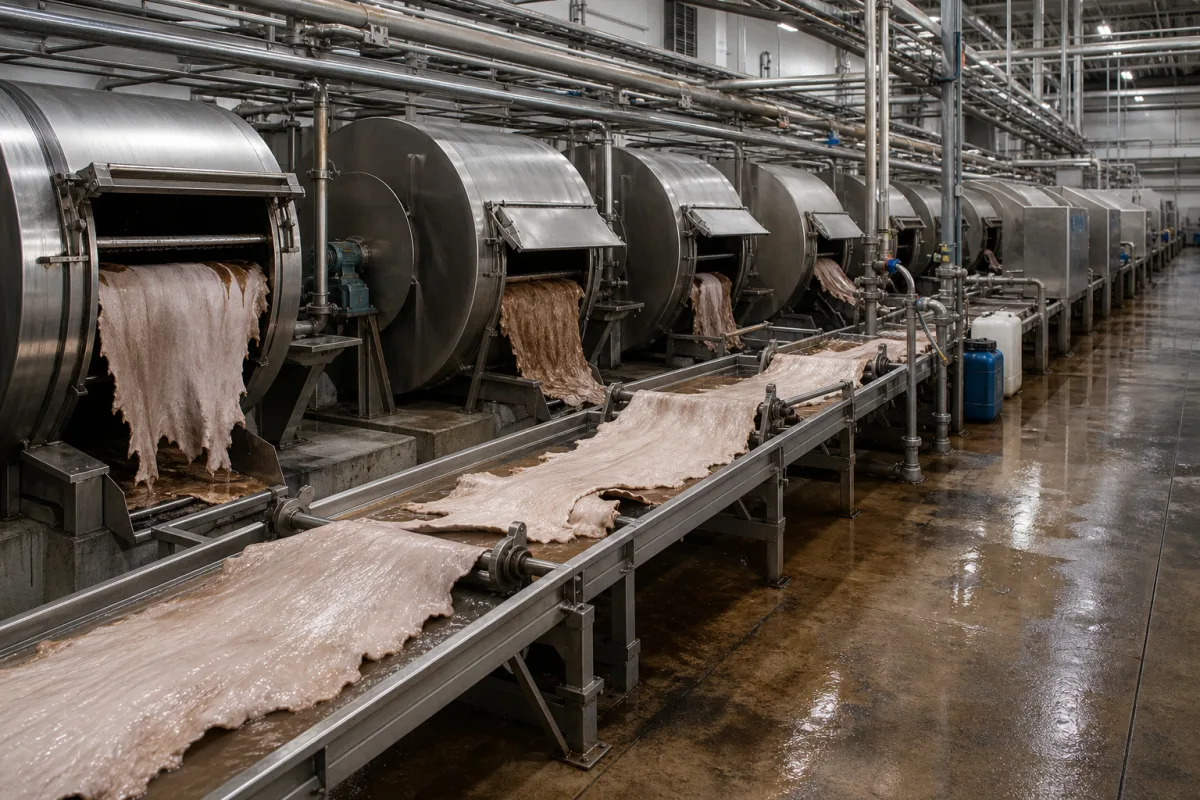
Integrated leather wet-end processing line: drum row, central water and chemical dosing, recipe control
Tannery wet end as one line · a row of processing drums fed by central water mixing and chemical dosing, run from one recipe controller, with hides passed between stages
A tannery's wet end runs hides through a sequence of baths: soaking, liming, deliming and bating, pickling and tanning, then neutralising, retanning, dyeing and fatliquoring. Each bath is a measured float of water at a set temperature with weighed chemicals, added to a rotating drum in a set order. An integrated line takes those additions out of the operators' hands. A central mixer delivers water by volume and temperature to whichever drum the recipe calls, a dosing station prepares and pumps the chemicals, pH and float are monitored, drum rotation follows the program, and wet hides leave the drums onto conveyors for the next stage. What it has to deliver is set by the recipe and by the water and chemical benchmarks the plant will be judged against.
Tannery wet-end lines specified as a whole: a row of processing drums with central water mixing, chemical preparation and dosing, pH and float monitoring, recipe and drum-rotation control, odour extraction, and hide discharge and conveying between stages, with the line's water, chemical and yield benchmarks. Single rotating processing drums, their size, load, float, drive and speed are covered on the Tanning drum system page; drum shelves, pegs and paddles on the Leather drumming paddle assembly page; fleshing machines on the Fleshing machine page; spray finishing on the Leather spray finishing line page; and cutting of finished hides on the Leather cutting system page. Effluent treatment plants are outside this page.
CNFX editorial research · Sources checked October 12, 2026 · 4 sources
Float volumes the line has to deliver, stage by stage, for a one-tonne batch
UNIDO's mass balance of leather processing (Buljan, Reich and Ludvik, 2000) bases its calculation on 1,000 kg of wet salted cattle hides, 39 pieces at about 25.6 kg salted weight each, made into shoe upper leather by conventional liming and chrome tanning. Its recipe annex gives each float as a percentage of the weight being processed, which is the volume the central water system must measure into the drum. [1]
Editorial calculation from the annex: the five beamhouse floats before deliming come to 1.5 + 1.5 + 2 + 3 + 4 = 12 m³ for the one-tonne batch, and the largest single fill is the 400% wash at 4 m³. The water mixer and its pipework to each drum have to deliver that volume at the recipe temperature within the time the program allows. [1]
The same paper says post-tanning formulations vary between tanners more than beamhouse and chrome tanning formulations do, with chemicals, float length, duration, temperature and sequence differing, and its authors offer the calculation as a reference for tanners making their own. [1]
Stage in the reference recipe
Float and main additions
Weight basis
Pre-soaking; main soaking
150% water (1.5 m³) each, with 0.15% surfactant [1]
Send the supplier your recipe, or at least the largest float per drum, the drum count and capacities, the temperatures per stage and the number of chemicals to be dosed, so the water mixer, tanks and pumps are sized on your process rather than a catalogue line.
02
Central hot and cold water mixing, chemical dosing, pH and float recycling, drum rotation and odour control
CSIR-CLRI, India's leather research institute, describes its automatic process control for tanneries as five modules: water addition, chemical preparation and dosing, pH monitoring and float recycle, drum rotation, and odour reduction, built as a process computer with field instruments and PLCs connected in a distributed control system. The institute states that these systems have been implemented in tanneries. [3]
A UNIDO demonstration unit at a tannery in Kanpur shows the water module on its own. The operator sets an amount of water at a temperature; the computer mixes hot and cold inputs to that temperature and forwards the volume to the drum, controlling every parameter for up to 10 drums independently and storing temperature, volume and other data for later processes. UNIDO's note on the project names quantity and temperature as the factors that matter in process water. [2]
The World Bank Group's EHS guideline for tanning sets out what the dosing and drainage side has to respect. Chemicals should be distributed from a gangway over the beamhouse and the tanning and post-tanning drums, with tanks connected to the drum axle; pipes, valves and other equipment should be designed to prevent incorrect addition or mixing of incompatible chemicals, such as acid into a sulphide solution; and wastewater streams such as soaking liquors, sulphide-rich lime liquors and chrome-containing liquors should be segregated. It also lists batch washes in place of running-water washes and recycling of process streams among the ways to cut water consumption. [4]
Module of the line
What it does
Published detail
Water mixer
Delivers set volume at set temperature to each drum
Hot and cold mixing, up to 10 drums controlled independently in the UNIDO unit [2]
Chemical preparation and dosing
Prepares and adds chemicals to the drum
One of five CLRI modules [3]; distribution from a gangway with tanks connected to the drum axle [4]
pH monitoring and float recycle
Checks the bath and returns reusable floats
One of five CLRI modules [3]; recycling of process streams named as a water saving [4]
Segregation of soak, sulphide-lime and chrome liquors [4]
Ask how many drums the water mixer serves at once, how volume and temperature are measured, how many chemicals the dosing station handles and which are dosed by hand, how incompatible chemicals are kept apart, and where each drum's liquor goes when it is drained.
03
Water, energy, chemicals and leather yield per tonne of bovine hide
The World Bank Group guideline publishes benchmark loads per tonne of raw hide under good practice: 12–50 m³ of water for the bovine salted raw hide process, 32–69 m³ for pig skins and 110–265 m³ for wet-salted sheepskins, with energy of 9.3–42 GJ and chemicals of approximately 500 kg per tonne for bovine salted hides in conventional chrome tanning. [4]
UNIDO's model tannery uses approximately 32 m³ of process water and 8 m³ of technical water per 1,000 kg of wet salted hides, 40 m³ in all; the authors add that technically advanced plants use considerably less, below 25–30 m³ per tonne. Of 452 kg of process chemicals, they estimate 72 kg are retained in and on the leather and 380 kg are discharged, an effective utilisation of about 15%. One tonne of wet salted hides gives 195 kg of grain leather and 60 kg of split. [1] Editorial calculation: 195 + 60 = 255 kg, about 25.5% of the salted hide weight leaves as leather. The paper gives the hide weight as about 25.6 kg salted in its assumptions and as an average of 28 kg in its yield section; confirm which basis a line supplier uses when quoting capacity in hides per day.
The guideline also notes that water consumption is greatest in the pre-tanning areas, with significant amounts also used in post-tanning. [4]
Paste it into your enquiry below or into an email to a maker, then replace every bracket.
Raw material: [bovine, pig, sheep; salted or fresh; hide weight; tonnes or hides per day]
Products: [leather types; wet blue, crust]
Recipe: [stages; floats in %; temperatures; number of chemicals]
Drums: [number per stage; capacity; existing or new]
Water: [hot and cold supply; maximum float per fill; recycling]
Dosing: [liquid and solid chemicals; incompatible pairs]
Control: [recipe storage; pH monitoring; data export]
Drainage: [segregated liquors; odour extraction]
Hide handling: [discharge; conveying between stages]
Explore company information and manufacturing capabilities, then discuss the scope of your project with a relevant supplier.
Share this page
Compiled and source-reviewed by the CNFX editorial team.
Each manufacturer above links to the page on that company's own website where the product is listed, with the date we checked it. How we source and review
· Page last updated 13 October 2026
Buyer questions
How much water does a tannery wet end use per tonne of hide?
The World Bank Group guideline gives 12–50 m³ per tonne of raw hide for the bovine salted hide process; UNIDO's model tannery uses 40 m³ including 8 m³ of technical water. [4][1]
What does an automated wet-end line control?
CSIR-CLRI lists five modules: water addition, chemical preparation and dosing, pH monitoring and float recycle, drum rotation and odour reduction. [3]
How many drums can one water mixer serve?
The UNIDO demonstration unit in Kanpur controls volume and temperature for up to 10 drums independently. [2]
How much of the chemical input stays in the leather?
UNIDO estimates 72 kg of 452 kg, about 15%, in its model tannery. [1]
Sources and what still needs a direct check
Sources checked 2026-10-12. Recipe floats, water and yield come from a UNIDO mass-balance paper; the automation modules from CSIR-CLRI and a UNIDO demonstration project; benchmarks and chemical-handling practice from the World Bank Group EHS guideline for tanning.