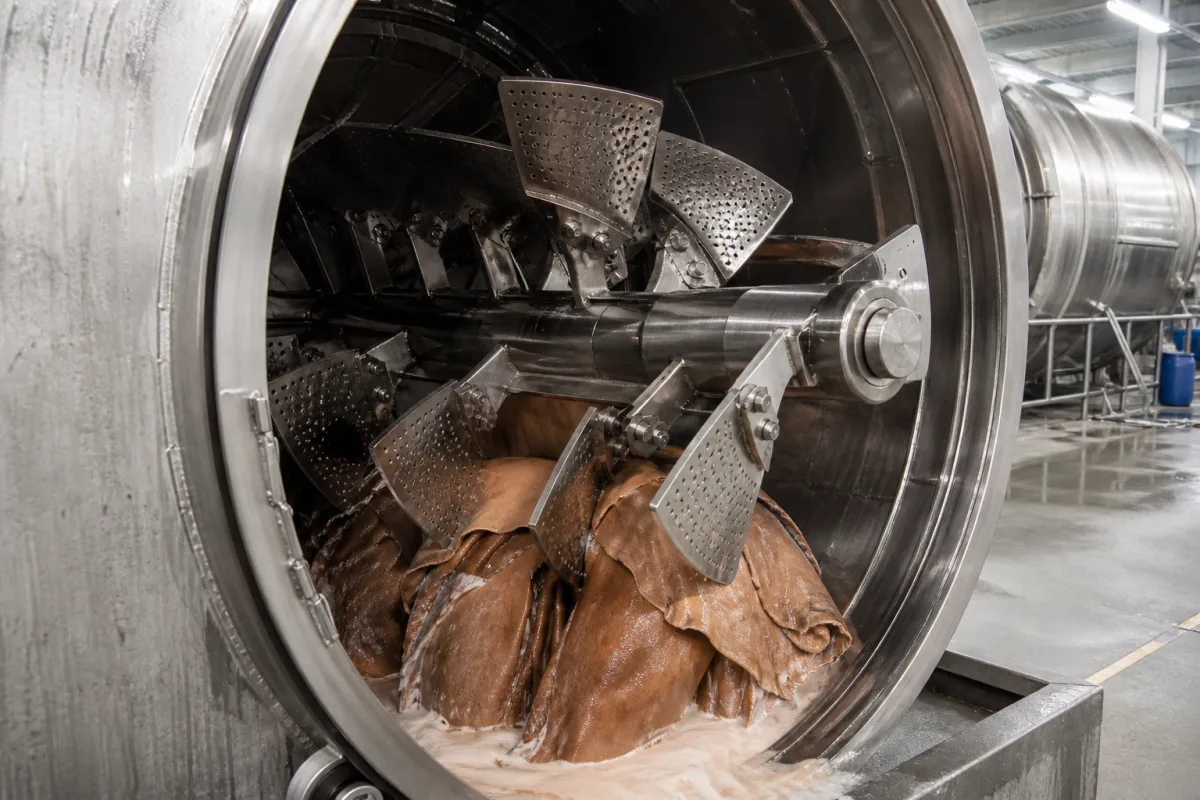
Leather drumming paddle assembly (drum shelves, pegs and paddles)
Agitation fittings for leather wet processing · Shelves, pegs and paddle blades that lift, drop and move hides in drums and paddle vessels, deep-shelf and peg layouts, tangling and grain damage, materials, drive torque and float limits
In leather wet processing, hides and chemical floats are moved either in rotating drums, where fixed shelves or pegs lift the hides and drop them back into the float, or in paddle vessels, where rotating blades stir the liquor. These fittings decide how much mechanical action the hides receive. Ask three things first: which processes and leathers the vessel runs, what lift-and-drop or stirring action is needed without tangling or grain damage, and what material and fixing the fittings use.
Internal agitating fittings of leather processing vessels: shelves, pegs and paddle blade assemblies for drums, compartmented (Y-section) vessels and paddle vats, including replacements and their fixing. Complete tanning drums and drives, hide processors and dyeing drums as whole machines are outside this page except where compared.
CNFX editorial research · Sources checked October 12, 2026 · 4 sources
Choose shelves, pegs or paddles for the mechanical action
The Leather Working Group's Making Leather Overview (Part 2) says drums are the leading vessel for all wet operations; on rotation hides and floats are mixed, and the forces applied, governed by rotation speed, load weight, float volume, time and internal construction, help determine how chemicals penetrate while the hide is flattened. Its simplest drum has 6 shelves set horizontally across the body, giving a moderate drop but a rolling motion that can tangle the goods; pegs give a gentler, continuous teasing action that helps avoid tangling, and the two can be combined. Deep shelves, at 25–40% of the drum radius, fitted 3 or 4 per drum according to shelf length, give a high lift and drop and good mechanical action while helping avoid tangling. [1]
It adds that tri-compartmental (Y-section) vessels, divided into 3 sections by perforated divisions, are used for more delicate leathers and are fitted with small pegs; that drums are traditionally wooden, with polypropylene and stainless steel also used; and that paddle arrangements are used occasionally, with paddles made of wood and polypropylene. [1]
Editorial calculation: in a drum of 3.0 m diameter (1.5 m radius), deep shelves at 25–40% of the radius would project about 0.38 to 0.60 m from the shell; check the actual depth on the supplier's drawing for your drum. [1]
US patent 6,151,932 (Drum for treating leather, fur and similar products) replaces radial bats or rods with scoop-shaped bats set slightly off the radius at the vertices of an imaginary polygon with an even number of corners, each opposite pair parallel; its example drum has four scoops, each pair perpendicular to the other, with transverse heels at the scoop tips. It gives scoop heights of 600–1,500 mm fitted to the drum heads and rotation in one or both directions at 0.25–8 rpm. The inventors estimate about 60% lower energy use and about 50% less water in soaking, unhairing and tanning than with conventional drums fitted with bats or rods; these are the patent's own estimates. [3]
Editorial calculation: a 3.0 m drum at the patent's top speed of 8 rpm moves its shell at about 75 m/min (π × 3.0 × 8); at 0.25 rpm, about 2.4 m/min. The drum size is an assumed example. [3]
Give the supplier the vessel type (drum, Y-section, paddle vat) and its internal diameter and length, shell material, the processes and leathers run (soaking, liming, tanning, retanning, dyeing), load weight and float volume, rotation speed, the fitting type and layout wanted (shelves, pegs, deep shelves, paddle blades), fitting material and fixing method, chemical and temperature exposure, and drainage or perforation details.
02
Check hide damage, capacity and drive limits
US patent 6,935,144 B2 (Council of Scientific and Industrial Research, Device for leather processing) states that wet processing is conventionally done in pits, vats, paddles and wooden drums; paddles impart agitation by rotating blades driven by a motor and gearbox, while drums lift hides with shelves or pegs and let them fall into the liquor. It lists drumming limitations: possible damage by scraping, scuffing, knotting, distortion, wrinkling, grain pebbling, loosening of fibre structure or loss of area; difficult cleaning; float limited to below the axle so capacity use is only about 35% of drum volume; turbulence that increases friction between hides; and starting torque about 3 times running torque, so the patent says drum motors are oversized. [2]
Editorial note: when replacing or changing fittings, ask the supplier how the new layout changes lift height, drop and load on the drive, and agree a trial batch to check tangling and grain damage on your leather.
03
Size drum, drive and paddle speed against a reference tannery
The UNIDO/ILO technical memorandum Tanning of Hides and Skins (Technical Memorandum No. 1; ILO 1981, UNIDO edition 1982) specifies, for deliming, bating, pickling and chrome tanning in its model hide tannery, four wooden drums each 2.5 m long by 2 m in diameter, each handling 100 hides (200 sides) per 2-day cycle and rotated by a 7.5 kW (10 HP) electric motor at approximately 5 rpm. Retanning, dyeing and fatliquoring use three smaller drums of 2.5 m by 1.2 m diameter. [4]
For the paddle pits in its skin line, it sets paddle speed between 5 and 10 rpm, enough to keep the skins moving without entangling them in the blades. Paddle axles and mountings should be wood, plastic or stainless steel, not iron, which may stain the liquors and skins, and the nails or pegs in the paddles should preferably be of non-corrosive material. [4]
Editorial calculation: at 5 rpm the shell of a 2 m drum travels π × 2 m × 5 ≈ 31 m per minute, and deep shelves at 25–40% of its 1 m radius would project 0.25 to 0.40 m. [4][1] Editorial note: give the fittings supplier your drum diameter, speed range and motor rating.
04
Horizontal and deep shelves, pegs, Y-section dividers, scoop bats and paddle blades
Shelves and pegs act differently on the hide: shelves lift and drop hides but can roll and tangle them, pegs tease more gently, and the LWG overview notes that shelves and pegs can be combined in one drum. [1]
Shelf or blade size, speed range, weight, material and fixing for a drum-fittings order
The speed row has three published references to work from: 0.25–8 rpm for the scoop-bat drum patent, 5–10 rpm for UNIDO/ILO paddle pits, and the drum speed of your own vessel, which sets the drop the new fittings will give. [3][4]
Field
What it means and published values
Ask the supplier for
Blade Diameter (mm)
Paddle sweep or shelf depth (25–40% of radius); scoops 600–1,500 mm high. [1][3]
Drawing.
Shaft Diameter (mm)
Paddle shaft.
Value.
Maximum RPM (rpm)
Rotation affects force on hides; one scoop-drum patent 0.25–8 rpm. [1][3]
Explore company information and manufacturing capabilities, then discuss the scope of your project with a relevant supplier.
Share this page
Compiled and source-reviewed by the CNFX editorial team.
Each manufacturer above links to the page on that company's own website where the product is listed, with the date we checked it. How we source and review
· Page last updated 13 October 2026
Buyer questions
Shelves or pegs in a tanning drum?
The LWG overview says shelves give more drop but can roll and tangle hides, pegs give gentler teasing and less tangling, and the two can be combined. [1]
What are deep shelves?
Shelves at 25–40% of the drum radius, 3 or 4 per drum, giving high lift and drop with less tangling (LWG). [1]
How does a leather paddle work?
US 6,935,144 describes paddles as vessels where motor- and gearbox-driven rotating blades agitate the liquor and hides. [2]
What speed do leather drums with scoop bats turn at?
US patent 6,151,932 gives 0.25–8 rpm in one or both directions, with scoops 600–1,500 mm high. [3]
How fast should leather processing paddles turn?
The UNIDO/ILO memorandum Tanning of Hides and Skins sets paddle speed between 5 and 10 rpm, enough to keep skins moving without entangling them in the blades. [4]
Sources and what still needs a direct check
Sources checked 2026-10-12. The Leather Working Group overview is an industry training document; the UNIDO/ILO memorandum describes a model tannery; the two US patents describe their own devices and summarise conventional drumming in their own terms.