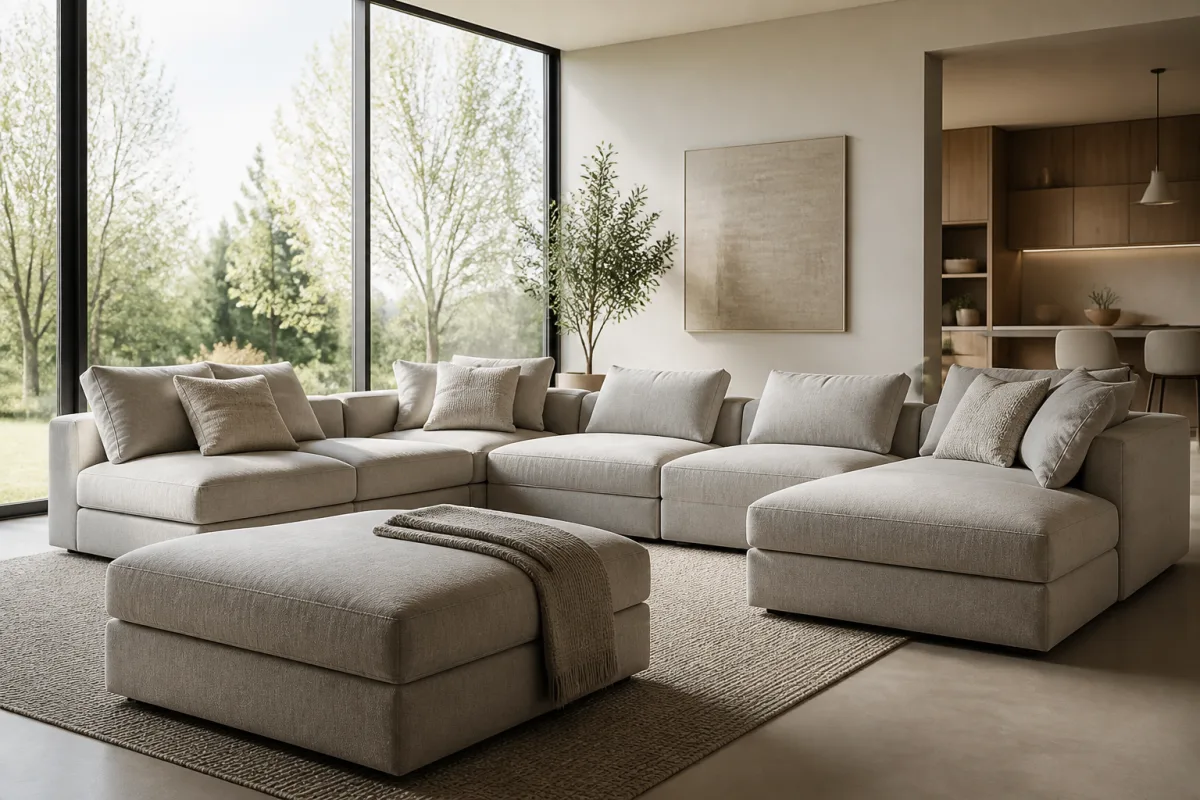
Modular sectional sofas for OEM and wholesale buyers · seat, corner, wedge and side modules and their connectors, seat height and depth, frame materials, foam density, Martindale abrasion, US upholstered furniture flammability (16 CFR 1640 / TB 117-2013)
A modular sectional sofa is built from separate upholstered modules — seats, corner or wedge seats, chaise or ottoman pieces, and arm or back sides — that connect to form a sofa of the size and shape the buyer wants, and can be reconfigured later. For OEM and wholesale orders, ask three things first: which module types and connector system the range uses, what the seat dimensions, frame, foam and cover are, and which flammability and durability tests the range has passed for your market.
Modular sectional sofa ranges for residential and light contract use, bought as OEM or wholesale programmes: seat, corner, wedge, chaise and ottoman modules, arm and back sides, connectors, cushions and removable covers. Fixed-frame sofas, recliner mechanisms sold on their own, sofa beds, outdoor seating, foam and fabric sold as raw materials, and office lounge seating systems are outside this page except where compared.
CNFX editorial research · Sources checked October 11, 2026 · 5 sources
Match the module types, connectors and seat dimensions
Lovesac's Sactionals system is built from Seats and Sides: each Seat comes with a seat frame, a seat cushion and a back pillow, and Sides work as arms or backs. Standard, Deep, Storage and Reclining Seats share an overall size of 35 in L × 29 in W × 18 in H; a Wedge Seat tapers from 35 in at the back to 12 in at the front, is 26.75 in deep and 18 in high, and creates a 45° angle, so two Wedge Seats form a 90° corner. A Standard Side measures 35 × 6 × 28.5 in and weighs 36 lbs; Deep Sides are used only as backs, and Roll Arm and Swept Arm Sides only as arms. Steel clamps connect the pieces, and shoes and feet keep Seats and Sides from sliding apart. [4]
IKEA's VIMLE series uses sections that can be combined into different sizes and shapes. Its 1-seat section is 71 cm wide and 98 cm deep, with a seat width of 71 cm, seat depth of 55 cm, seat height of 48 cm, backrest height of 68 cm, height of 83 cm including back cushions and 6 cm of free height under the furniture. IKEA notes that the section can only be used together with VIMLE sections bought from April 2021 onwards, which shows why connector compatibility between production generations belongs in an OEM contract. [3]
Editorial calculation: Lovesac's 35 × 29 × 18 in seat converts to about 88.9 × 73.7 × 45.7 cm (1 in = 2.54 cm), so its 18 in seat module height sits about 2.3 cm below the VIMLE's 48 cm seat height; compare seat height measured the same way on every sample. [4][3]
Give the supplier the module list (seat, corner or wedge, chaise, ottoman, arm and back sides, armless units) with quantities per configuration, target seat height, seat depth and module width, the connector type and how modules lock together, compatibility with earlier and later production runs, removable-cover requirements, carton sizes and weights, and the markets the range will be sold in.
02
Check the foam, frame and cover fabric
IKEA lists the VIMLE 1-seat section's seat cushion as highly resilient polyurethane foam (cold foam) at 35 kg/cu.m., its back cushion as 30% cut polyurethane foam and 70% polyester fibres, and its frame as plywood, polyurethane foam at 20 kg/cu.m., particleboard, solid wood, laminated veneer lumber and fibreboard, with polypropylene clips. The cover is 80% cotton and 20% polyester, removable and machine washable at max. 40 °C, with a lightfastness level of 5 on a scale of 1 to 8. The section ships in 2 packages; the frame package has a net weight of 18.45 kg. [3] Lovesac lists Standard and Deep Seats at 53 lbs and Storage Seats at 66 lbs. [4]
For abrasion, Kothea, an upholstery fabric supplier, explains that the Martindale test is defined in BS EN ISO 12947, with Part 2 (specimen breakdown) the part cited in fabric specifications. The machine applies a load of 12 kPa, the sample is inspected every 5,000 cycles, and the test ends at two yarn breaks or a noticeable change in appearance. Kothea classes 15,000 to 25,000 rubs as general domestic use, 25,000 to 40,000 as heavy domestic and light contract use, and 40,000 and above as contract grade, and advises asking whether the result was achieved with a foam backing, which abradant was used and which part of ISO 12947 was applied. [5]
None of the reviewed sources states a frame load capacity or a strength and stability test result for a modular sofa, so ask each supplier for structural and stability test reports on the worst-case configuration you will sell.
03
Meet US upholstered furniture flammability rules
Under 16 CFR part 1640, all upholstered furniture manufactured, imported or reupholstered on or after June 25, 2021 must comply with California Technical Bulletin 117-2013, and from June 25, 2022 each manufacturer must put the statement "Complies with U.S. CPSC requirements for upholstered furniture flammability" on a permanent label. The rule covers indoor seating furniture with an upholstered seat, back or arm that is filled or is made or sold with a cushion or pillow, and excludes mattresses, foundations and bedding products. [1]
TB 117-2013 tests smolder resistance with a lighted cigarette on a small plywood mock-up, with separate tests for cover fabrics, barrier materials, resilient filling materials and decking materials. A cover fabric specimen fails if it continues to smolder after the 45 minute test, transitions to open flaming, or develops a vertical char length of more than 1.8 inches (45 mm); the limits are 2 inches (51 mm) for barrier materials and 1.5 inches (38 mm) for resilient filling. Three specimens are tested, with three more if one fails. A cover fabric or filling that fails can still be used over a barrier that passes, and the barrier must then cover all sides and the top of the seat cushion. The bulletin states that it does not measure performance under open-flame exposure. [2]
04
Drawings, foam, fabric, fire and structural reports to ask each sofa supplier for
When requesting quotations, ask each supplier for module drawings with seat height and depth, the connector design, frame and foam specifications with densities, cover fabric Martindale reports, TB 117-2013 test reports and the 16 CFR 1640 label, structural test reports, carton data and samples.
05
Seat, corner and wedge modules, sides, connectors, frame, cushions and cover
The connector row decides whether the range is truly modular: Lovesac joins its Seats and Sides with steel clamps and IKEA's VIMLE sections use polypropylene clips, so ask which connector every module in the programme shares. [4][3]
Removable; tested for abrasion and smolder. [5][2]
Fabric, rub count.
06
Module size, seat height, foam density, Martindale rub count and flammability label for a sofa order
Frame load capacity is the one structural row without a published figure in any reviewed source, so it has to come from the supplier's own test report on your worst-case configuration.
Field
What it means and published values
Ask the supplier for
Module width
71 cm (VIMLE 1-seat); 35 in seat (Sactionals). [3][4]
1 company lists this product among what they make. Company figures are quoted from each
company's own website; every card states where the relationship came from.
Explore company information and manufacturing capabilities, then discuss the scope of your project with a relevant supplier.
Share this page
Compiled and source-reviewed by the CNFX editorial team.
Each manufacturer above links to the page on that company's own website where the product is listed, with the date we checked it. How we source and review
· Page last updated 13 October 2026
Buyer questions
What flammability rule applies to modular sofas sold in the US?
16 CFR 1640 requires upholstered furniture made or imported from June 25, 2021 to meet California TB 117-2013 and carry a CPSC compliance label. [1]
How are modular sofa corners built?
In Lovesac's Sactionals, each Wedge Seat creates a 45° angle, and two Wedge Seats form a 90° corner. [4]
What foam density is used in modular sofa seat cushions?
IKEA lists the VIMLE seat cushion as highly resilient polyurethane cold foam at 35 kg/m³. [3]
Sources and what still needs a direct check
Sources checked 2026-10-11. Sources are the US federal flammability rule, the California bulletin it adopts, two retailers' modular sofa product pages and a fabric supplier's Martindale guide.