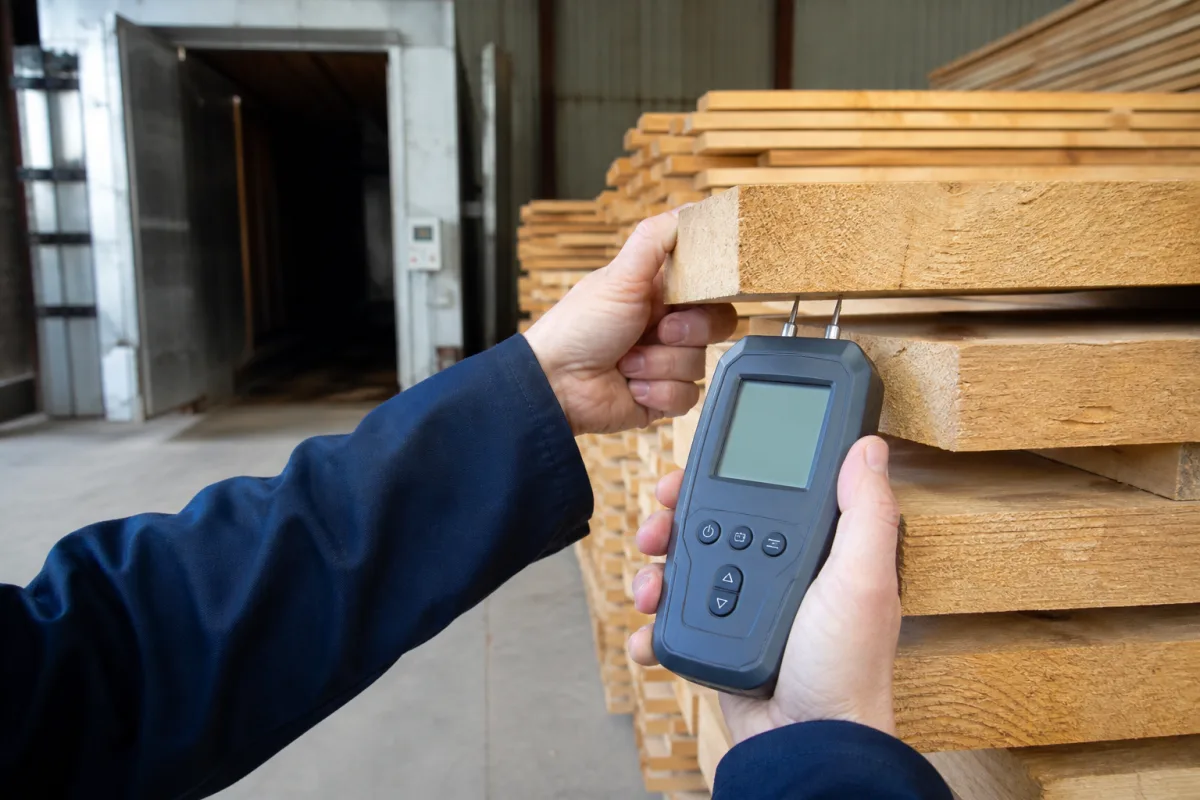
Portable digital wood moisture analyzer with Bluetooth: logging piece-by-piece checks on kiln-dried lumber
Kiln-dried lumber checks · Piece-by-piece readings against the 19% dry limit, meter accuracy at the limit, and the logged record
A portable wood moisture meter with Bluetooth sends each reading to a phone or tablet as it is taken, so a lumber check becomes a stored record of pieces, readings, times and photos rather than numbers written on a tally sheet. That matters where moisture is a pass/fail limit on every piece: kiln-dried lumber leaving a mill, arriving at a yard, or disputed on reinspection.
Handheld digital moisture meters for wood, pin or pin-and-pinless, that transmit and log readings over Bluetooth to a mobile app, used to check kiln-dried and dry lumber lots at mills, yards and building sites. How pin and pinless meters work, species and temperature corrections and oven-dry verification are covered on the Wood moisture meter (moisture content analyzer) page; in-line kiln and planer-line moisture systems are outside this page; leather meters are covered on the Leather moisture analyzer page.
CNFX editorial research · Sources checked October 12, 2026 · 4 sources
Every piece at or under 19%: what a dry or KD lumber lot has to show
The American Softwood Lumber Standard (NIST PS 20-25) defines dry lumber as lumber under nominal 5-inch thickness seasoned or dried to a maximum moisture content of 19%, and the KD grade mark as kiln dried to a maximum of 19% at the time of surfacing; lower limits apply only where certified grading rules include them. Limits are expressed as the maximum allowed in each piece, apply at shipment, at grade marking and at any reinspection, and any piece over the limit is out of compliance. [1]
In a dispute, PS 20-25 requires moisture content to be determined with a meter that complies with ASTM D4444 (laboratory calibration) and ASTM D7438 (field calibration and application). On a moisture reinspection each piece is tested, and conforming pieces are separated from those over the limit; an item stands as invoiced if 95% or more is found to be of the grade, while degrades above 5% of the board footage are kept separate as the seller's property unless otherwise agreed. Complaints have to reach the seller within 72 hours of unloading. [1]
Editorial calculation: in an item of 500 pieces of equal size, 5% of the board footage is 25 pieces; with 26 or more pieces over 19%, the wet pieces are set aside. A logged, time-stamped reading for each piece is the evidence both parties work from. [1]
PS 20-25 also allows for size change with moisture: 1% shrinkage or expansion for each four percentage points of moisture-content change (0.7% for redwood, western red cedar and northern white cedar). [1]
State the lumber species and grading rules, the moisture limit (19% or a lower certified limit), the number of pieces per lot to be logged, and what the record must contain: piece ID, reading, species setting, time and photo.
02
Meter accuracy and pin depth at the 19% limit, and what the Bluetooth module stores
Extech's MO55W reads wood from 5 to 50.0% with its pins (resistance method) and 0.1–99.9% in pinless (capacitance) mode, at 0.1% resolution, with a basic pin-mode accuracy of ±(3% of reading + 5 digits). Its 10 mm pins measure to about 8 mm depth; the pinless sensor reads to 25 mm. The DAT12 Bluetooth module logs 15,360 data points, streams to iOS and Android apps, exports to Excel, attaches photos and raises programmable high and low alarms. [2]
FLIR's MR55 pin meter, which also links over Bluetooth LE to the METERLiNK app, states wood accuracy of ±2% MC only from 7% to 29%, with 30–99% for reference only. It tunes readings through 11 material groups (groups 1–9 for wood), compensates automatically for ambient temperature, and operates at 0–50 °C. [3]
Editorial calculation: reading 5 digits as 0.5 percentage points at 0.1% resolution, the MO55W's tolerance at a reading of 19.0% is ±(0.57 + 0.5) ≈ ±1.1 points, so the true value could lie between about 17.9% and 20.1%; with the MR55's ±2% the band is 17–21%. A reading of 18% does not on its own prove a piece is under 19%, so an acceptance reading below the limit, set from the meter's stated accuracy, keeps borderline pieces out of shipped lots. [2][3]
ASTM D7438 explains why the meter's specification is not the whole story: hand-held readings are inferential, built from electrical measurements compared against a calibration, and are influenced by wood variables, environment and geometry; meters using different technologies will not necessarily give equivalent readings under the same conditions. [4]
Editorial calculation: pins reaching about 8 mm into an assumed 38 mm thick board stop short of its 19 mm mid-thickness, so the reading reflects the outer layer of each piece. [2]
Ask for accuracy across 12–22% on your species group, pin length and insulated-pin options, log capacity, export format, and which app and phone operating systems are supported.
03
What to specify for a Bluetooth wood moisture meter
Paste it into your enquiry below or into an email to a maker, then replace every bracket.
Wood: [species or species groups; thickness; kiln-dried or air-dried]
Limit: [19% or certified lower limit; acceptance reading]
Method: [pins (length, insulated) or pinless; depth]
Accuracy: [stated tolerance near the limit]
Logging: [pieces per lot; storage capacity; app; export format; photos]
Use: [mill, yard or site; temperature range]
Explore company information and manufacturing capabilities, then discuss the scope of your project with a relevant supplier.
Share this page
Compiled and source-reviewed by the CNFX editorial team.
Each manufacturer above links to the page on that company's own website where the product is listed, with the date we checked it. How we source and review
· Page last updated 13 October 2026
Buyer questions
What moisture content counts as dry lumber?
Under PS 20-25, lumber under nominal 5-inch thickness at a maximum of 19% in each piece; KD means kiln dried to a 19% maximum at surfacing. [1]
How accurate are Bluetooth pin meters near 19%?
Extech states ±(3% of reading + 5 digits) for the MO55W in pin mode; FLIR states ±2% MC from 7–29% for the MR55, so readings close to 19% need a margin. [2][3]
How many readings can a Bluetooth module store?
Extech's DAT12 module for the MO55W logs 15,360 data points and exports to Excel. [2]
Do different meters give the same reading?
Not necessarily; ASTM D7438 notes that meters using differing technologies will not necessarily provide equivalent readings under the same conditions. [4]
Sources and what still needs a direct check
Sources checked 2026-10-12. PS 20-25 is the U.S. Department of Commerce voluntary product standard for softwood lumber; ASTM D7438 is read from its published scope and significance. The two meter datasheets are from one group (Extech is a FLIR Systems brand) and describe those models only.