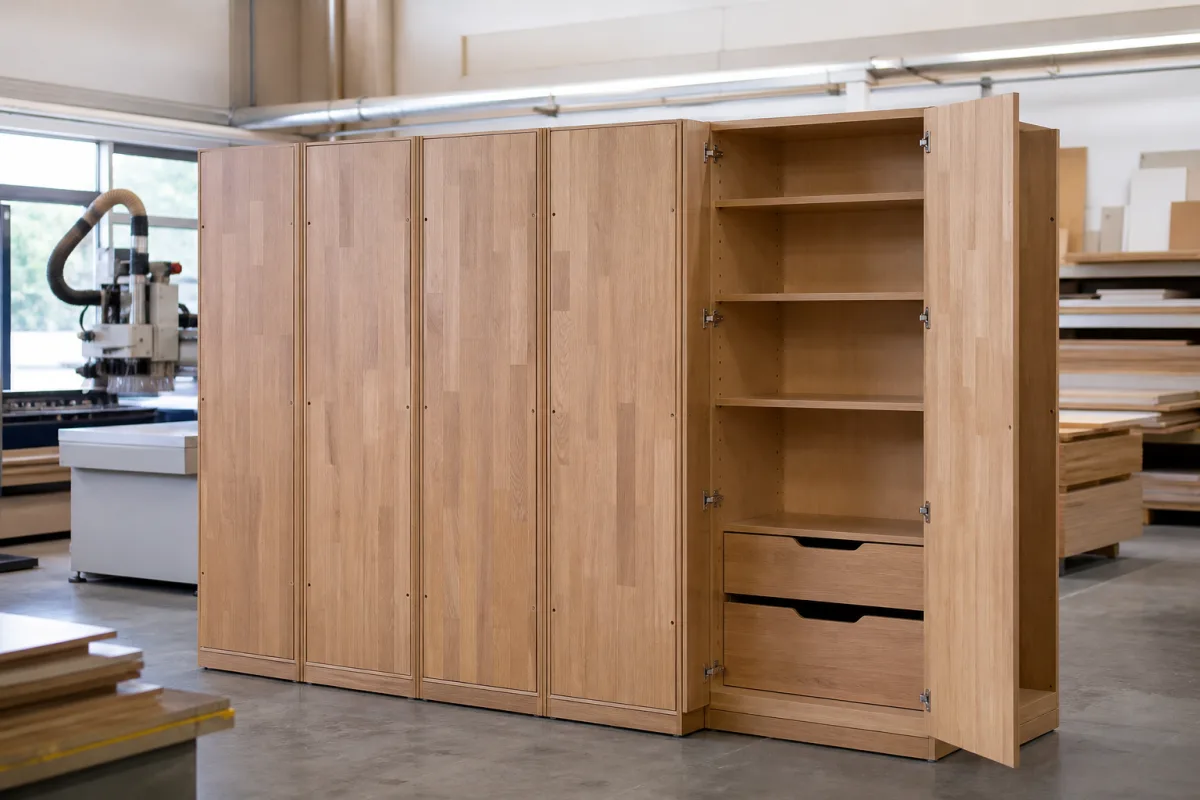
Modular panel-built storage cabinets for offices, schools and institutions · particleboard and MDF, formaldehyde emission (TSCA Title VI), sizes, shelf load, BIFMA X5.9 durability and stability, tip-over rule scope, hardware
A commercial modular storage cabinet is a free-standing cupboard built from melamine-faced particleboard or MDF panels joined with knock-down hardware, fitted with doors, adjustable shelves or drawers, and made in repeatable widths so units can be lined up or stacked in offices, classrooms, libraries and other institutions. Ask three things first: which board it is made of and what formaldehyde certification covers it, what load each shelf is rated for and to which test standard, and how the unit is kept stable against tipping.
Free-standing and stackable storage cabinets, cupboards, bookcase-style units and file storage for business and institutional use, made from particleboard, MDF or plywood panels with laminate or melamine faces, including mobile classroom cabinets. Steel cabinets, lockers, kitchen cabinetry, built-in casework, wardrobes and dressers for bedroom clothing storage are outside this page except where compared.
CNFX editorial research · Sources checked October 11, 2026 · 5 sources
In the United States, 40 CFR part 770 (TSCA Title VI) sets formaldehyde emission standards for composite wood products sold, supplied, offered for sale or manufactured on or after June 1, 2018, whether as a panel, a component part or incorporated into a finished good. The limits, based on test method ASTM E1333-14, are 0.09 ppm for particleboard, 0.11 ppm for medium-density fiberboard, 0.13 ppm for thin MDF (8 mm or less) and 0.05 ppm for hardwood plywood. [1]
A cabinet built from these boards is a finished good under the rule. Fabricators must label every finished good, or every box or bundle, with at least the fabricator's name, the month and year of production and a statement that the goods are TSCA Title VI compliant; panels themselves carry the producer's name, lot number, the EPA TSCA Title VI third-party certifier number and a TSCA Title VI certified statement. Finished goods containing no more than 144 square inches of regulated composite wood are excepted from labeling. [1]
Published cabinets show the board choices in practice: an office cabinet tested for office use is built from particleboard with melamine foil and plastic edging on its top, doors, shelves and bottom panel [4], and a mobile classroom cabinet uses a steel frame with outer and inner panels of 3/4-inch particleboard core with thermofused melamine and 3/4-inch T-mold edge banding, listing BIFMA, GreenGuard Gold and CPSIA. [5]
Editorial calculation: 3/4 inch is 0.75 × 25.4 = 19.05 mm, the panel thickness to quote against metric 18 or 19 mm board. [5]
Give the supplier the board type and thickness for carcass, shelves, doors and back panel, the face (melamine, laminate, veneer) and edge banding, the formaldehyde certification required (TSCA Title VI panel certifier and finished-good label, or the destination market's equivalent), and any indoor-air or low-emission certificate the project specifies.
02
Check shelf load, durability and stability
ANSI/BIFMA X5.9 is the US industry test standard for storage units. Intertek's summary of the 2019 edition, released on February 1, 2019, notes that it now covers vertical files, adds applicability notes for distributed functional and proof load tests, exempts storage units under 450 mm high from the stability tests, sets the horizontal force stability test for units without extendible elements at 762 mm height with 105 kg/m² on the lowest inside surface, limits the stability test for pedestals or units with a seat surface to 965 mm height, and exempts extendible elements rated under 7 kg without mechanical suspension from cycle tests. [3]
One published office cabinet states that it has been tested for office use and meets the durability and stability requirements of EN 16121 Level 2 (Severe) and ANSI/BIFMA X5.9; it lists a maximum load of 30 kg per shelf at 80 cm wide, 45 cm deep and 120 cm high, with adjustable shelves and an add-on unit for building upward. [4]
The US federal tip-over rule in 16 CFR part 1261 applies to clothing storage units — free-standing furniture intended for the storage of clothing, with bedroom furniture named as the reference type — manufactured after September 1, 2023, and requires compliance with ASTM F2057-23 to protect children up to 72 months of age. [2] Editorial note: an office or classroom storage cabinet not intended for clothing storage falls outside that definition; a wardrobe-type unit marketed for clothing should be checked against it.
Editorial calculation: at 105 kg/m², a lowest inside surface of 0.80 m × 0.45 m (the 80 × 45 cm cabinet's footprint, ignoring panel thickness) would carry about 0.80 × 0.45 × 105 ≈ 38 kg during that test. [3][4]
03
Compare what suppliers offer
The companies in the manufacturer list below show this product on their own websites. Confirm the legal seller, factory and scope for your order.
When requesting quotations, ask each supplier for module drawings, the board and formaldehyde certificates, a BIFMA X5.9 or EN 16121 test report naming the model tested, shelf load ratings, hardware specifications and assembly instructions.
04
Trace the cabinet parts
This is a functional reference built from the sources cited; it is not one maker's design.
Part
Role
Fix in the order
Carcass panels
Particleboard with melamine foil or thermofused melamine. [4][5]
Fill the specification fields with values for your project
A storage cabinet quotation needs values for your project. The table explains each field, gives published values where a reviewed source states them, and says what to obtain from the supplier.
Field
What it means and published values
Ask the supplier for
Module width
80 cm office example; 48 in classroom example. [4][5]
Explore company information and manufacturing capabilities, then discuss the scope of your project with a relevant supplier.
Share this page
Compiled and source-reviewed by the CNFX editorial team.
Published product pages show what a company offers, not tested performance. Confirm the legal seller, factory and scope for your order. How we source and review
· Page last updated 13 October 2026
Buyer questions
What formaldehyde limit applies to particleboard in a storage cabinet sold in the US?
40 CFR 770 sets 0.09 ppm for particleboard and 0.11 ppm for MDF, and the finished cabinet must carry a TSCA Title VI compliant label. [1]
Which standard tests office storage cabinets?
ANSI/BIFMA X5.9; its 2019 edition revised the stability tests and exempts units under 450 mm high. [3]
Does the federal tip-over rule cover office storage cabinets?
16 CFR 1261 covers free-standing units intended for clothing storage, with bedroom furniture as the reference type, made after September 1, 2023. [2]
Sources and what still needs a direct check
Sources checked 2026-10-11. Two US federal regulations from eCFR, a testing-laboratory summary of ANSI/BIFMA X5.9-2019 and two published cabinet specifications.