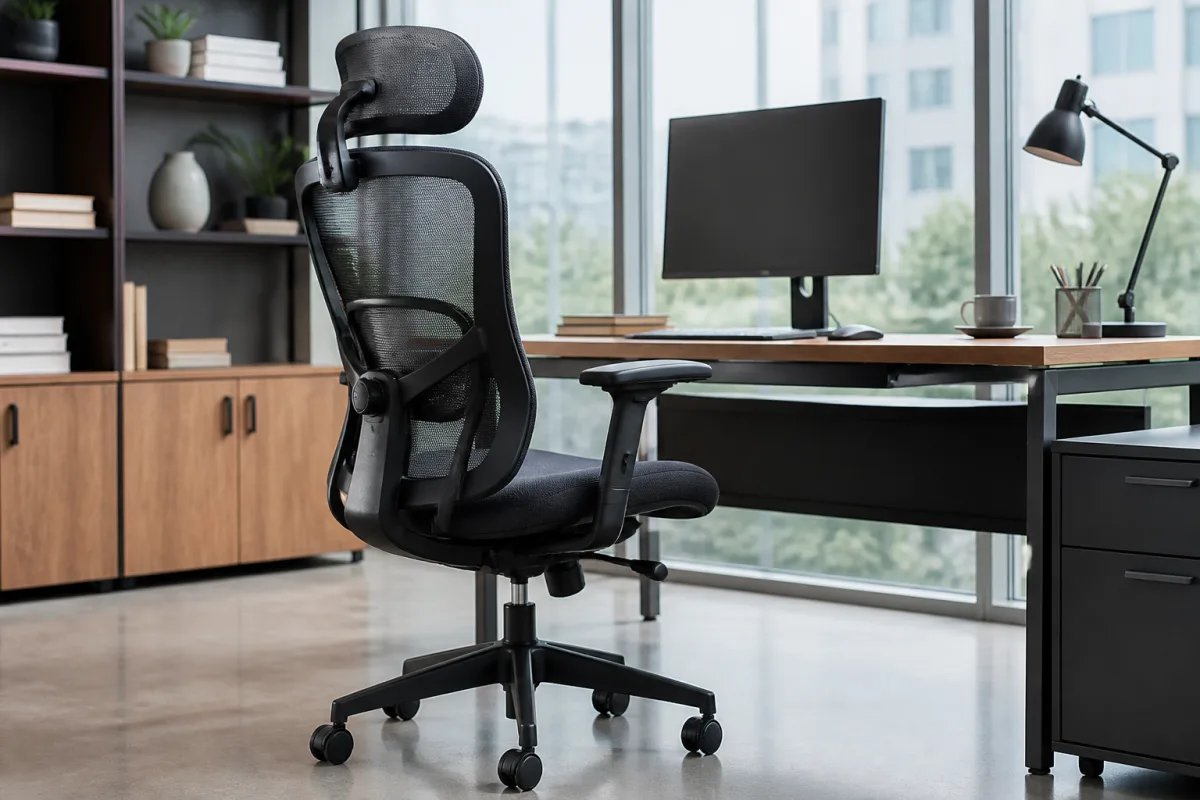
Office task chairs · Seat height and depth ranges, backrest recline and lumbar height, armrests, weight capacity
An ergonomic office chair, or task chair, is a swivel chair on a five-leg castor base whose seat, backrest and armrests adjust to fit the user and the task. Ask three things first: whether the seat height and depth ranges cover your shortest and tallest users, how far the backrest reclines and where the lumbar support can sit, and what user weight the chair is rated and tested for.
Office task chairs for computer and desk work with adjustable seat, backrest and armrests. Executive lounge chairs without task adjustments, stools, gaming chairs sold without stated ranges and laboratory chairs with special requirements are outside this page.
CNFX editorial research · Sources checked October 18, 2026 · 4 sources
The University of California’s June 2015 task-chair purchase checklist distinguishes minimum and preferred criteria. It requires at least 4.5 in of seat-height adjustment within 15–22 in above the floor. Preferred seat depth is adjustable with up to 3 in movement and a range including 16.9 in; the minimum for a fixed-depth seat is no greater than 16.9 in. Seat-pan width is at least 17.7 in. Weight capacity is at least 250 lb, with at least 275 lb preferred. These are the identified university’s procurement criteria, not a universal chair standard or a guarantee of fit for every person. [1]
CCOHS, Canada's occupational health and safety centre, gives an approximate one-quarter-of-body-height rule of thumb, explicitly warning that torso-to-leg proportions vary, says users should sit with feet on the floor or a footrest without pressure under the thighs, and recommends a five-point base for stability. [3] OSHA's computer workstation eTool asks for a seat that is height-adjustable, especially when shared, padded with a rounded 'waterfall' edge, and depth-adjustable so the front edge does not touch the back of the knee. [2]
Editorial calculation: using 25.4 mm/in, 15–22 in converts to 381–558.8 mm, 4.5 in adjustment to 114.3 mm and 16.9 in depth to about 429.3 mm. Using 0.45359237 kg/lb, 250 and 275 lb convert to approximately 113.4 and 124.7 kg. These are unit conversions of UC’s inch/pound criteria, not different metric acceptance limits. If illustrative user heights of 1.60 and 1.90 m are assumed, the CCOHS quarter-height rule gives 400 and 475 mm respectively; these are starting estimates, not manufacturer-published fit data or measurements of an individual user. Assess feet, thighs and workstation fit in person. [1][3]
Give the supplier the user population (height and weight range), task and desk height, floor type, seat height and depth ranges required, recline and lumbar adjustment, armrest adjustment, upholstery and cleaning needs, standards and test reports (e.g. ANSI/BIFMA X5.1, EN 1335), warranty and quantities.
02
Check backrest recline, lumbar position and armrests
OSHA’s workstation eTool recommends a backrest that follows the spine's natural curve with a height-adjustable lumbar support, a recline of at least 15° from vertical that locks or has adjustable tension, and armrests, if fitted, that let the shoulders relax with elbows close to the body. [2]
The UC checklist asks for a backrest top at least 17.7 in above the seat, width at least 14.2 in, and backrest and/or lumbar height adjustment within 5.9–9.8 in. Its preferred backrest-angle criterion is adjustment of 15° or more within 90–120°, with a headrest necessary above 120°; its minimum is an upright 90° position or a position to its rear. These minimum and preferred criteria are distinct. The minimum lock criterion is locking in different positions; freely moving with user-adjustable resistance is preferred. [1] CCOHS advises adjusting or removing armrests if they prevent sitting close to the desk. [3]
UC’s preferred armrest-height range extends from at least 6.7 to 10.6 in above the seat; its minimum is adjustable height within that interval. It asks for at least 18.1 in clearance between armrests, with inward/outward adjustment and pivot preferred. Editorial calculation using 25.4 mm/in: the lumbar interval is about 149.9–248.9 mm, armrest interval 170.2–269.2 mm, minimum backrest width 360.7 mm and armrest clearance 459.7 mm. Keep the original inch criteria when specifying acceptance. [1]
03
Compare a maker's user-weight rating and recline stops with procurement minimums
Steelcase's product page for its Leap task chair states that the chair is durable enough for users up to 400 lb, that the Leap stool is rated to 300 lb, and that the Leap Plus version supports users up to 500 lb with the same functions. The recline range includes full recline with four recline-angle stop settings and an upright back lock, and the back resistance is set manually. Lumbar support is height-adjustable as standard with a separate lower-back firmness control; the LiveBack backrest is designed to change shape with the spine, and the Natural Glide System moves the seat forward as the user reclines so the distance to the work surface stays the same. Arms are offered as armless or height-adjustable with further adjustable options, and the adjustment labels are in English and Braille. [4]
Editorial calculation: using 0.45359237 kg/lb, the published 400, 500 and 300 lb ratings convert to approximately 181.4, 226.8 and 136.1 kg respectively. These are conversions of Steelcase’s differently identified chair, Plus and stool ratings, not new test results or proof of compliance with the UC checklist. A count of recline stops does not establish the angle at each stop or demonstrate OSHA’s 15° recommendation. Request the actual recline angles, adjustment ranges and the applicable test basis for the offered variant. [4][1][2]
Match the offered chair model to the intended users
The UC checklist calls for evaluation of each chair under consideration and allows local ergonomics review for chairs outside its stated criteria. [1]
Obtain measured adjustment ranges, the identified chair variant and its weight-rating test evidence. A supplier’s executive, meeting or lounge seating range alone does not select a task chair for a shared workstation. [1][3]
05
Check seat travel, lumbar adjustment and floor-compatible castors
The seat, backrest, armrests and base have separate adjustment and fit requirements in the UC checklist and OSHA guidance. [1][2]
Record minimum and preferred adjustment criteria separately
UC’s 2015 checklist distinguishes a minimum from a preferred adjustment span. Inch and pound entries below preserve its original criteria; the metric equivalents elsewhere are editorial conversions. [1]
Field
What it means and published values
Ask the supplier for
Seat height adjustment range (in)
UC: at least 4.5 in adjustment within 15–22 in from floor. [1]
Measured range.
Backrest tilt angle (degrees)
OSHA recommends at least 15° from vertical, lockable or tension-adjustable. UC’s 15° criterion is preferred, not its minimum. [2][1]
3 companies list this product among what they make. Company figures are quoted from each
company's own website; every card states where the relationship came from.
Foshan Aston Furniture Co., Ltd.
TBC
Lists ergonomic office chairs within a range of office furniture.
Explore company information and manufacturing capabilities, then discuss the scope of your project with a relevant supplier.
Share this page
Compiled and source-reviewed by the CNFX editorial team.
Each manufacturer above links to the page on that company's own website where the product is listed, with the date we checked it. How we source and review
· Page last updated 18 October 2026
Buyer questions
What seat height range should a task chair have?
UC requirements ask for at least 4.5 in of adjustment within 15–22 in from the floor. [1]
How far should an office chair recline?
OSHA’s eTool recommends at least 15° from vertical, with a lock or adjustable tension. UC’s checklist instead distinguishes preferred adjustment of 15° or more within 90–120° from a minimum upright or rear-of-upright position. [2][1]
How do I pick seat height for a user?
CCOHS gives an approximate quarter-of-body-height rule of thumb and explicitly warns that torso-to-leg proportions vary. Check actual seating and workstation fit; it is not an individual fit guarantee. [3]
What weight capacity should a task chair have?
UC asks for at least 250 lb, preferably 275 lb. [1]
What user weight should an ergonomic office chair be rated for?
The UC checklist gives at least 250 lb minimum and at least 275 lb preferred. Steelcase identifies up to 400 lb for Leap and up to 500 lb for Leap Plus. Select the variant and test basis for the actual user population. [1][4]
Sources and evidence scope
Sources checked 2026-10-18. The UC requirements are a public university's purchasing criteria citing ANSI/HFES and ANSI/BIFMA; OSHA and CCOHS are government and public occupational health guidance. The standards themselves govern tests.