Wood moisture measurement · Pin versus pinless meters, species and temperature corrections, oven-dry reference, meter uncertainty at acceptance limits
A wood moisture meter estimates the moisture content (MC) of lumber, panels and furniture parts from an electrical property of the wood, either the resistance between pins driven into it or the dielectric response under a surface sensor. Furniture and joinery plants use handheld meters and in-line systems to accept incoming lumber and check parts before machining and finishing. Ask three things first: whether a pin or pinless meter suits your wood and range, which species, density and temperature corrections it applies, and how its readings compare with oven-dry values near your acceptance limits.
Handheld and in-line electric moisture meters for wood and wood products. Hygrometers for air, moisture meters for concrete, grain or hay, and laboratory oven-drying balances are outside this page.
CNFX editorial research · Sources checked October 11, 2026 · 4 sources
The University of Wisconsin Extension guide by Boone and Wengert explains that pin (resistance) meters measure resistance between electrodes driven into the wood and read the wettest zone touching the uninsulated pin; their effective range is 7–30% MC. Below 7% resistance is too high for reliable readings (about 15,000 megohms for red oak and 72,000 for hard maple at 7% MC), and above 30% it varies too much. Pinless (dielectric) meters project a field from a surface plate and read about 5–30% MC, averaging the cross-section of lumber up to about 2 in thick. [1]
For pin meters the guide advises measuring at least 1 ft from the end, with pins parallel to the grain above 15% MC, and driving insulated pins to 1/5–1/4 of the thickness for average MC or to the centre for core MC; readings at different depths from surface to core show whether moisture gradients exist. For pinless meters it advises full sensor-plate coverage and no metal rollers or supports behind the board. [1]
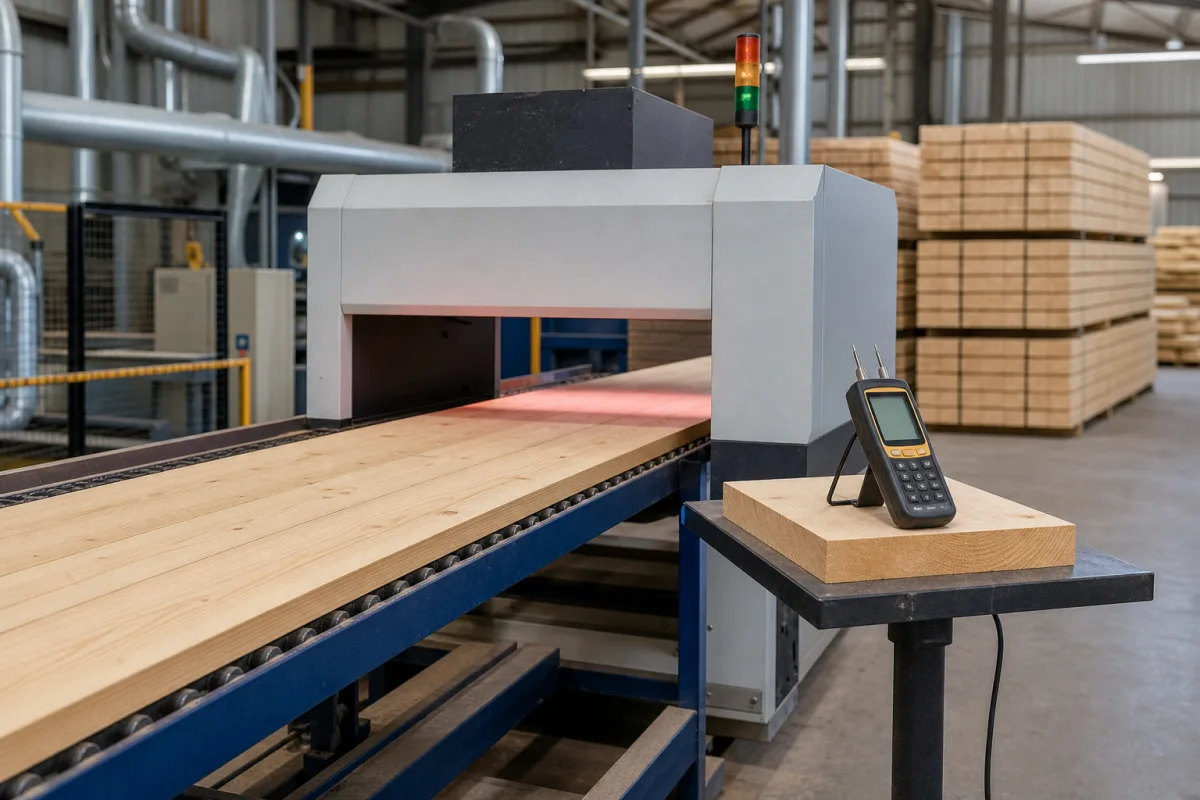
Editorial note: in-line meters on a conveyor work on the same electrical principles and need the same species, density and temperature settings; ask the supplier how their calibration was made and checked.
Give the supplier the species and density range, thickness, MC range to measure (for example your kiln target and acceptance limits), whether readings are on lumber, panels or finished parts, wood temperature range, handheld or in-line use, line speed for in-line systems, data logging and interface, and the reference method (oven-dry) used to check it.
02
Apply species, density and temperature corrections
The Wisconsin guide says "Meters are usually calibrated for 70-80°F" and that corrections should be made when lumber is 20 °F or more above or below; for pin meters, "Species corrections are usually very slight (1% MC or less) for most North American woods" but can be greater for some tropical woods, and "Most meters sold in the U.S. are factory calibrated for Douglas-fir or for Southern pine". Pinless meters can be heavily influenced by specific gravity, so their species or density setting must be used. [1]
The guide warns against readings on wet surfaces, on meters brought cold into a hot humid kiln (condensation can read about 10% MC or more), in very dry air below about 30% RH where static charge disturbs pin meters, and on wood treated with water-borne salt preservatives or fire retardants. [1]
A CSIRO study for Australia's Forest and Wood Products Research and Development Corporation produced new species and CCA corrections for radiata and slash pine. In the 8–15% MC range, 95% of readings from the resistance-type meter tested (Deltron DCR22) fell within ±1.0% (near 8%) to ±3.0% (near 15%) of oven-dry MC, while the capacitance meters tested (Wagner L612, Brookhuis FMW) fell within ±3.0% to ±4.0%; density explained about half of the remaining uncertainty for the L612 on radiata pine. [3]
03
Use the oven-dry reference and allow for uncertainty
OIML Recommendation R 92 makes oven drying the reference for verifying wood-moisture meters: samples dried at (103 ± 2) °C for up to 20 h, weighed to ±0.001 g, with moisture U = (m1 − m2)/(m2 − m0) × 100%, where m0 is the weighing vessel, m1 the vessel with the moist sample and m2 the vessel with the dried sample; moisture on a wet-mass basis is W = U/(100 + U) × 100%. [2]
The CSIRO report shows why uncertainty matters at acceptance limits: a board reading 14% with a ±1.5% meter could be 12.5–15.5% oven-dry, and with ±4.0% anything from 10% to 18%. In its example of 1,000 boards against an 8–15% limit, where 5 boards truly fail, rejecting by meter reading would reject 20 boards with a ±1.5% meter, 72 with ±3.0% and 125 with ±4.0%. [3]
Editorial calculation with OIML's formula: wood at 12% MC on a dry basis is 12/112 × 100 ≈ 10.7% on a wet-mass basis, so confirm which basis a meter and a specification use.
04
Handheld pin and pinless meters among the listed instrument makers
The suppliers reviewed list handheld pin or inductive (pinless) meters among general test instruments; ask each for the range, species or density settings, temperature correction, accuracy against oven-dry values and calibration check device.
05
Correct pin readings for wood temperature and insulated pins
Delmhorst, a moisture meter maker, publishes manual correction tables for its meters that do not have corrections built in. It uses Douglas fir, the USDA standard, as the basis for all its wood calibrations. Its temperature section says there is "no need to apply a correction" when the wood is between 50 °F/10 °C and 90 °F/32 °C, yet the temperature table on the same page still lists corrected values inside that band: at 60 °F/15 °C a reading of 10 corrects to 11 and 20 to 21, and at 80 °F/30 °C 10 corrects to 9 and 20 to 19. As wood temperature rises its electrical resistance falls and the indicated moisture content rises; colder wood reads lower. [4]
The table below gives corrected readings from its temperature table. Its default pin calibration was made with non-insulated pins that penetrate 5/16 inch; insulated pins such as the 26-ES electrode read slightly lower, so a reading of 12 corrects to 12.8 and a reading of 20 to 21.4. Its pinless TechScan meter is calibrated for wood at a specific gravity of 0.46, so other species need a correction; its look-up list gives 0.56 for red oak and 0.36 for white pine. [4]
Editorial note: Delmhorst's text and its own table disagree for wood between 50 °F and 90 °F, and both are reproduced here as published; ask Delmhorst or the meter's supplier which one applies, and ask each supplier for the correction tables of the meter quoted and for the electrode they were made with.
Wood temperature (row as listed)
Meter reading 10 → corrected
Meter reading 20 → corrected
−20 °C / 0 °F
15
31
15 °C / 60 °F
11
21
40 °C / 100 °F
8
17
60 °C / 140 °F
7
14
06
Pins, hammer probe, sensor plate, species setting and temperature correction
All six rows follow the Wisconsin guide; Delmhorst's tables above show what the temperature-correction row has to cover on a meter without built-in correction. [1][4]
Range, accuracy against oven-dry, wood temperature and measuring depth for a wood moisture meter
Range, accuracy and measuring depth carry published figures from the Wisconsin guide and the CSIRO tests; response time, resolution, battery life and IP rating have to come from the supplier's data sheet. [1][3]
3 companies list this product among what they make. Company figures are quoted from each
company's own website; every card states where the relationship came from.
Shenzhen GVDA Technology Co., Ltd.
Manufacturing site to be confirmed for the order
Lists wood moisture meters among measuring instruments.
Explore company information and manufacturing capabilities, then discuss the scope of your project with a relevant supplier.
Share this page
Compiled and source-reviewed by the CNFX editorial team.
Each manufacturer above links to the page on that company's own website where the product is listed, with the date we checked it. How we source and review
· Page last updated 13 October 2026
Buyer questions
What range do wood moisture meters cover?
The Wisconsin guide gives pin meters 7–30% MC and pinless meters about 5–30% MC. [1]
When do wood moisture meter readings need temperature correction?
When wood is about 20 °F or more away from the 70–80 °F calibration temperature. [1]
What is the reference method for wood moisture content?
Oven drying at (103 ± 2) °C and weighing, as used in OIML R 92 to verify meters. [2]
How much does cold or hot wood change a pin meter reading?
In Delmhorst's temperature correction table, a reading of 20 corresponds to 31 on wood at 0 °F (listed with −20 °C) and to 17 at 100 °F (40 °C). Delmhorst's text says no correction is needed between 50 °F and 90 °F, but the same table lists 20 → 21 at 60 °F (15 °C); confirm with Delmhorst which applies to the meter quoted. [4]
Sources and what still needs a direct check
Sources checked 2026-10-11. The University of Wisconsin Extension guide and the CSIRO report are research and extension publications; OIML R 92 is an international legal-metrology recommendation. Your acceptance rules should follow the standard named in your purchase contract.