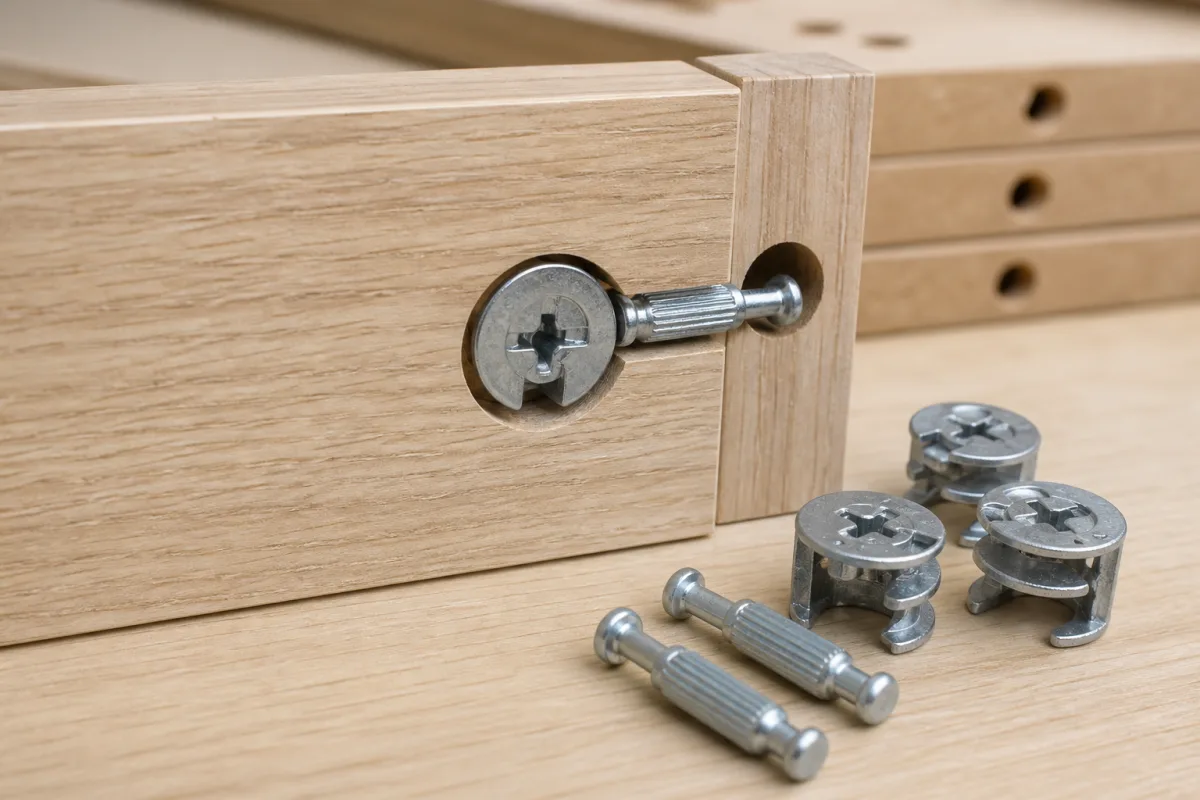
Furniture cam connectors (cam lock and connecting bolt) for knock-down panel furniture · housing diameter, panel thickness and drilling depth, drilling distance 24 or 34 mm, bolt thread, zinc alloy and finishes, tightening travel, joint strength
A furniture cam lock is a two-part knock-down connector: a round cam housing sits in a bore in the face of one panel, and a connecting bolt (dowel) screwed into the edge or face of the mating panel is drawn in and locked when the housing is turned. It joins chipboard, MDF and solid-wood panels in cabinets, wardrobes and flat-pack furniture that must be assembled and taken apart again. Ask three things first: which housing diameter and drilling depth suit your panel thickness, which drilling distance and bolt thread your drilling pattern uses, and what joint strength data the supplier can show for your board.
Cam (eccentric) connector housings in zinc alloy or plastic and their connecting bolts and dowels for panel furniture, including Ø12 mm and Ø15 mm housings, rimmed and rimless types, and bolts for 24 mm and 34 mm drilling distances. Confirmat screws, shelf supports, lightweight-panel inserts, bed fittings and cam locks for cabinet doors and drawers (keyed locks) are outside this page except where compared.
CNFX editorial research · Sources checked October 11, 2026 · 4 sources
Match housing diameter, panel thickness and drilling distance
Häfele's furniture fittings catalogue gives a complete drilling pattern for its Minifix cam connectors. The Minifix 15 housing is Ø15 mm, made of zinc alloy, for a minimum wood thickness of 12 mm, with drilling depths of 9.5–22.5 mm set by the housing chosen and the panel thickness. The bolt hole is Ø5, 7 or 8 mm depending on the connecting bolt, and drilling distance B — from the centre of the housing to the panel's front edge — is 24 or 34 mm, also set by the bolt. Dimension A, from the bolt-hole centre to the housing's top edge, is 6 mm. The smaller Minifix 12 housing is Ø12 mm, zinc alloy, for wood from 12 mm, with a 9.5+0.2 mm drilling depth. [1]
For rimless Minifix 15 housings Häfele lists drilling depth against minimum wood thickness: 15 mm → 12.0+0.5 mm, 16 mm → 12.5+0.5 mm, 18 mm → 13.5+0.5 mm, 19 mm → 14.0+0.5 mm, 23 mm → 16.5+0.5 mm, 26 mm → 18.5+0.5 mm and 29 mm → 19.5+0.5 mm; a rimmed housing for 34 mm wood is drilled 22.5+0.5 mm deep with dimension A of 17.0 mm. Finishes listed are zinc alloy bright, black and nickel plated. [1]
Titus's 2022 cabinet connector catalogue shows the same 24/34 mm pattern: its Quickfit dowels come in 5, 8 and 10 mm diameters and 24 and 34 mm lengths and are compatible with Titus Ø15 mm cams, and its Cam5000 is a Ø15 mm cam made of zinc, with drilling depth tabulated against panel thickness. [2] Häfele's Red Jig drilling jig, offered with a Minifix 12/15 drill guide and a 15 mm multi-spur drill bit, is described as adapted to system 32 with a 5 mm hole system. [3]
Editorial calculation: in a 19 mm panel the rimless Ø15 mm housing is drilled 14.0 mm deep, leaving 19 − 14.0 = 5.0 mm of board below the housing; in a 16 mm panel the 12.5 mm depth leaves 3.5 mm. [1]
Give the supplier the panel material and thickness, housing diameter (Ø12 or Ø15 mm), rim or rimless, drilling depth, drilling distance (24 or 34 mm), bolt type and thread (special thread for a Ø5 mm hole, M6 thread, spreading or capped bolt), bolt-hole diameter, drive (PZ2, flat blade, hexagon), finish, cover caps, packing and quantity.
02
Check tightening travel and joint strength
Häfele describes its Minifix housings as giving more than 5 mm of tightening travel from half a turn, compensating drilling-distance tolerances from +1 mm to approx. −0.5 mm. Its clockface divides the travel into a closing distance of 0°–75° (3.2 mm pull), a tightening distance of 75°–165° (2 mm pull, with tightening starting at 120° when the specified drilling distance is held) and a retightening distance of 165°–195° (0.5 mm pull) for drilling tolerances, repeated disassembly or heavy loading. [1] Titus lists a drilling tolerance of +1/−1 mm for its Quickfit TL dowels and a lock position at 2 o'clock for its cams, and offers zinc+steel combi dowels whose steel neck and head are described as resisting torsion and pull-out. [2]
Janíková et al. (2025) tested L-shaped joints of 18 mm three-layer particleboard (type P2 to EN 312) at an 8 mm/min feed rate, using Minifix 15 housings (262.26.034) with unglued beech dowels and different bolts. Mean maximum bending moment was 19 Nm in compression and 16 Nm in tension with the S100 steel bolt, 18 Nm and 16 Nm with the S200 bolt, 15 Nm and 14 Nm with an M4 bolt in an insert nut, and 47 Nm and 31 Nm with a capped bolt. [4]
None of the reviewed catalogues publishes a pull-out or tensile rating in newtons for cam connectors; Häfele marks pull-out strength only as a selection category and Titus recommends assessment by testing in the application. [1][2]
Editorial calculation: the three Häfele clockface segments add to 3.2 + 2 + 0.5 = 5.7 mm of pull, consistent with the stated travel of more than 5 mm. [1]
03
Drawings, finishes and joint test data to ask each cam-lock bidder for
When requesting quotations, ask each supplier for housing and bolt drawings with drilling patterns, material and finish, the panel thicknesses covered, and any joint or pull-out test report with the board type and test method stated.
04
Cam housing, connecting bolt, spreading dowel, wooden dowels, cover cap and drilling jig
Housing and bolt work as a pair, and the bolt sets the 24 or 34 mm drilling distance, so order them as one matched set rather than by housing alone. [1]
Part
Role
Fix in the order
Cam housing
Ø12 or Ø15 mm zinc-alloy or plastic body set in the panel face. [1][2]
Diameter, rim, depth.
Connecting bolt or dowel
Steel or zinc+steel; 24 or 34 mm drilling distance. [1][2]
Thread, length, hole Ø.
Spreading dowel
Plastic dowel spread by the bolt taper (Minifix C100). [1]
Hole Ø8 or 10 mm.
Wooden dowels
Beech dowels used alongside the cam in tested joints. [4]
Housing diameter, bolt thread, drilling depth, finish, tolerance and joint strength for a cam-lock order
The joint-strength row has no catalogue rating to copy: the only figures are bending moments of 14–47 Nm measured in 18 mm particleboard, and Titus leaves strength assessment to testing in the application. [4][2]
Field
What it means and published values
Ask the supplier for
Cam diameter
Ø15 mm (Minifix 15, Titus Cam5000); Ø12 mm (Minifix 12). [1][2]
Housing Ø and bore Ø.
Thread size
Special thread for Ø5 mm hole, or M6 thread (Minifix S100/S200). [1]
Thread, length L.
Engagement depth
Drilling depth 9.5–22.5 mm by panel thickness. [1]
Depth for your board.
Torque capacity
Not stated in reviewed sources.
Breaking torque, N·m.
Operating temperature
Not stated in reviewed sources.
Range, °C.
Cycle life
Not stated in reviewed sources; Häfele cites secure tightening after repeated disassembly. [1]
Tested cycles.
Material
Zinc-alloy housing; steel or galvanized steel bolts. [1]
Explore company information and manufacturing capabilities, then discuss the scope of your project with a relevant supplier.
Share this page
Compiled and source-reviewed by the CNFX editorial team.
Each manufacturer above links to the page on that company's own website where the product is listed, with the date we checked it. How we source and review
· Page last updated 13 October 2026
Buyer questions
What drilling distance does a cam lock use?
Häfele's Minifix uses 24 or 34 mm from the housing centre to the panel edge, set by the bolt; Titus dowels come in 24 and 34 mm lengths. [1][2]
How thick must the panel be for a 15 mm cam housing?
Häfele lists the Minifix 15 housing for wood from 12 mm, with drilling depth rising from 12.0 mm at 15 mm to 19.5 mm at 29 mm. [1]
How strong is a cam lock joint?
In 18 mm particleboard, Minifix 15 joints with beech dowels reached 14–19 Nm with standard bolts and 31–47 Nm with a capped bolt. [4]
Sources and what still needs a direct check
Sources checked 2026-10-11. Two maker catalogues (Häfele, Titus), a Häfele drilling-jig catalogue page and an open-access joint-strength study.