Strukturierte Fertigungsdaten · 2026

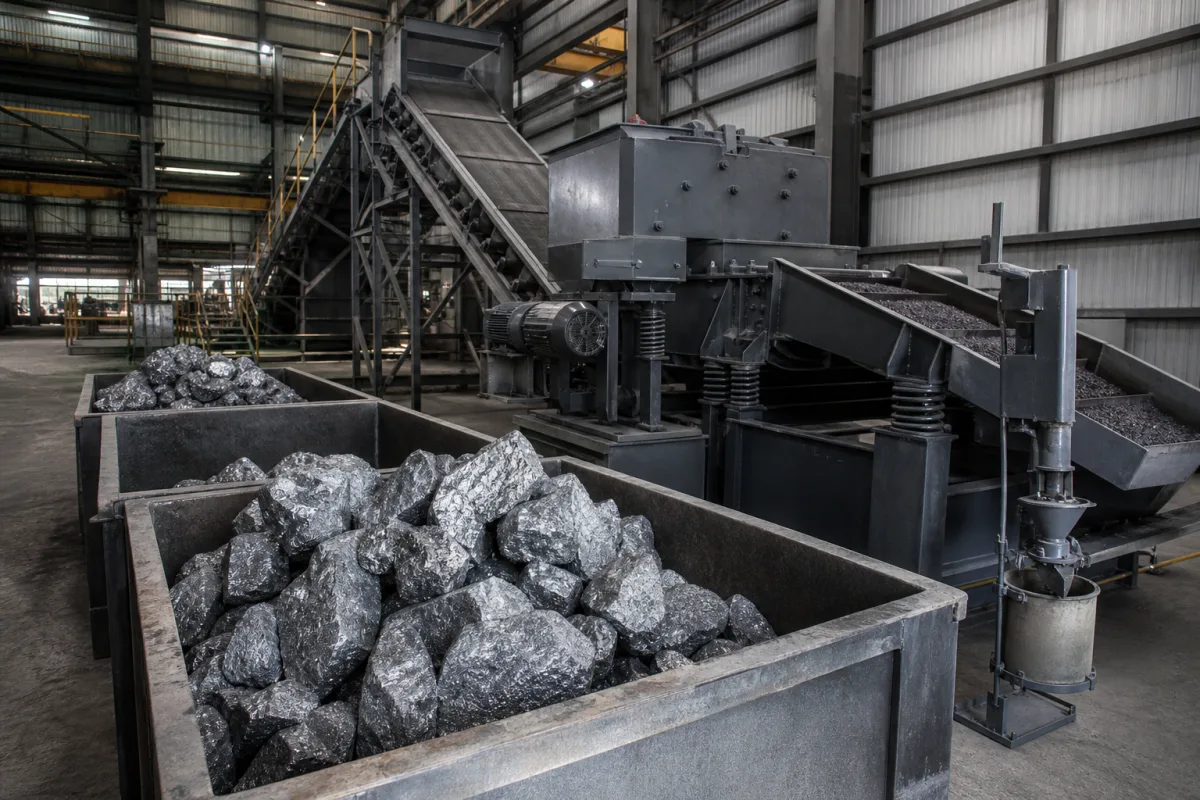
High-Purity Ferrosilicon Alloy

Auf Basis strukturierter CNFX-Herstellerprofile wird High-Purity Ferrosilicon Alloy im Bereich Grundmetallherstellung anhand von Siliziumgehalt bis Eisengehalt eingeordnet.

Technische Definition und Kernbaugruppe

Ein typisches High-Purity Ferrosilicon Alloy wird durch die Baugruppe aus Siliziummatrix und Eisenmatrix beschrieben. Für industrielle Anwendungen werden Materialauswahl, Fertigungsprozess und Prüfbarkeit gemeinsam bewertet.

High-purity iron-silicon alloy for steelmaking and foundry applications

Technische Definition

High-purity ferrosilicon is a critical deoxidizing and alloying agent in steel production, manufactured through carbothermic reduction of quartz and iron ore in submerged arc furnaces. This material effectively removes oxygen from molten steel while introducing silicon to enhance mechanical properties like strength and elasticity. It serves as a nucleating agent in ductile iron production, promoting graphite nodule formation for improved castability and machinability. The high-purity grade minimizes impurities that could compromise final product quality in demanding applications.

Funktionsprinzip

Acts as a strong deoxidizer through silicon's high affinity for oxygen, forming stable silica slag while simultaneously alloying steel with silicon to modify microstructure and properties.

Technische Parameter

Technical Parameters
  • Siliziumgehalt(%) Primäres Legierungselement in Gewichtsprozent
  • Eisengehalt(Masse-%) Eisengehalt in der Legierungszusammensetzung
  • Kohlenstoffgehalt(%) Maximaler Kohlenstoffverunreinigungsgrad
  • Aluminiumgehalt(ppm) Maximale Aluminium-Verunreinigungs-Konzentration
  • Korngrößenverteilung(mm) Standardgrößenbereich für industrielle Anwendungen
  • Schüttdichte(g/cm³) Scheinbare Dichte für Handhabungs- und Lagerberechnungen

Hauptmaterialien

Silicon Iron Carbon

Komponenten / BOM

Components / BOM
  • Siliziummatrix
    Primäres Desoxidations- und Legierungselement
    Material: Kristallines Silizium
  • Eisenmatrix
    Grundmetall zur Gewährleistung der strukturellen Integrität
    Material: Metallisches Eisen
  • Spurenelemente
    Nebenelemente, die die endgültigen Stahleigenschaften beeinflussen
    Material: Verschiedene metallische Verunreinigungen

FMEA · Fehleranalyse

Ursache → Fehlermodus → Engineering-Maßnahme

Incomplete reduction of silica (SiO2) in submerged arc furnace at temperatures below 1900°C Silicon content drops to 73.2 wt%, aluminum contamination rises to 0.08 wt% Install optical pyrometer with ±10°C accuracy for real-time furnace temperature control, implement XRF analyzer for hourly composition verification
Carbon electrode degradation during smelting, releasing 0.04 wt% carbon into alloy Carbon content increases to 0.045 wt%, steel yield strength rises by 22 MPa beyond specification Use graphite electrodes with ash content <0.5%, implement electrode immersion depth control within ±5 cm of optimal position

Technische Bewertung

Betriebsbereich
Betriebsbereich
Silicon content: 74.5-76.5 wt%, Iron content: 23.5-25.5 wt%, Impurity limits: Al <0.02 wt%, Ca <0.01 wt%, C <0.02 wt%, P <0.02 wt%, S <0.005 wt%
Belastungs- und Ausfallgrenzen
Silicon content deviation >±0.5 wt% from target specification, Aluminum contamination >0.05 wt%, Carbon contamination >0.03 wt%
Silicon content deviation beyond ±0.5 wt% alters liquidus temperature by >15°C, causing improper deoxidation kinetics in steel (Si-O equilibrium shift). Aluminum contamination >0.05 wt% forms refractory Al2O3 inclusions with melting point 2072°C, disrupting steel fluidity. Carbon contamination >0.03 wt% increases steel's yield strength by >15 MPa through interstitial solid solution strengthening, exceeding design limits.
Fertigungskontext
High-Purity Ferrosilicon Alloy wird innerhalb von Grundmetallherstellung nach Material, Prozessfenster und Prüfanforderungen bewertet.

Weitere Produktbezeichnungen

ferro silicon FeSi alloy silicon iron steelmaking ferroalloy

Taxonomie und Suchbegriffe

Suchbegriffe, Aliase und technische Bezeichnungen für diesen CNFX Datensatz.

Industrielles Ökosystem und Lieferkette

Eignung und Auslegungsdaten

Betriebsgrenzen
Traglast:Atmospheric to 1.5 bar (standard ladle treatment conditions)
other spec:Silicon content: 65-90%, Particle size: 10-100mm, Slurry concentration: Not applicable (solid addition)
Einsatztemperatur:Up to 1600°C (melting point dependent on silicon content)
Montage- und Anwendungskompatibilität
Carbon steel ladle deoxidationStainless steel silicon adjustmentDuctile iron inoculation
Nicht geeignet: High-moisture environments (risk of hydrogen pickup)
Auslegungsdaten
  • Required silicon addition (kg/ton of steel)
  • Target final silicon content (%)
  • Melt temperature and ladle capacity

Zuverlässigkeits- und Risikoanalyse

Ausfallmodus und Ursache
Thermal fatigue cracking
Cause: Rapid temperature cycling during alloy production causes differential expansion/contraction stresses in the ferrosilicon structure, leading to crack initiation and propagation.
Silicon segregation and phase transformation
Cause: Improper cooling rates or temperature control during solidification causes uneven silicon distribution, creating brittle phases and reducing mechanical integrity.
Wartungsindikatoren
  • Visible surface discoloration or oxidation spots indicating abnormal thermal exposure
  • Audible cracking or popping sounds during cooling cycles suggesting internal stress relief
Technische Hinweise
  • Implement controlled cooling protocols with gradual temperature gradients to minimize thermal shock and prevent phase transformation issues
  • Use non-destructive testing (ultrasonic or eddy current) at regular intervals to detect early-stage microcracks before they propagate to critical failure

Compliance & Manufacturing Standards

Reference Standards
ISO 5445:2020 Ferrosilicon - Specification and conditions of deliveryASTM A100-09(2020) Standard Specification for FerrosiliconDIN 17560-1:2017-08 Ferrosilicon - Technical delivery conditions
Manufacturing Precision
  • Silicon content: +/- 1.0%
  • Particle size distribution: +/- 5% of specified range
Quality Inspection
  • Chemical composition analysis via optical emission spectrometry
  • Particle size distribution test via sieve analysis

Hersteller, die dieses Produkt fertigen

Herstellerprofile mit passender Produktionsfähigkeit in China.

Die Herstellerliste dient der Vorrecherche und Einordnung von Fertigungskapazitäten. Sie ist keine Zertifizierung, kein Ranking und keine Transaktionsgarantie.

Beispielhafte Bewertungskriterien aus Einkaufsprozessen

Keine Kundenbewertung und keine Echtzeitdaten. Die Werte zeigen typische Prüfkriterien in RFQ- und Lieferantenbewertungsprozessen.

Technische Dokumentation
4/5
Fertigungsfähigkeit
4/5
Prüfbarkeit
5/5
Lieferantentransparenz
3/5

Die Kriterien dienen als Orientierung für technische Einkaufsprüfungen. Konkrete Kunden, Länder, Bewertungsdaten oder Live-Nachfragen werden nur angezeigt, wenn entsprechende belastbare Daten vorliegen.

Supply ChainRelated Products and Components

Legierungsstation

Eine spezialisierte Station innerhalb eines integrierten Schmelzsystems, in der die präzise Legierung von Nichteisenmetallen durch kontrollierte Zugabe von Legierungselementen erfolgt.

Spezifikationen ansehen ->
Atmosphärenregelsystem

Ein System, das die spezifische Gaszusammensetzung in einem Wärmebehandlungsofen regelt und aufrechterhält, um gewünschte metallurgische Eigenschaften zu erzielen.

Spezifikationen ansehen ->
Atmosphärensystem

Ein System, das in einem industriellen Wärmebehandlungsofen eine kontrollierte Gasatmosphäre erzeugt und aufrechterhält, um Oxidation zu verhindern, spezifische chemische Reaktionen zu ermöglichen oder gewünschte Materialeigenschaften während der thermischen Behandlung zu erreichen.

Spezifikationen ansehen ->
Automatische Längenschneideinheit

Ein Präzisionsschneidsystem, das automatisch Nichteisenmetallbänder oder -bleche auf vorgegebene Längen innerhalb einer Stranggieß- und Walzanlage misst und schneidet.

Spezifikationen ansehen ->

Häufige Fragen

What are the main applications of high-purity ferrosilicon alloy?

High-purity ferrosilicon alloy is primarily used in steelmaking as a deoxidizer and alloying agent, and in foundries for producing cast iron with improved mechanical properties and fluidity.

How does aluminum content affect ferrosilicon alloy performance?

Low aluminum content (measured in ppm) in ferrosilicon alloy reduces slag formation, improves steel cleanliness, and enhances alloy recovery rates during steelmaking processes.

What particle size distribution is optimal for foundry applications?

For foundry applications, ferrosilicon alloy typically requires controlled particle size distribution (measured in mm) to ensure proper dissolution rates, uniform distribution in molten metal, and minimal dust generation during handling.

Kann ich Hersteller direkt kontaktieren?

CNFX ist ein offenes Verzeichnis, keine Handelsplattform und kein Beschaffungsagent. Herstellerprofile und Formulare helfen bei der Vorbereitung des direkten Kontakts.

CNFX Industrial Index v2.6.05 · Grundmetallherstellung

Datenbasis

CNFX-Herstellerprofile, technische Klassifikation, öffentlich verfügbare Produktinformationen und fortlaufende Plausibilitätsprüfung.

Vorläufige technische Einordnung
Diese Seite dient der strukturierten Vorbereitung von Recherche, RFQ und Lieferantenbewertung. Sie ersetzt keine Lieferantenqualifizierung, keine Normenprüfung und keine technische Freigabe durch den Käufer.

Beschaffungsinformationen anfragen für High-Purity Ferrosilicon Alloy

Informationen zu Einsatzbereich, Spezifikationsgrenzen, Lieferantentypen und RFQ-Vorbereitung anfragen.

Ihre Geschäftsdaten werden nur zur Bearbeitung dieser Anfrage verwendet.

Vielen Dank. Ihre Anfrage wurde gesendet.
Vielen Dank. Ihre Anfrage wurde empfangen.

Fertigung für High-Purity Ferrosilicon Alloy?

Herstellerprofile mit passender Produkt- und Prozesskompetenz vergleichen.

Herstellerprofil anlegen Kontakt
Vorheriges Produkt
High-Purity Electrolytic Manganese Flake
Nächstes Produkt
High-Purity Magnesium Alloy Billet