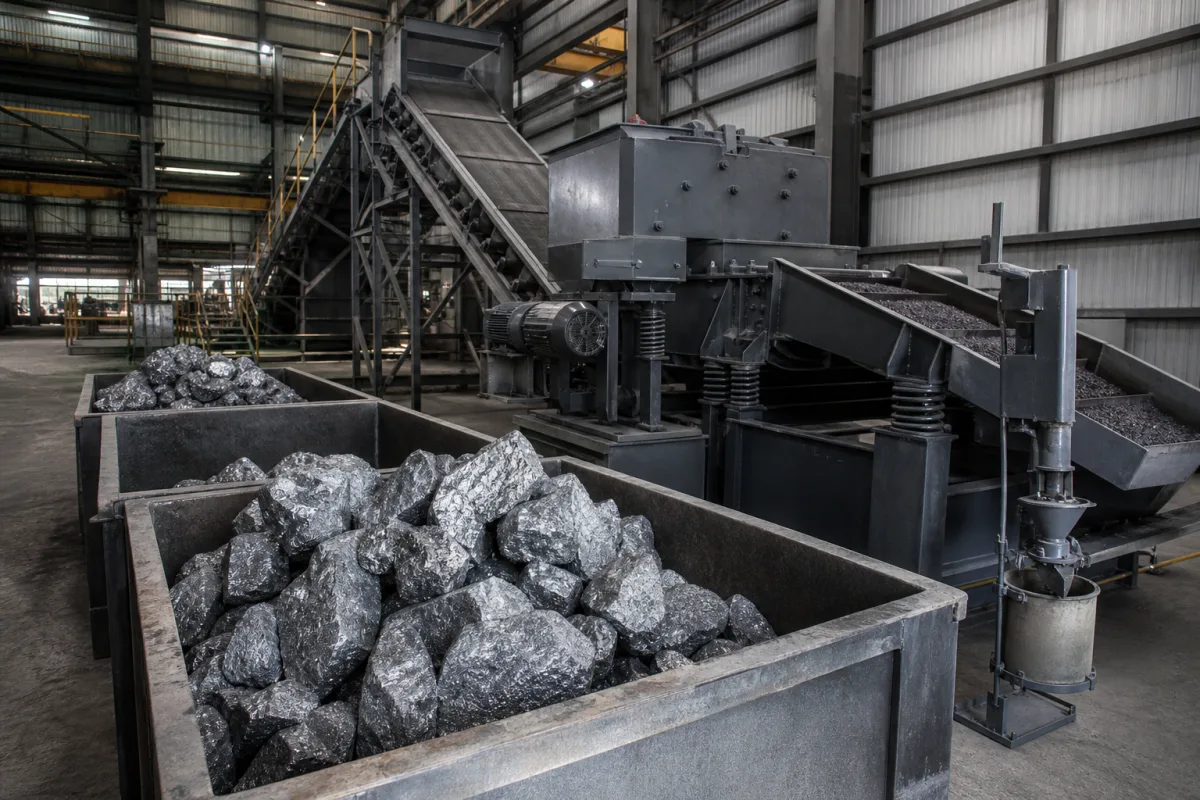
Ferroalloys · Silicon grade, aluminium and residual limits, lump size, pricing on contained silicon and trade classification
Ferrosilicon is an iron–silicon alloy made by reducing quartz with carbon in a submerged arc furnace. Ask three things first: the silicon grade, the limits on aluminium and other residuals that your steel needs, and the lump size, packing and analysis certificate for each lot.
Ferrosilicon lumps, granules and powder in standard and low-aluminium (high-purity) grades. Silicon metal, ferrosilicon-magnesium nodulisers, ferrosilicon-chromium, silicon-iron anodes and ferroalloy furnaces are outside this page.
CNFX editorial research · Sources checked October 12, 2026 · 4 sources
Anyang Jintong's ferrosilicon table lists FeSi 60%, 72% and 75% with silicon of at least 65, 72 and 75%, carbon ≤0.2%, aluminium ≤2.0%, phosphorus ≤0.04% and sulfur ≤0.02%, and a low-aluminium FeSi 75% with aluminium ≤0.5%. It describes production by reducing silica with carbon in a submerged arc furnace, and uses as a deoxidiser and alloying agent. [2]
Anyang Jinfang lists 72.0–80.0% silicon grades with aluminium ≤0.5, ≤1.0 or ≤1.5%, carbon ≤0.2%, calcium ≤1.0%, phosphorus ≤0.040% and sulfur ≤0.02%, in sizes of 1–3, 3–10, 10–50 or 10–100 mm, packed in 1-tonne bags. It states that about 3–5 kg of 75% ferrosilicon is used per tonne of steel. [3]
Editorial calculation: at 3–5 kg of 75% ferrosilicon per tonne, a steel melt receives about 2.3–3.8 kg of silicon per tonne, and every 0.1 percentage point of aluminium in the alloy adds about 3–5 g of aluminium per tonne of steel. [3] Specify aluminium and other residual limits from your steel grade, not the alloy's name.
Give the supplier the grade (Si %), maximum Al, C, P, S, Ca, Ti and other residuals, size range and fines limit, quantity and lot size, packing, sampling and analysis method, certificate of analysis per lot, delivery terms and destination.
02
Read prices on a contained-silicon basis
The US Geological Survey's 2026 Mineral Commodity Summary for silicon reports data on a silicon-content basis, gives the average US price of 75% ferrosilicon as 131.96 cents per pound of contained silicon in 2024 and an estimated 140 in 2025, and says “most ferrosilicon was consumed in the ferrous foundry and steel industries”. US tariff headings separate ferrosilicon with more than 55% up to 80% silicon (with more than 3% calcium, or other), 80–90% and over 90% silicon. [1]
Editorial calculation: 140 cents per pound of contained silicon × 0.75 × 2,204.6 lb per tonne ≈ US$2,315 per tonne of 75% alloy; the 2024 figure gives about US$2,180. [1] When comparing offers, convert per-tonne alloy prices to contained silicon at the guaranteed minimum grade.
03
Check the US tariff line and general duty rate for the grade
The US International Trade Commission's Harmonized Tariff Schedule splits ferrosilicon (heading 7202.2) by silicon content and lists a general (normal trade relations) duty rate for each line. Ferrosilicon with more than 55% but not more than 80% silicon falls under 7202.21.10.00 at 1.1% if it contains more than 3% calcium, and 7202.21.50.00 at 1.5% otherwise; 7202.21.75.00 covers more than 80% but not more than 90% silicon at 1.9%; and 7202.21.90.00 covers more than 90% silicon at 5.8%. Ferrosilicon with 55% silicon or less is 7202.29.00 at a general rate of Free, with a statistical split at more than 2% magnesium (7202.29.00.10). [4]
The 72% and 75% grades in the supplier tables above fall in the 55–80% band, so the calcium content in the analysis decides between 1.1% and 1.5%. [2][3][4] The general rate column does not show any additional duties that may apply by country of origin, so check the current schedule for the shipment.
Editorial calculation: at the about US$2,300 per tonne worked out above, the 1.5% general rate adds about US$35 per tonne; a > 90% silicon grade at 5.8% would add about US$133 per tonne at the same value. [1]
HTS line (USITC)
Silicon content and condition
General duty rate
7202.21.10.00
> 55% to ≤ 80% Si, > 3% calcium
1.1%
7202.21.50.00
> 55% to ≤ 80% Si, other
1.5%
7202.21.75.00
> 80% to ≤ 90% Si
1.9%
7202.21.90.00
> 90% Si
5.8%
7202.29.00
≤ 55% Si (other)
Free
State the guaranteed silicon and calcium range on the order so the tariff line is clear, and ask the supplier for the analysis certificate the customs entry will rely on.
04
Composition tables, low-aluminium grades, lump sizes and powder from listed suppliers
Anyang Jintong and Anyang Jinfang publish ferrosilicon composition tables including low-aluminium grades; ZhenAn lists 65–75% ferrosilicon lumps in 10–50 and 50–100 mm sizes and powder; Qinghai Yuyuan, HS Ferroalloy and Anyang Xinhai list ferrosilicon with silicon metal and other ferroalloys.
05
Silicon, aluminium, carbon, phosphorus and sulfur, calcium, and lump size
Aluminium is what separates the high-purity grades here: Anyang Jintong lists ≤2.0% Al for regular FeSi 75 and ≤0.5% for its low-aluminium grade, at the same silicon, carbon, phosphorus and sulfur limits. [2]
6 companies list this product among what they make. Company figures are quoted from each
company's own website; every card states where the relationship came from.
Explore company information and manufacturing capabilities, then discuss the scope of your project with a relevant supplier.
Share this page
Compiled and source-reviewed by the CNFX editorial team.
Each manufacturer above links to the page on that company's own website where the product is listed, with the date we checked it. How we source and review
· Page last updated 13 October 2026
Buyer questions
What makes ferrosilicon 'high purity'?
Lower residuals, especially aluminium: published tables show regular FeSi 75% at ≤2.0% Al and low-aluminium grades at ≤0.5%. [2]
How is ferrosilicon priced?
USGS reports prices per pound of contained silicon; 140 cents/lb for 75% grade is about US$2,315 per tonne of alloy (editorial calculation). [1]
How much ferrosilicon goes into a tonne of steel?
One supplier states about 3–5 kg of 75% ferrosilicon per tonne of steel. [3]
What US import duty applies to 75% ferrosilicon?
The USITC Harmonized Tariff Schedule puts > 55% to ≤ 80% silicon ferrosilicon at a 1.5% general rate (7202.21.50.00), or 1.1% if it contains more than 3% calcium. [4]
Sources and what still needs a direct check
Sources checked 2026-10-12. The USGS Mineral Commodity Summaries are US government statistics and the USITC Harmonized Tariff Schedule gives US duty lines. Anyang Jintong and Anyang Jinfang are suppliers listed on this page; their composition tables are used as examples.