Strukturierte Fertigungsdaten · 2026

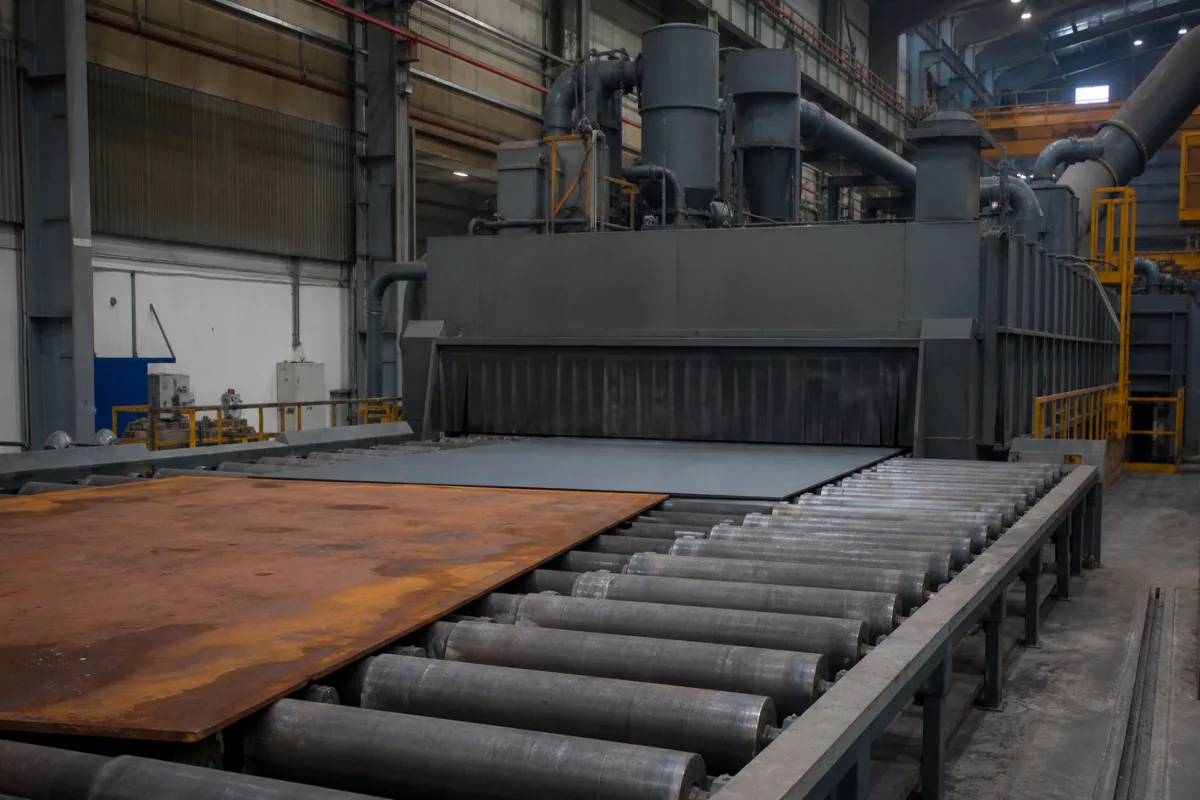
Marine Hull Plate Shot Blasting Machine

Auf Basis strukturierter CNFX-Herstellerprofile wird Marine Hull Plate Shot Blasting Machine im Bereich Schiffbau anhand von Maximale Blechbreite bis Verarbeitungsgeschwindigkeit eingeordnet.

Technische Definition und Kernbaugruppe

Ein typisches Marine Hull Plate Shot Blasting Machine wird durch die Baugruppe aus Fliehkraftrad-Baugruppe und Schleifmittel-Rückgewinnungssystem beschrieben. Für industrielle Anwendungen werden Materialauswahl, Fertigungsprozess und Prüfbarkeit gemeinsam bewertet.

Industrial machine for surface preparation of ship hull plates via abrasive blasting

Technische Definition

A specialized industrial machine used in shipbuilding for cleaning and preparing steel plates before assembly. It removes mill scale, rust, and contaminants from hull plates to ensure proper adhesion of coatings and prevent corrosion. The machine uses centrifugal wheels to propel abrasive media at high velocity against the plate surface. This process creates an anchor profile that improves coating durability and meets shipyard surface preparation standards.

Funktionsprinzip

Centrifugal wheels accelerate abrasive media (steel shot/grit) that impacts plate surfaces to remove contaminants and create surface profile

Technische Parameter

Maximale Blechbreite
Maximale Breite des Stahlblechs, die verarbeitet werden kannmm
Verarbeitungsgeschwindigkeit
Geschwindigkeit, mit der Platten durch die Maschine bewegt werdenm/min
Abrasivmittel Durchflussrate
Verbrauchsrate des Abrasivmittels während des Betriebskg/min
Motorleistung
Gesamtinstallierte Leistung aller AntriebsmotorenkW
Ankerprofil Tiefe
Ankerprofil-Tiefe auf behandeltem Stahl erreichtµm
Staubabscheidevermögen
Luftvolumenkapazität des integrierten Staubabsaugsystemsm³/h

Hauptmaterialien

High-Carbon Steel Abrasion-Resistant Steel Plate Hardened Steel Components

Komponenten / BOM

Beschleunigt und lenkt Schleifmittel auf Plattenoberfläche
Material: Gusseisen mit hohem Chromgehalt
Trennt wiederverwendbares Schleifmittel von Abrieb und führt es dem Trichter zu
Material: Verschleißfester Stahl
Transportiert Stahlplatten durch die Strahlkammer
Material: Gehärtete Stahlrollen
Entfernt luftgetragenen Staub und Partikel aus dem Arbeitsbereich
Material: Gehäuse aus feuerverzinktem Stahl
HMI-Schnittstelle für Maschinenbedienung und Parametereinstellung
Material: Gehäuse aus Edelstahl

FMEA · Fehleranalyse

Ursache → Fehlermodus → Engineering-Maßnahme

Abrasive moisture content exceeding 0.5% by mass Nozzle clogging within 15 minutes of operation Integrated desiccant dryer with dew point monitoring at -40°C
Recirculation system imbalance creating 15% abrasive concentration gradient Uneven surface profile with 50 μm Ra variation across plate width Turbine-type abrasive mixer with 120 RPM constant rotation and real-time density monitoring

Technische Bewertung

Betriebsbereich
Betriebsbereich
0.6-0.8 MPa (6-8 bar) abrasive pressure, 15-25 m/min conveyor speed, 0.3-0.5 mm abrasive particle size
Belastungs- und Ausfallgrenzen
Abrasive pressure exceeding 1.2 MPa causes wheel bearing seizure, conveyor speed below 10 m/min creates incomplete coverage, particle size above 0.8 mm induces surface pitting
Hertzian contact stress exceeding 2.8 GPa at abrasive-wheel interface causes bearing raceway spalling, turbulent air flow at 35 m/s creates abrasive particle rebound reducing impact energy by 40%
Fertigungskontext
Marine Hull Plate Shot Blasting Machine wird innerhalb von Schiffbau nach Material, Prozessfenster und Prüfanforderungen bewertet.

Weitere Produktbezeichnungen

ship plate shot blaster marine steel abrasive blasting machine hull plate surface preparation machine

Taxonomie und Suchbegriffe

Suchbegriffe, Aliase und technische Bezeichnungen für diesen CNFX Datensatz.

Eignung und Auslegungsdaten

Betriebsgrenzen
Traglast:0.6-0.8 MPa (blast pressure range)
Verstellbereich / Reichweite:15-25 m³/min (abrasive flow)
plate width:Up to 4000 mm (max conveyor width)
Einsatztemperatur:5°C to 40°C (operating ambient)
plate length:Minimum 2000 mm (for continuous operation)
plate thickness:6-50 mm (typical processing range)
slurry concentration:Not applicable (dry abrasive system)
Montage- und Anwendungskompatibilität
Steel grit (G25-G40)Steel shot (S330-S550)Aluminum oxide grit (16-36 mesh)
Nicht geeignet: High-humidity environments (>85% RH) due to abrasive clumping and corrosion risk
Auslegungsdaten
  • Maximum plate dimensions (width × length × thickness)
  • Required surface preparation standard (e.g., SA 2.5, SA 3)
  • Production throughput (plates/hour or m²/hour)

Zuverlässigkeits- und Risikoanalyse

Ausfallmodus und Ursache
Abrasive media degradation and contamination
Cause: Repeated use of steel shot/grit leads to fracturing, dust accumulation, and loss of kinetic energy, reducing cleaning efficiency and increasing wear on internal components like impellers and liners.
Wheel/impeller imbalance or bearing failure
Cause: High rotational speeds (often 2000-4000 RPM) combined with abrasive particle impacts cause uneven wear, fatigue, or contamination ingress, leading to vibration, overheating, and catastrophic mechanical breakdown.
Wartungsindikatoren
  • Abnormal vibration or loud grinding noises from the blast wheel housing, indicating impeller imbalance, bearing wear, or liner failure.
  • Visible dust leakage around seals or joints, or a significant drop in cleaning rate/quality, signaling media degradation, clogged nozzles, or air pressure loss.
Technische Hinweise
  • Implement strict media management: regularly sieve and replenish abrasive to maintain optimal size/hardness, and use moisture-controlled storage to prevent clumping and corrosion.
  • Schedule predictive maintenance using vibration analysis and thermal imaging on blast wheels and bearings, coupled with routine inspection/replacement of wear liners and seals to prevent unplanned downtime.

Compliance & Manufacturing Standards

Reference Standards
ISO 8501-1:2007 (Surface preparation standards for steel substrates)ASTM E165/E165M-23 (Standard Practice for Liquid Penetrant Testing)CE Machinery Directive 2006/42/EC (Safety requirements for machinery)
Manufacturing Precision
  • Blast nozzle alignment: +/-0.5° angular tolerance
  • Recovery system efficiency: 95% minimum abrasive recovery rate
Quality Inspection
  • Non-destructive testing (NDT) of pressure vessel components
  • Abrasive particle size distribution analysis

Hersteller, die dieses Produkt fertigen

Herstellerprofile mit passender Produktionsfähigkeit in China.

Die Herstellerliste dient der Vorrecherche und Einordnung von Fertigungskapazitäten. Sie ist keine Zertifizierung, kein Ranking und keine Transaktionsgarantie.

Beispielhafte Bewertungskriterien aus Einkaufsprozessen

Keine Kundenbewertung und keine Echtzeitdaten. Die Werte zeigen typische Prüfkriterien in RFQ- und Lieferantenbewertungsprozessen.

Technische Dokumentation
4/5
Fertigungsfähigkeit
4/5
Prüfbarkeit
5/5
Lieferantentransparenz
3/5

Die Kriterien dienen als Orientierung für technische Einkaufsprüfungen. Konkrete Kunden, Länder, Bewertungsdaten oder Live-Nachfragen werden nur angezeigt, wenn entsprechende belastbare Daten vorliegen.

Häufige Fragen

What materials is this marine hull plate shot blasting machine constructed from?

This machine is built with high-carbon steel, abrasion-resistant steel plate, and hardened steel components to withstand the demanding conditions of shipbuilding surface preparation.

What are the key specifications for processing ship hull plates?

Key specs include abrasive flow rate (kg/min), dust collection capacity (m³/h), maximum plate width (mm), motor power (kW), processing speed (m/min), and surface profile depth (μm) for consistent hull preparation.

How does the abrasive recycling system work in this machine?

The integrated abrasive recycling system collects, cleans, and recycles abrasive media through centrifugal separation and filtration, reducing material costs and ensuring efficient blasting operations.

Kann ich Hersteller direkt kontaktieren?

CNFX ist ein offenes Verzeichnis, keine Handelsplattform und kein Beschaffungsagent. Herstellerprofile und Formulare helfen bei der Vorbereitung des direkten Kontakts.

CNFX Industrial Index v2.6.05 · Schiffbau

Datenbasis

CNFX-Herstellerprofile, technische Klassifikation, öffentlich verfügbare Produktinformationen und fortlaufende Plausibilitätsprüfung.

Vorläufige technische Einordnung
Diese Seite dient der strukturierten Vorbereitung von Recherche, RFQ und Lieferantenbewertung. Sie ersetzt keine Lieferantenqualifizierung, keine Normenprüfung und keine technische Freigabe durch den Käufer.

Beschaffungsinformationen anfragen für Marine Hull Plate Shot Blasting Machine

Informationen zu Einsatzbereich, Spezifikationsgrenzen, Lieferantentypen und RFQ-Vorbereitung anfragen.

Ihre Geschäftsdaten werden nur zur Bearbeitung dieser Anfrage verwendet.

Vielen Dank. Ihre Anfrage wurde gesendet.
Vielen Dank. Ihre Anfrage wurde empfangen.

Fertigung für Marine Hull Plate Shot Blasting Machine?

Herstellerprofile mit passender Produkt- und Prozesskompetenz vergleichen.

Herstellerprofil anlegen Kontakt
Vorheriges Produkt
Filterpatrone für Marine-Ballastwasser-Behandlungssysteme
Nächstes Produkt
Marine Propeller Shaft Seal