Industry-Verified Manufacturing Data (2026)

Marine Hull Plate Shot Blasting Machine

Based on aggregated insights from multiple verified factory profiles within the CNFX directory, the standard Marine Hull Plate Shot Blasting Machine used in the Shipbuilding sector typically supports operational capacities ranging from standard industrial configurations to heavy-duty production requirements.

Technical Definition & Core Assembly

A canonical Marine Hull Plate Shot Blasting Machine is characterized by the integration of Centrifugal Wheel Assembly and Abrasive Recycling System. In industrial production environments, manufacturers listed on CNFX commonly emphasize High-Carbon Steel construction to support stable, high-cycle operation across diverse manufacturing scenarios.

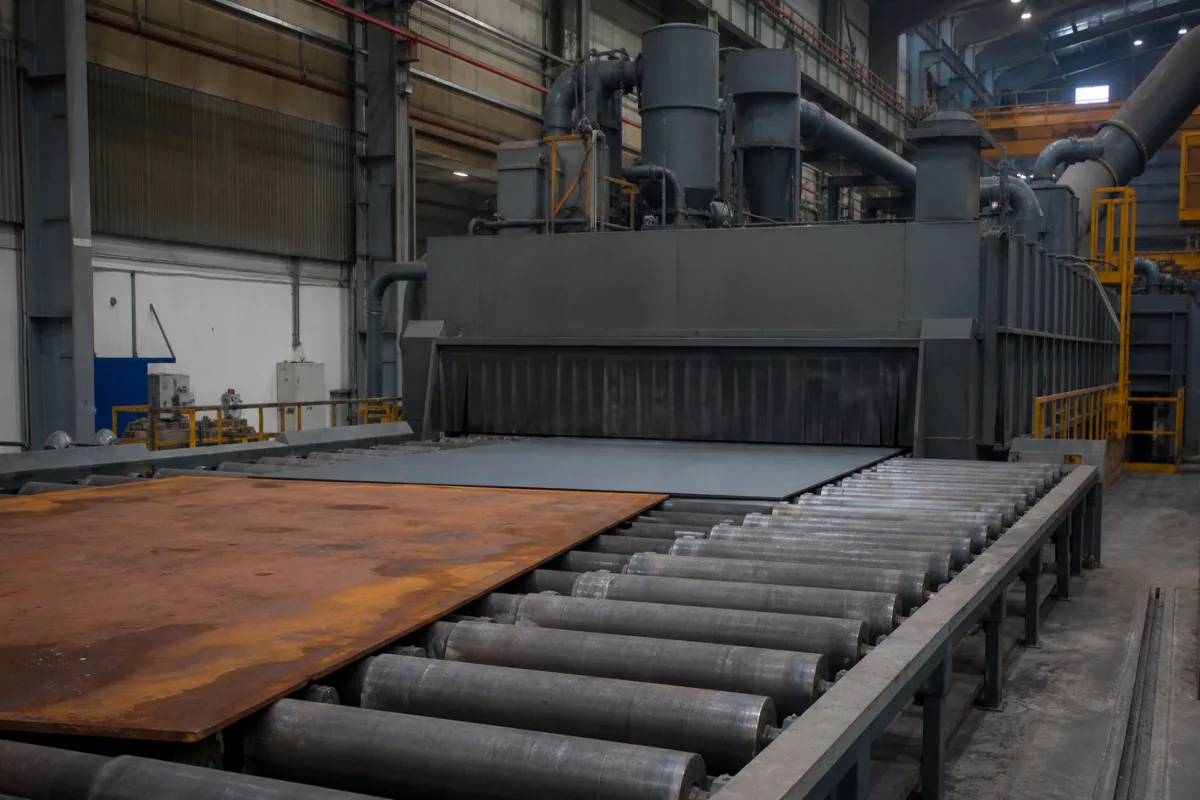
Industrial machine for surface preparation of ship hull plates via abrasive blasting
Product Specifications

Technical details and manufacturing context for Marine Hull Plate Shot Blasting Machine

Definition
A specialized industrial machine used in shipbuilding for cleaning and preparing steel plates before assembly. It removes mill scale, rust, and contaminants from hull plates to ensure proper adhesion of coatings and prevent corrosion. The machine uses centrifugal wheels to propel abrasive media at high velocity against the plate surface. This process creates an anchor profile that improves coating durability and meets shipyard surface preparation standards.
Working Principle
Centrifugal wheels accelerate abrasive media (steel shot/grit) that impacts plate surfaces to remove contaminants and create surface profile
Common Materials
High-Carbon Steel, Abrasion-Resistant Steel Plate, Hardened Steel Components
Technical Parameters
  • Maximum plate width capacity (mm) Per Request
  • Processing speed through machine (mm/min) Per Request
Components / BOM
  • Centrifugal Wheel Assembly
    Accelerates and directs abrasive media onto plate surface
    Material: High-chromium cast iron
  • Abrasive Recycling System
    Separates reusable abrasive from debris and returns it to hopper
    Material: Abrasion-resistant steel
  • Plate Conveyor System
    Transports steel plates through the blasting chamber
    Material: Hardened steel rollers
  • Dust Collector
    Removes airborne dust and particulate from the work area
    Material: Galvanized steel housing
  • Control Panel
    HMI interface for machine operation and parameter setting
    Material: Stainless steel enclosure
Engineering Reasoning
0.6-0.8 MPa (6-8 bar) abrasive pressure, 15-25 m/min conveyor speed, 0.3-0.5 mm abrasive particle size
Abrasive pressure exceeding 1.2 MPa causes wheel bearing seizure, conveyor speed below 10 m/min creates incomplete coverage, particle size above 0.8 mm induces surface pitting
Design Rationale: Hertzian contact stress exceeding 2.8 GPa at abrasive-wheel interface causes bearing raceway spalling, turbulent air flow at 35 m/s creates abrasive particle rebound reducing impact energy by 40%
Risk Mitigation (FMEA)
Trigger Abrasive moisture content exceeding 0.5% by mass
Mode: Nozzle clogging within 15 minutes of operation
Strategy: Integrated desiccant dryer with dew point monitoring at -40°C
Trigger Recirculation system imbalance creating 15% abrasive concentration gradient
Mode: Uneven surface profile with 50 μm Ra variation across plate width
Strategy: Turbine-type abrasive mixer with 120 RPM constant rotation and real-time density monitoring

Industry Taxonomies & Aliases

Commonly used trade names and technical identifiers for Marine Hull Plate Shot Blasting Machine.

Industrial Ecosystem & Supply Chain DNA

Complementary Systems
Downstream Applications
Specialized Tooling

Application Fit & Sizing Matrix

Operational Limits
pressure: 0.6-0.8 MPa (blast pressure range)
flow rate: 15-25 m³/min (abrasive flow)
plate width: Up to 4000 mm (max conveyor width)
temperature: 5°C to 40°C (operating ambient)
plate length: Minimum 2000 mm (for continuous operation)
plate thickness: 6-50 mm (typical processing range)
slurry concentration: Not applicable (dry abrasive system)
Media Compatibility
✓ Steel grit (G25-G40) ✓ Steel shot (S330-S550) ✓ Aluminum oxide grit (16-36 mesh)
Unsuitable: High-humidity environments (>85% RH) due to abrasive clumping and corrosion risk
Sizing Data Required
  • Maximum plate dimensions (width × length × thickness)
  • Required surface preparation standard (e.g., SA 2.5, SA 3)
  • Production throughput (plates/hour or m²/hour)

Reliability & Engineering Risk Analysis

Failure Mode & Root Cause
Abrasive media degradation and contamination
Cause: Repeated use of steel shot/grit leads to fracturing, dust accumulation, and loss of kinetic energy, reducing cleaning efficiency and increasing wear on internal components like impellers and liners.
Wheel/impeller imbalance or bearing failure
Cause: High rotational speeds (often 2000-4000 RPM) combined with abrasive particle impacts cause uneven wear, fatigue, or contamination ingress, leading to vibration, overheating, and catastrophic mechanical breakdown.
Maintenance Indicators
  • Abnormal vibration or loud grinding noises from the blast wheel housing, indicating impeller imbalance, bearing wear, or liner failure.
  • Visible dust leakage around seals or joints, or a significant drop in cleaning rate/quality, signaling media degradation, clogged nozzles, or air pressure loss.
Engineering Tips
  • Implement strict media management: regularly sieve and replenish abrasive to maintain optimal size/hardness, and use moisture-controlled storage to prevent clumping and corrosion.
  • Schedule predictive maintenance using vibration analysis and thermal imaging on blast wheels and bearings, coupled with routine inspection/replacement of wear liners and seals to prevent unplanned downtime.

Compliance & Manufacturing Standards

Reference Standards
ISO 8501-1:2007 (Surface preparation standards for steel substrates) ASTM E165/E165M-23 (Standard Practice for Liquid Penetrant Testing) CE Machinery Directive 2006/42/EC (Safety requirements for machinery)
Manufacturing Precision
  • Blast nozzle alignment: +/-0.5° angular tolerance
  • Recovery system efficiency: 95% minimum abrasive recovery rate
Quality Inspection
  • Non-destructive testing (NDT) of pressure vessel components
  • Abrasive particle size distribution analysis

Factories Producing Marine Hull Plate Shot Blasting Machine

Verified manufacturers with capability to produce this product in China

✓ 97% Supplier Capability Match Found

T Technical Director from Canada Feb 03, 2026
★★★★★
"Standard OEM quality for Shipbuilding applications. The Marine Hull Plate Shot Blasting Machine arrived with full certification."
Technical Specifications Verified
P Project Engineer from United States Jan 31, 2026
★★★★☆
"Great transparency on the Marine Hull Plate Shot Blasting Machine components. Essential for our Shipbuilding supply chain. (Delivery took slightly longer than expected, but technical support was excellent.)"
Technical Specifications Verified
S Sourcing Manager from United Arab Emirates Jan 28, 2026
★★★★★
"The Marine Hull Plate Shot Blasting Machine we sourced perfectly fits our Shipbuilding production line requirements."
Technical Specifications Verified
Verification Protocol

“Feedback is collected from verified sourcing managers during RFQ (Request for Quote) and factory evaluation processes on CNFX. These reports represent historical performance data and technical audit summaries from our B2B manufacturing network.”

19 sourcing managers are analyzing this specification now. Last inquiry for Marine Hull Plate Shot Blasting Machine from Vietnam (25m ago).

Frequently Asked Questions

What materials is this marine hull plate shot blasting machine constructed from?

This machine is built with high-carbon steel, abrasion-resistant steel plate, and hardened steel components to withstand the demanding conditions of shipbuilding surface preparation.

What are the key specifications for processing ship hull plates?

Key specs include abrasive flow rate (kg/min), dust collection capacity (m³/h), maximum plate width (mm), motor power (kW), processing speed (m/min), and surface profile depth (μm) for consistent hull preparation.

How does the abrasive recycling system work in this machine?

The integrated abrasive recycling system collects, cleans, and recycles abrasive media through centrifugal separation and filtration, reducing material costs and ensuring efficient blasting operations.

Can I contact factories directly on CNFX?

CNFX is an open directory, not a transaction platform. Each factory profile provides direct contact information and production details to help you initiate direct inquiries with Chinese suppliers.

Get Quote for Marine Hull Plate Shot Blasting Machine

Request technical pricing, lead times, or customized specifications for Marine Hull Plate Shot Blasting Machine directly from verified manufacturing units.

Your business information is encrypted and only shared with verified Marine Hull Plate Shot Blasting Machine suppliers.

Thank you! Your message has been sent. We'll respond within 1–3 business days.

Need to Manufacture Marine Hull Plate Shot Blasting Machine?

Connect with verified factories specializing in this product category

Add Your Factory Contact Us
Previous Product
Marine Hull Plate Bending Roller
Next Product
Marine Propeller Shaft Seal