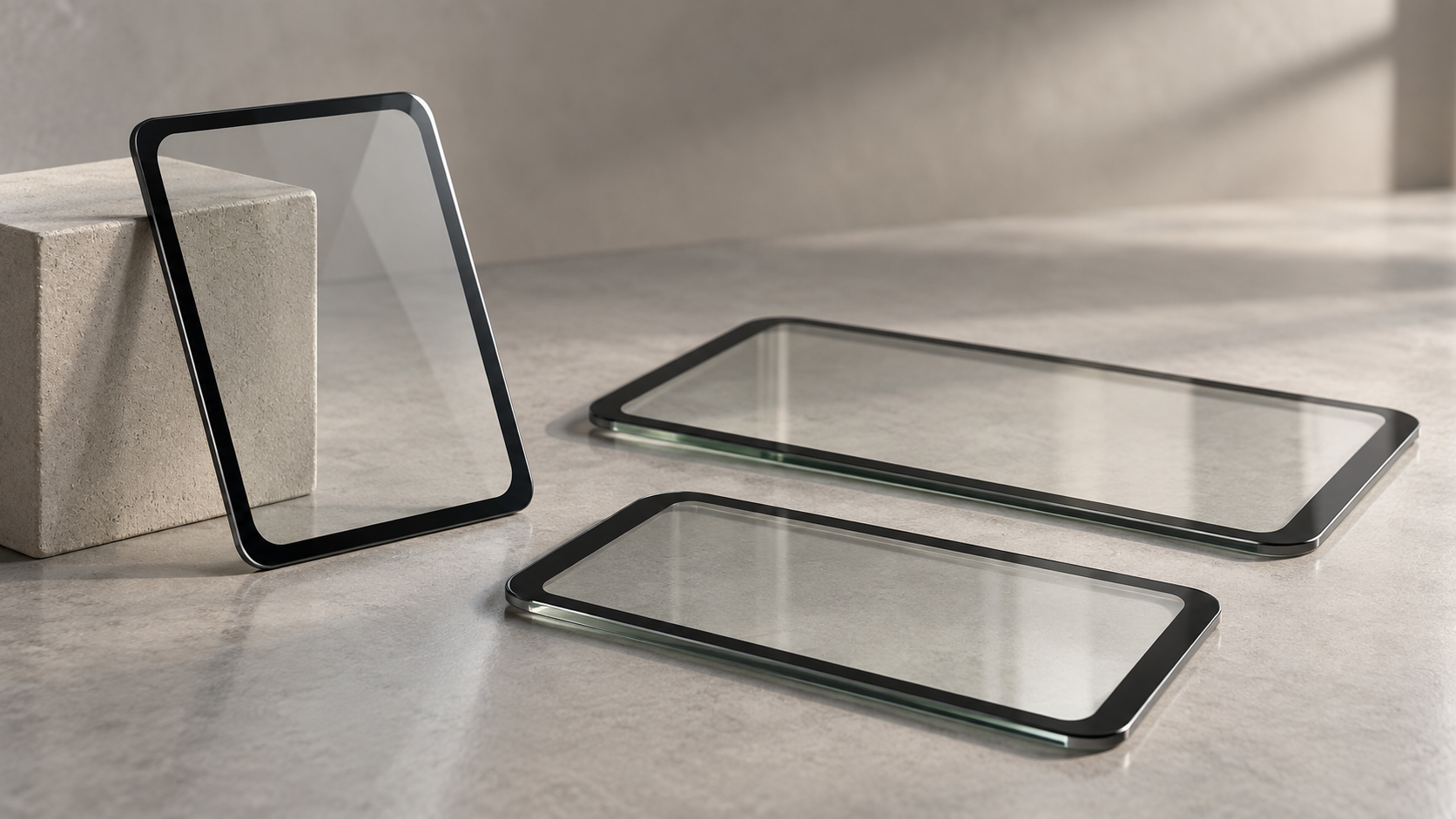
Wuhan Jitu Department Store (Sole Proprietorship) operates under the CrystalEdge Optical Technology trading name. The Wuhan business handles sales, contracting and project coordination, working with a cooperating glass-processing factory in Dongguan. This is a coordinated custom-component supply offering, not a claim that the Wuhan business owns that factory.
For equipment brands, the product is the finished cover lens specified for a particular front panel. It is not a complete display, touch sensor or assembled control system. Buyers can discuss the lens geometry, visible graphics, surface finish and assembly interface together through the CrystalEdge manufacturer profile on CNFX.
One front panel, several configurable elements
A cover lens can do more than cover a screen. Its outline establishes how the panel sits within a housing; its printed areas frame the viewing window; and its surface finish contributes to the appearance and handling of the finished equipment. CrystalEdge lists glass and PMMA cover-lens work, CNC shaping and holes, strengthening, printed graphics and adhesive-related options in its submitted company information. The final combination is agreed for the project.
| Product element | What to discuss | Where it contributes |
|---|---|---|
| Outline and openings | Panel dimensions, corner shapes and positions of required cutouts | A front panel shaped around the enclosure and component layout |
| Printed border and graphics | Viewing-window boundary, brand artwork and control markings | A consistent visual interface across a product family |
| Surface treatment | AG, AR or AF options for the intended viewing and handling conditions | A finish selected for the actual display assembly |
| Assembly interface | Adhesive pattern and areas that must remain clear | A component prepared around the customer's mounting approach |
Industrial display covers that match your enclosure
An equipment maker may need the same display module behind several different front-panel designs. A custom cover lens provides a way to adapt the outside presentation without treating every enclosure as a completely unrelated visual product. One version might have a narrow printed border; another might extend the lens around indicator areas or physical controls.
Start with the front-panel drawing and mark the active viewing area separately from the overall lens outline. This gives the supplier a practical basis for discussing machining and printing. Include the intended orientation of the panel: a landscape operator console and a portrait access-control unit may have different artwork and mounting requirements even when their overall dimensions are similar.
CrystalEdge's industrial application page presents industrial display and control-panel cover-glass projects as part of its offering. A buyer should request a project-specific sample rather than assume that a pictured example is an off-the-shelf part in the required size.
Printed borders and product identity
A border can visually integrate the display into the surrounding equipment. It can also provide a consistent place for brand identity, legends or other graphics. CrystalEdge offers silkscreen-printing services; its approved company description also lists dead-front graphics. Ask which printing construction is appropriate for your artwork and lighting arrangement.
For a family of control units, supply a shared artwork reference alongside the drawing for each lens. This makes it easier to distinguish the elements that remain constant from those that change with screen size. For example, a common border color may be retained while window dimensions and model markings vary. Keep the artwork revision visible in the project brief so that a sample and its corresponding drawing can be compared without ambiguity.
A dead-front appearance is a design objective to review with a physical sample and the intended illumination. It should not be assumed from a dark printed sample photographed without the display behind it. The useful buying conversation is about the appearance of your assembled product, both lit and unlit.
Choose the surface finish around the use case
CrystalEdge lists AG, AR and AF within its surface-treatment offering. These are distinct options, not interchangeable labels for a universally better glass. Ask the supplier to explain the available construction and show representative samples before choosing a finish.
For the buyer, a simple comparison is more useful than a long list of treatment names. View candidate samples with the intended display content, in representative lighting, and at normal operating angles. Check the legibility of small text, the visual character of bright areas and the appearance of the surface after handling. Record which sample corresponds to which finish so the selected version can be specified clearly.
Selection also depends on the rest of the assembly. A cover-lens finish by itself does not establish a complete panel's touch performance, ingress protection or impact rating. Those are system requirements to agree with the relevant component and equipment suppliers.
Plan the adhesive and mounting areas early
The supplier also presents adhesive-tape bonding as a capability. If adhesive preparation is part of the requested component, identify the intended bonding area and any regions that must remain clear. Send the mating-part information with the lens drawing rather than leaving the mounting interface until after the appearance sample is approved.
A practical sample review can separate three questions: does the lens fit the enclosure, does the assembled display look right, and is the proposed attachment suitable for the customer's assembly process? Agree who evaluates each point. This turns the sample into a useful product-development step without implying that the lens supplier certifies the entire machine.
What to include in your CrystalEdge inquiry
- The equipment type and the front panel's role.
- A dimensioned drawing, including the viewing window and openings.
- Preferred material, or a request to compare available material options.
- Print artwork and any color or appearance references.
- Surface-treatment preferences and representative viewing conditions.
- The mounting approach, sample quantity and expected order range.
If the design is still evolving, say which decisions are fixed and which are open. A preliminary project discussion can then focus on the unresolved product choices. Do not treat a general website example as confirmation of a particular tolerance, lead time or certification; request the quotation and sample proposal for your design.
Common product questions
Can I order the cover lens without a display module?
The offering described here is a custom cover-lens component. Identify the display and touch arrangement in the inquiry so the supplier understands the interface, but confirm the exact delivered items in the quotation.
Can several models share a common visual design?
That is a useful way to structure the inquiry: provide one visual reference and a separate drawing for each size or layout. Ask the supplier to identify which elements can be shared and which require separate samples.
Who handles the project?
The CNFX-listed Wuhan legal business coordinates sales, contracting and the project under the CrystalEdge trading name. Processing is described as performed with a cooperating factory in Dongguan. Confirm the named contracting party and the supply scope in the quotation.
Discuss your cover-lens project: visit the CrystalEdge profile and send a product inquiry with your drawing and intended application.
Product scope is based on the company's submitted profile and linked supplier pages, reviewed on 14 September 2026. Options remain subject to project confirmation.