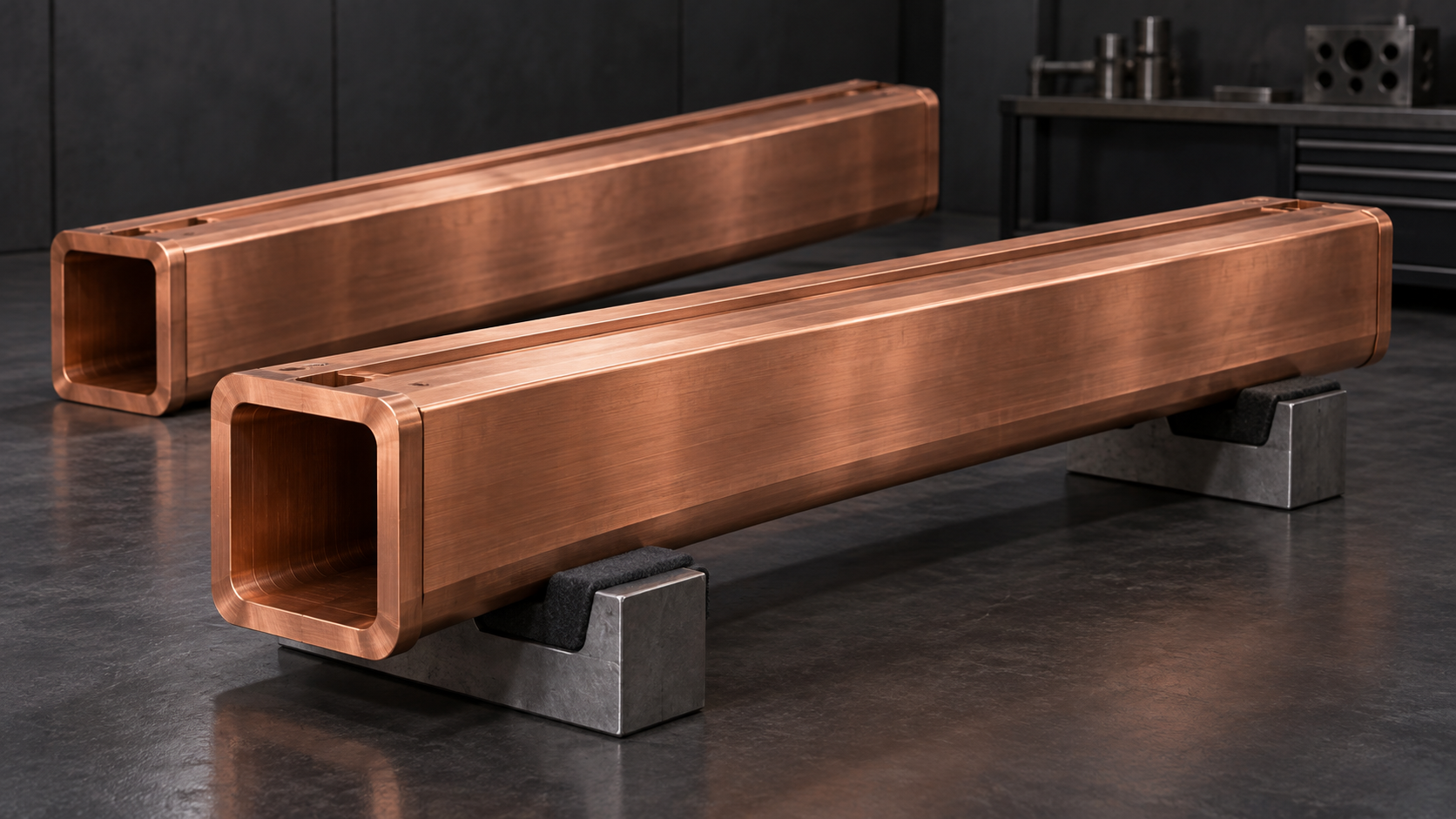
A supplier range built around continuous casting
DDMET's published copper mould tube range includes square, round, bloom and beam-blank formats. Its broader catalogue also covers mould plates, assemblies and continuous-casting spare parts. This makes the company relevant to steelworks purchasing teams sourcing a defined replacement component, as well as teams discussing a larger equipment package.
Use the DDMET manufacturer profile on CNFX to introduce your plant's requirement. A useful first message identifies the caster, the part being replaced and the drawing revision. The supplier can then address the requested configuration instead of interpreting a request for a generic copper tube.
Choose the supply scope before comparing quotations
DDMET also publishes a billet mould assembly example. A mould tube and a complete mould assembly are different purchases: the tube is the copper component associated with forming and cooling the steel strand; an assembly includes additional components whose exact scope must be listed. A tube-only price cannot be compared directly with an assembly quotation.
| Your purchasing task | Product scope to discuss | Useful starting document |
|---|---|---|
| Replace a known tube | Copper mould tube to an agreed drawing | Current approved tube drawing and part number |
| Replace a tube and matching components | Tube plus individually listed associated parts | Tube drawing, interface drawings and component list |
| Purchase an assembly | Complete assembly with inclusions and exclusions | Assembly drawing and equipment interface requirements |
| Discuss a change of cast section | Engineering review before a supply proposal | Existing caster configuration and proposed section |
The last case is not simply a larger or smaller repeat order. Have the plant's responsible engineering team agree the configuration with the equipment supplier before converting it into a purchase specification.
Make the drawing the centre of the order
The nominal billet section is a useful identifier, but it is not a complete tube specification. Length, curvature, internal profile and interfaces also distinguish one item from another. SMS Concast's mould-tube overview explains why the taper is designed around the application. Its design discussion is technical context, not evidence of a relationship with DDMET.
For procurement, turn that context into a simple document convention: give every requested tube a buyer part number, a drawing number and a revision. Ask the quotation to repeat all three. If a proposed alternative changes the drawing, retain it as a separately identified option until the responsible engineer approves it.
A frequent ordering mistake is treating two tubes with the same headline section as interchangeable. Another is accepting a material or coating substitution by email without updating the order record. A written revision trail lets both sides distinguish an approved change from an accidental mismatch.
Build a replacement-parts enquiry in one page
The following is an editorial worksheet for a purchasing team, not a claim about DDMET's standard inspection package. Fill it with your approved information and ask the supplier to confirm what it can provide.
| Enquiry field | What to enter | What to request in the reply |
|---|---|---|
| Identity | Plant, caster and buyer part number | Supplier reference matched to that part |
| Geometry | Drawing number, revision and units | Drawing acceptance or a clearly marked alternative |
| Material and finish | Approved material and coating specification | Quoted specification and available supporting records |
| Supply boundary | Tube only, listed parts or complete assembly | Itemised inclusions and exclusions |
| Quantity and schedule | Initial quantity, repeat demand and required arrival date | Proposed production and shipping schedule |
| Acceptance | Requested dimensional report and identification method | Documents included, additional checks and their cost |
Keep drawings in their original units and state which document controls if there is a conflict. Photos can explain the context, but they should accompany—not replace—the approved dimensional information.
From first delivery to a repeatable spare-parts record
Consider a purchasing team managing two tube designs for different caster positions. Instead of ordering “two sets of copper tubes,” create one line for each approved drawing. Assign an internal stock code to each design and keep the supplier's quotation against the corresponding line. This is a planning example, not a reported customer installation.
At delivery, record the package identification, quantity, supplier reference and documents received. The plant's authorised team can then complete its specified inspection and equipment acceptance. Purchasing should retain the resulting acceptance record with the drawing revision so the next enquiry refers to the approved configuration.
If the team later changes a finish, drawing or associated component, issue a new revision rather than overwriting the earlier record. That small distinction is valuable when a warehouse holds more than one generation of the same nominal tube size.
Questions to settle with DDMET
Does the catalogue show the exact tube I can order?
The catalogue establishes the types of products offered. Your drawing and the supplier's confirmed quotation establish the item for your order. A historical product example is not evidence of current stock or a guaranteed delivery date.
Can I request both a tube and an assembly quotation?
Yes—describe them as separate alternatives with an explicit component list. Ask DDMET to identify what is included in each proposal so the technical and commercial comparison is meaningful.
How should I compare service life?
Do not treat a generic lifespan claim as a purchasing guarantee. Ask how any proposed performance statement would be measured for your application, which conditions apply and what evidence supports it. This article provides no universal heat count, wear limit or operating setting.
What should I send first?
Send the approved drawing revision, quantity, intended caster application and requested scope. Add the required arrival date and the documentation your receiving team expects. DDMET can use that information to discuss the product and quotation.
Discuss your copper mould tube requirement
For a known replacement part or a broader casting-equipment enquiry, introduce your project through the DDMET profile. Keep the first request focused on the component you need; related parts can be itemised once the scope is clear.
Sources and scope
Prepared by CNFX from the linked DDMET product pages and technical context, checked on 15 September 2026. The purchasing worksheet and two-design example are editorial planning aids, not a customer case study. Final configuration and commercial terms are agreed with the supplier. Suggest a correction.