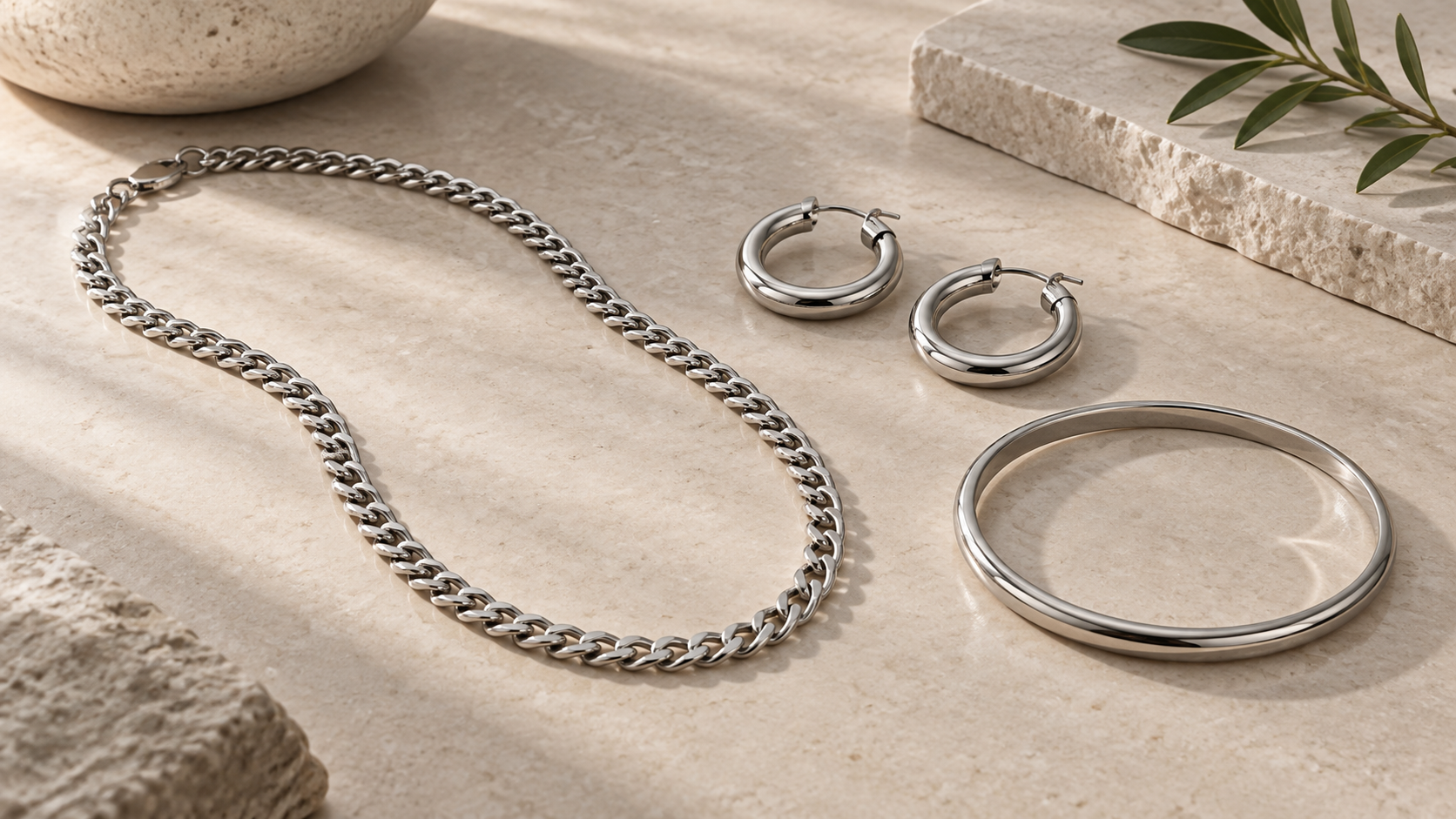
Make the signature piece the centre of the collection
Jiman's custom manufacturing service accepts sketches, CAD files and physical references for design review. It describes modelling, tooling, sampling and production, with options for engraved or stamped logos. These services give a brand a route from an idea to a physical piece that can be discussed and refined.
Begin with the part of the design that customers should remember. That might be the outline of a pendant, the proportions of a ring or the treatment of a bracelet link. Describe the feature in your brief and explain which details can change during development. A clear distinction between the essential design and flexible details gives the factory useful room to propose a workable solution.
Use references you own or are authorised to share. A mood board can communicate a direction without requesting an exact copy of another brand's design. Label a reference as inspiration, a required detail or an existing approved sample so that the supplier does not have to guess.
Combine custom development with existing styles
The company's bulk sourcing catalogue provides an alternative starting point through existing ODM designs. Its published terms distinguish business orders from individual retail purchases and describe logo personalisation and possible adjustments. Ask for the current quotation for the chosen style, finish and quantity; a catalogue route and a newly tooled design need not have the same cost or minimum.
A brand could develop a signature pendant while discussing complementary catalogue pieces for the same launch. The following collection worksheet is an original planning example, not a package already offered by Jiman or a reported customer project.
| Collection role | Potential starting route | Detail to discuss |
|---|---|---|
| Signature pendant | Custom design review | Outline, dimensions and chain connection |
| Complementary bracelet | Existing style or adaptation | Link appearance, length and closure |
| Coordinating earrings | Selected product family | Shape, pair orientation and finish sample |
| Brand identification | Logo application discussion | Artwork, location and readable size |
| Repeat-order reference | Approved sample and style record | Revision, finish and ordered variant |
Keep each row as an identifiable item. A general request for a matching set can conceal different sizes, surfaces and components. Item-level references make it easier to discuss a change without accidentally changing the whole collection.
Bring finish and proportions into the sample conversation
Jiman's official introduction presents stainless steel jewellery production with PVD finishing and brand-marking services. The important next step for your collection is to turn a colour description into a sample reference. A screen image is useful for direction, but it should not be the only description of the final appearance.
Review the proposed piece from the front, side and back. Note how the branding sits, how the closure feels in normal handling and whether the scale suits the intended collection. For a necklace, identify whether the quoted item includes the chain; for a bracelet, identify the length and closure variant. These are proposed review steps, not a claim that CNFX has tested the factory's products.
Record feedback against a dated sample rather than scattered messages. If the logo location changes, put that change on the same revision sheet as the finish decision. Before the production run, ask the supplier to confirm which sample and document revision represent the agreed order.
Prepare a brief the supplier can quote
Introduce your brand's customer group and the intended product family. Include the design references available, the desired variants, quantities by style and the destination market. Tell the company whether you want a new design, adaptation of an existing style or a discussion of both routes.
Separate the initial development work from the repeat-order plan. Ask the quotation to identify sampling, any new tooling, product variants and packing requirements. Confirm the production schedule after the design scope is established rather than carrying a general website estimate into your launch calendar.
For consumer-facing descriptions, use information supported for the actual finished item. A metal name or a finish photograph alone does not establish a universal allergy, waterproof or lifetime-colour promise. Request the relevant product information and agree which statements your brand can substantiate. Keep that practical verification alongside the creative work, without turning the collection into a page of unsupported superlatives.
Discuss your collection with Jiman on CNFX
Visit the Dongguan Jiman Jewelry Co., Ltd. profile to introduce your project. Start with the piece you want to develop and explain whether complementary styles are part of the same enquiry.
Discuss a stainless steel jewellery collection with Jiman. Include your country, product family and the design information you already have. The factory can then discuss the appropriate next step for your collection.
Questions from jewellery brands
Can I start with a sketch instead of a complete CAD model?
Jiman lists sketches and physical references as well as CAD files among its design-review inputs. Explain the intended dimensions and distinctive details so that the company can discuss the development work needed.
Can I combine existing styles and a custom piece?
You can enquire about both published routes. Ask for separate style references and quotations, and discuss how the finish and branding should coordinate. Availability and modifications remain subject to the supplier's confirmation.
Is this the same as ordering one personalised gift?
No. This introduction concerns a brand or business collection. Jiman's bulk page states that it does not handle single-piece retail orders; ask the company about the commercial requirements for your specific custom project.