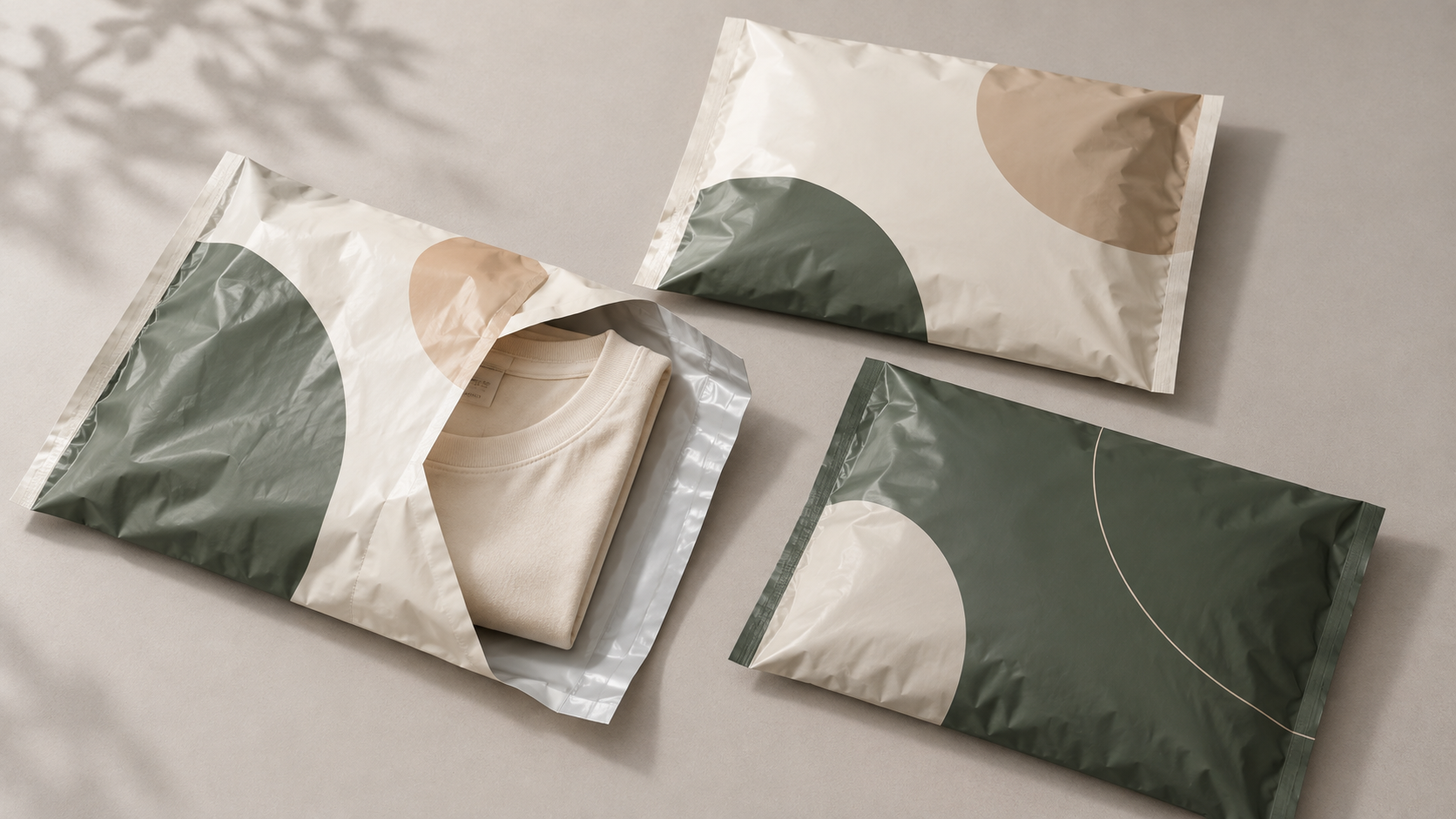
A shipping bag designed around your clothing brand
Shenzhen J-Origin Packaging Co., Ltd. offers custom poly mailers for clothing and other soft, non-fragile products. Its published mailer range provides a starting point for discussing bag dimensions, film, closure and printed artwork. Rather than choosing a generic envelope and squeezing the garment inside, start with the packed order and develop the outer bag around it.
For a clothing label, that means bringing together two practical needs: an outside surface that carries the brand clearly, and an inside space that accommodates the actual item. A single T-shirt, a folded knit and a two-piece set may share the same visual identity while needing different bag formats.
Three apparel orders, one consistent look
The following planning matrix helps turn a collection into a packaging enquiry. These are suggested use cases, not a list of guaranteed stock sizes or tested load ratings.
| Your order | Packaging direction to discuss | What to include in the brief |
|---|---|---|
| Single T-shirt or light top | A compact outer mailer with a clear logo area | Folded size, any inner wrap and the final shipping-label position |
| Hoodie or knitwear | A larger format that accommodates the packed thickness | Actual filled sample, closure clearance and preferred finished appearance |
| Coordinated two-piece set | One outer mailer for the complete order | Combined bundle size, inner arrangement and whether the pieces stay together during handling |
Try the largest version of each intended pack, not only the smallest clothing size. Include hangtags, an inner bag or a card if they will be shipped. This keeps the discussion focused on the package customers receive, rather than the garment measured on its own.
Make the print work after the parcel is packed
J-Origin lists custom printing alongside its flexible packaging products. Bring your brand colours, logo file and a rough layout to the conversation. Request the supplier's current artwork template before preparing the final print file; the printable area depends on the agreed construction.
One useful starting design places the main identity on the front, leaves a deliberate area for the address label and puts a short brand message on the reverse. A second version can use a repeating pattern. Compare both with an actual shipping label attached: a striking flat artwork can lose its focal point once the label, filled shape and folds are present.
Keep colour approval separate from layout approval. A screen proof helps check position and spelling; a physical print sample helps you judge the proposed film and print together. Do not treat a digital mock-up as a promise of the final surface finish.
Coordinate the outer mailer with the rest of the pack
The J-Origin catalogue also lists resealable bags, apparel packaging and labels. Buyers can ask about combining these with the outer mailer rather than briefing each element in isolation. Discuss which items should carry the logo and which can remain plain.
For example, a brand could compare a printed outer mailer with a plain inner pack against a restrained outer design with a branded label inside. This is a planning example, not a J-Origin customer case study. Request availability and a separate price for each component so the comparison remains useful when the order mix changes.
J-Origin's CNFX manufacturer profile brings its listed product lines and company enquiry into one place. Use that profile to discuss the packaging set with the same supplier.
A practical sample review before the first run
- Pack: insert the complete garment order using the intended packing method. Check that the flap closes naturally without forcing the bundle.
- Present: attach the real label and inspect the front, reverse and folded areas. Confirm that important print remains visible.
- Open: try the proposed opening method and check access to the clothing. If reuse for returns matters, request a suitable closure option explicitly.
- Record: identify the approved sample, artwork revision and dimensions in the order brief. Keep a reference for reorders.
These checks support a product discussion; they are not a transport qualification test. An unpadded mailer is not a replacement for cushioning or a rigid pack when the order includes crush-sensitive accessories.
Questions clothing brands ask
Can I create my own custom poly mailers?
Yes. J-Origin's published offer includes custom mailer printing. Share your design and packed-product requirements, then ask which size, film and printing combination it can supply for the order. Confirm artwork and sample approval before production.
Can you ship clothes in poly mailers?
They are a suitable format to consider for soft clothing that does not require a rigid protective box. The complete pack still needs to fit and close correctly. Choose a different protective arrangement for fragile additions or garments whose presentation depends on retaining a rigid shape.
How much do custom poly mailers cost?
Ask J-Origin for a project quotation. Size, film specification, printing, quantity, packing and delivery destination all define what is being priced. Compare quotes for the same specification, and separate setup or sample charges from repeat-order unit costs. This article does not publish an unconfirmed factory price or minimum order.
Start your J-Origin packaging project
Send your garment type, packed measurements, initial quantity, repeat-order estimate, artwork and delivery destination. If you have two pack sizes or two print treatments in mind, ask for them as clearly labelled options. That gives J-Origin a concrete starting point for a coordinated apparel packaging proposal.
Sources and scope
Prepared by CNFX from the linked J-Origin product and catalogue pages, checked on 15 September 2026. Packaging examples are editorial planning aids, not customer case studies. Final configuration and commercial terms are agreed with the supplier. Suggest a correction.