Which marking process should you buy?
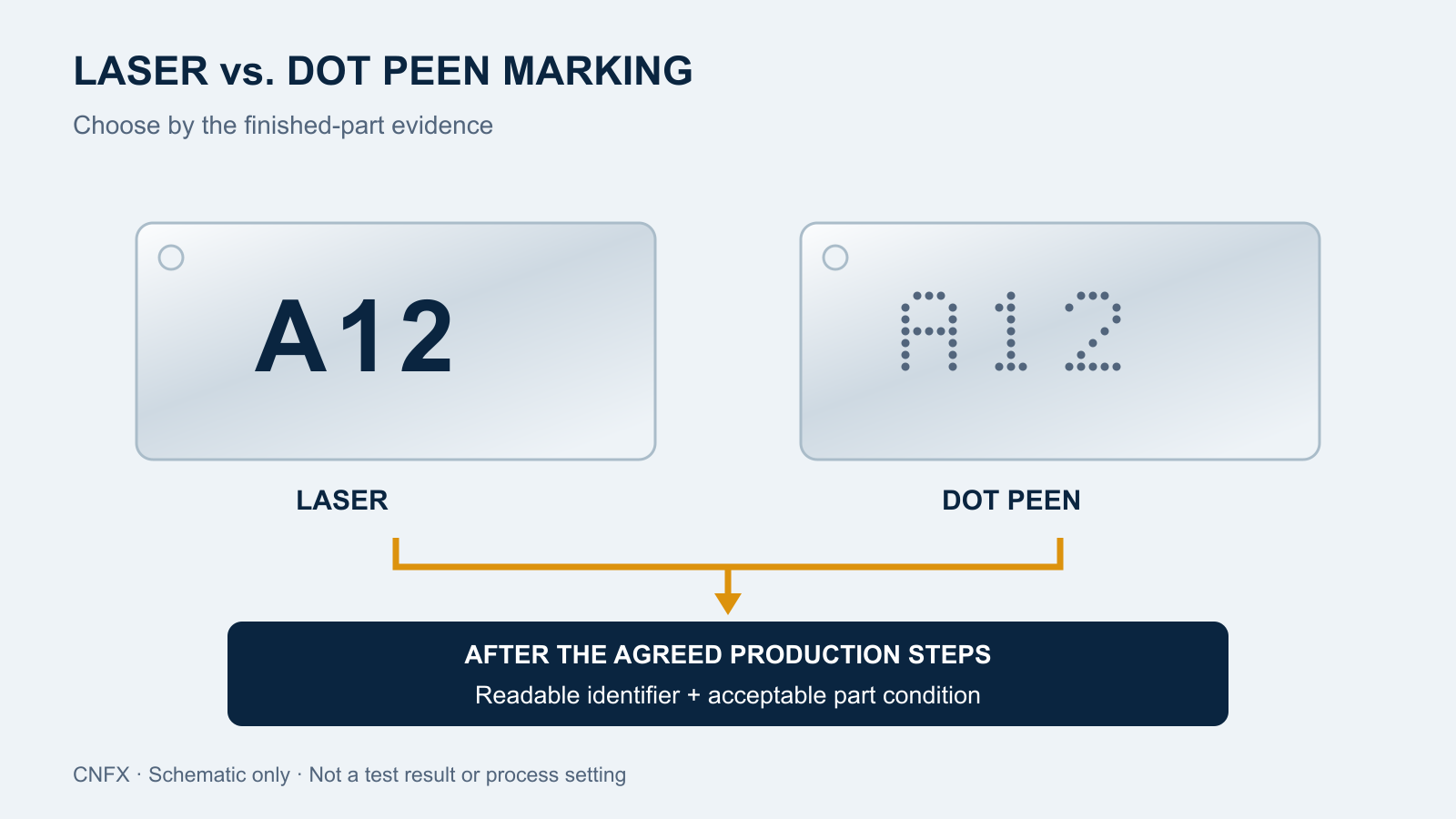
Shortlist laser marking when non-contact marking and fine detail matter; shortlist dot peen when an indented identifier is appropriate. Approve either only after trials on your material, finish and part geometry meet the agreed reading and part-condition requirements. A customer drawing or marking specification may already restrict the permitted method.
Dot peen uses a driven stylus to make a pattern of indentations. Laser marking uses light to alter or remove material at the surface. Both can produce identifiers and be integrated into production equipment; neither is automatically the correct choice for every metal component. Pryor’s comparison of the two processes.
This guide is for purchasing identification equipment for industrial metal parts and metal tags. It does not specify a safe marking depth, laser settings, code-quality grade or a regulated product’s marking requirements. The responsible engineering and quality teams must approve those limits for the actual application.
Laser vs. dot peen: compare the right questions
| Purchase question | Laser marking | Dot peen marking |
|---|---|---|
| How is the surface marked? | Non-contact optical process; the result depends on the selected laser process and material. | Contact process producing individual indentations; the part and fixture must suit the proposed operation. |
| What should the sample prove? | The specified text or code is readable on the actual surface without unacceptable changes to the part. | The indentations give the required readable identifier without unacceptable changes to the part. |
| What happens after finishing? | Test the selected mark through the intended downstream operations. | Test the selected mark through the same downstream operations; indentation alone is not an acceptance result. |
| How should speed be compared? | Time the complete supplied station with the agreed identifier and handling sequence. | Use the same identifier, acceptance requirements and start/end points. |
| What belongs in the price? | The complete station, application work, required safeguards, reading equipment and support—not only the laser source. | The complete station, fixture, marking head, applicable utilities, reading equipment and support—not only the controller. |
This is a quotation-review framework, not a performance ranking. Ask each supplier to fill in the missing application-specific evidence rather than treating a comparison table as a machine specification.
Start with the finished part, not the showroom sample
List the operations between marking and the point where someone must read the identifier: for example, coating, heat treatment or cleaning, if they apply to your process. Provide the actual sequence and conditions to the supplier. A readable fresh mark does not establish readability after a different surface condition.
MECCO’s selection guidance highlights surface condition, subsequent processing and the reader/lighting combination. Its practical implication is to test the application, not assume that “permanent” or “deep” describes every later condition. MECCO’s marking-technology selection guidance.
For a purchased nameplate, include the plate’s final material and finish in the trial. For direct part marking, identify the approved marking area on the drawing. Do not transfer a successful result from a flat tag to a curved component without checking that component.
Keep these two questions separate: can the identifier be read, and is the marked part still acceptable? A legible mark is not evidence that a critical surface or functional requirement has been preserved. Any additional engineering inspection belongs in the agreed acceptance plan.
A four-stage sample trial before purchase
- Agree the trial basis. Give both suppliers the same controlled drawing revision, material/finish description, identifier content, permitted location and required production cases. Ask the quality owner to define the sample selection and pass/fail criteria; do not let a supplier silently choose only the easiest sample.
- Identify every sample and setting record. Assign a trial ID before marking. Require the supplier to record the proposed machine configuration and process recipe reference. Keep photographs and results linked to that ID, not just to the machine’s sales name.
- Check at the actual use stage. Have authorized personnel complete the agreed downstream sequence. Check human-readable text or machine-readable codes using the specified method. Record the reader, lighting, orientation and surface condition where relevant. If the customer specifies formal verification, an ordinary successful scan is not a substitute for its required report.
- Close deviations before the order. Record failures, rework, changed recipes and retests. Carry the accepted configuration and evidence references into the quotation. Define what must be demonstrated again at delivery and at the installed station.
The number of samples and acceptance limits must come from the application’s quality plan. This guide does not supply a universal sample count or a claim of statistical qualification.
Use one evidence sheet for both bidders
Copy this worksheet into the RFQ review. Each “result” needs a linked record. “Supplier says yes” should remain an open item until the required evidence is available.
| Record | What to capture | Decision hold point |
|---|---|---|
| Sample identity | Trial ID, drawing revision, material, finish, geometry and photograph. | The demonstration coupon does not represent the part being ordered. |
| Identifier | Exact text or encoded data, format, permitted marking area and recipe reference. | The trial uses a shorter or easier identifier than production. |
| Downstream condition | Completed process sequence and the record identifying the tested finish. | Only the freshly marked surface was examined. |
| Reading result | Agreed method, equipment/configuration, results and failures for each sample. | A photograph or one phone scan replaces a specified acceptance test. |
| Part condition | The engineering/quality checks required for the approved marking location. | Legibility is treated as approval of the part itself. |
| Complete cycle | Agreed timing boundary, loading, positioning, marking, reading and unloading as applicable. | A marking-only time is compared with another bidder’s complete station time. |
| Data handling | Demonstration records for the required serial sequence, changeover and reject handling. | A correctly shaped mark contains the wrong production data. |
This worksheet is CNFX’s procurement synthesis, not a test standard. Attach your approved requirements to it; do not replace them with the table.
What to include in the RFQ
Request a quotation against the accepted trial, with these six scope items stated separately:
- Part family and marking requirement: controlled drawings, representative variations, identifier content and approved marking area.
- Complete station: proposed marking configuration, fixture, part handling, reader or verifier if required, and the interfaces your line needs.
- Site and safety review: installation requirements and the safeguards and extraction provisions appropriate to the selected process. Have the supplier and responsible site personnel resolve these before commissioning; do not improvise an open-beam arrangement.
- Acceptance deliverables: sample results, agreed procedures, training, configuration records and responsibility for unresolved deviations.
- Running costs: planned maintenance, replacement items, utilities, extraction/filter service where applicable, software and support charges.
- Commercial boundaries: exclusions, installation, spares, response arrangements, and what happens if the supplied station does not pass the agreed acceptance.
A complete laser machine may include an enclosure, fume management, controls, handling and code validation; Laserax lists these as configuration-dependent parts of an industrial solution. That is why a laser-source price alone is not a like-for-like station quotation. Laserax industrial marking-machine scope.
Common mistakes that make quotations misleading
- Choosing by wattage alone. Ask for the demonstrated result on your application, not a larger number on the brochure.
- Equating depth with lifetime readability. Preserve the evidence after the actual downstream operations.
- Buying from a photo. A clear-looking image does not establish the required code-reading result or part condition.
- Accepting “no maintenance” without a schedule. Obtain the service instructions and list of replacement items for the complete station.
- Assuming portability solves access. Check the real part position, fixture, work envelope and approved operating arrangement. Both technologies have portable product examples; portability is not, by itself, application approval. Rocklin’s portable marking comparison.
Questions buyers ask
What are the disadvantages of laser marking?
For a buyer, the main limitation is that a promising demonstration is specific to a material, finish, configuration and process. You still need application trials, a complete-station quotation and an approved installation. “Non-contact” does not mean that the surface is unchanged or that every part is suitable.
What is the difference between laser engraving and marking?
Laser marking is a broad description of producing an identifier with a laser. Engraving normally refers to removing material to create a recessed mark. Ask the supplier to name the actual process and its effect on your part; the marketing label alone is not a depth or durability specification. KEYENCE’s industrial engraving explanation.
Will dot peen marks remain readable after painting?
Do not assume so without an application trial. Test the proposed mark through your specified coating process, then inspect or read it at the intended use stage against the agreed criteria. An indentation visible before coating is not the final acceptance evidence.
Which method is cheaper?
Compare complete quotations after both meet the same requirements. Include fixtures, safeguards, reading equipment, integration, maintenance and acceptance work. A lower equipment price cannot compensate for a station that fails the required identifier or part-condition checks.
Sources and editorial responsibility
Prepared by CNFX. Linked original manufacturer guidance was checked on 13 September 2026. This is a document-based purchasing guide, not a factory trial, independent machine comparison or engineer-approved process. No sample results, prices or service-life figures have been invented.
The trial sequence and worksheet are editorial tools to help buyers request evidence. Follow the customer’s current specification and your engineering and quality teams’ approved requirements. Contact CNFX to report a correction.