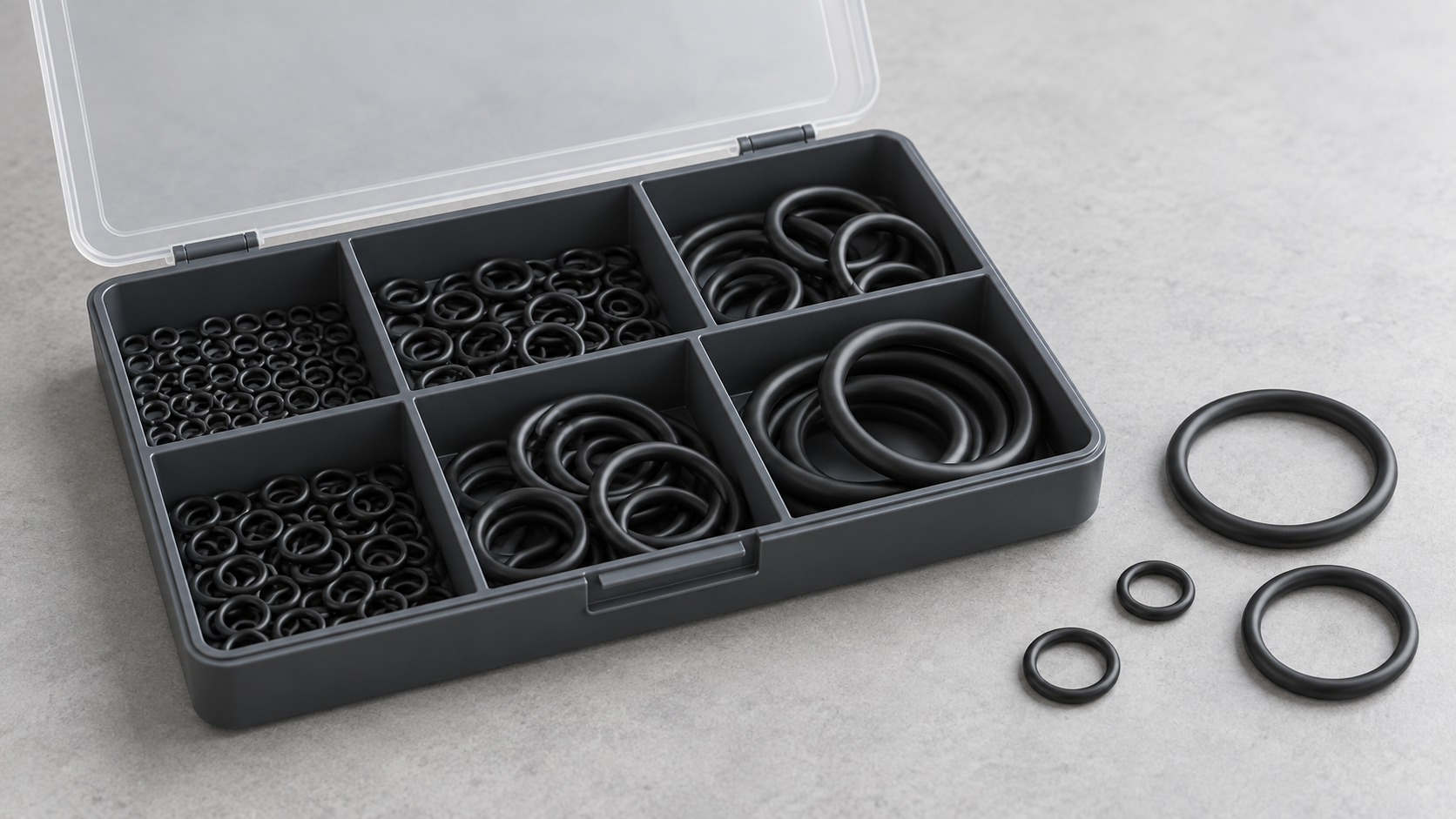
O-Ring Supply Co. offers standard assortments and custom O-ring kits for buyers who want a defined set of seals in one package. For an equipment service kit, start with the approved parts needed for a particular machine or service task; for a workshop assortment, start with the sizes your team actually uses. These are different products, even when their boxes look similar.
Choose the kit around the job
The company's kit range includes AS568, metric and material-specific assortments, alongside kits configured to a buyer's bill of materials. It also describes customer part numbering, bag or case packaging and label options. That creates a useful starting point for equipment brands, service organizations and distributors looking for a recognizable, repeatable product rather than a loose collection of rings.
| Buying situation | Useful kit concept | Your starting document |
|---|---|---|
| Maintaining one equipment model | Task-specific replacement set | Released service parts list and model revision |
| Supplying several repair branches | Common assortment with a controlled refill list | Branch consumption records and approved seal references |
| Launching a distributor product | Clearly named size or material assortment | Intended customer, contents schedule and packaging brief |
| Supporting a new machine design | Development set followed by a released service kit | Engineering-approved part list when available |
This is a planning comparison, not a claim that any assortment fits every machine. The most attractive kit is often the one a customer can identify, order and replenish without translating between several inconsistent parts lists.
Standard assortments or custom sealing parts?
Customizing a kit and customizing an individual seal are separate decisions. You might need standard rings packed in your preferred quantities, or a new sealing component that first needs its own drawing review. O-Ring Supply Co.'s custom service describes dimensional, material, hardness and color options as well as drawing-based sealing parts. Discuss the individual part before treating it as an approved item in a production kit.
The supplier also lists FKM O-rings. A material family can help organize an enquiry, but it is not a complete specification for a particular fluid, temperature or equipment duty. Where your machine already has an approved compound reference, carry that reference into the kit list rather than replacing it with a broad material name.
Give each kit an identity customers can reorder
A practical product brief separates three identifiers: the equipment model, the complete kit code and each component code. One model may use different kits for different service tasks. Conversely, a common approved component may appear in several kits. Keeping these relationships explicit makes product descriptions clearer and gives sales teams a straightforward way to respond to repeat enquiries.
For example, a distributor could describe an illustrative “Service Set A” as the parts for one scheduled maintenance operation, while “Workshop Assortment B” is a stock selection for multiple jobs. These names are examples, not O-Ring Supply Co. catalogue items. The distinction helps avoid advertising a general assortment as a complete model-specific replacement set.
A copyable kit contents brief
Use one row per approved component. Leave undecided fields marked “to confirm”; an empty cell is easy to mistake for an optional requirement.
| Field | What to put in the brief |
|---|---|
| Kit identity | Your kit code, revision and intended service task |
| Component identity | Your part reference and the corresponding supplier reference once agreed |
| Specification reference | Controlled drawing or approved size and compound specification |
| Quantity | Pieces of this component per complete kit |
| Presentation | Compartment or bag position and the wording required on its label |
| Release owner | The person responsible for approving changes to the contents |
For a first commercial discussion, attach this schedule to a short explanation of the customer: a maintenance department, reseller or equipment owner. Include destination, initial kit quantity and expected reorder pattern. Ask for sample arrangements, current minimum quantities and delivery terms in the quotation; they should not be assumed from a general web page.
Review a sample as a finished product
Receiving a sample kit is a chance to review the experience your own customer will have. Open it using the proposed instruction sheet, find each item using the contents list, count the contents and check the label-to-part mapping against the agreed specification. Record any requested change on the same revision-controlled brief.
Separately, have the responsible technical team qualify the seals for the intended equipment. A tidy package confirms presentation, not sealing performance. Keep the packaging review and the application approval distinct so a successful label check is never mistaken for product qualification.
Common avoidable mix-ups include using one kit name for two revisions, overlooking whether quantities mean pieces or complete sets, and allowing an undocumented substitute during replenishment. Resolving these details makes the offer easier to sell and reorder; it does not require turning the customer-facing description into a technical audit.
Questions buyers ask
Where can I find custom-made O-rings?
O-Ring Supply Co. lists a custom sealing-parts service. Use its CNFX company profile to discuss your requirement, distinguishing a custom ring from a custom assortment of already specified rings.
Is an O-ring kit a kit for making rings?
Not necessarily. This article concerns assortments of finished seals. Cord-and-splicing kits are a different product and should not be substituted without an appropriate application review.
Can a branded kit include my own part references?
The supplier describes customer part numbering and customized labels. Confirm the exact artwork, contents schedule and packaging sample for your order before approving the finished presentation.
How should I compare two kit quotations?
Compare equivalent contents and specification revisions first, then packaging, samples, delivery scope and reorder terms. A larger piece count is not automatically a more useful kit if the extra sizes do not serve your customers.
Explore the sealing component on CNFX
The O-Ring Seals reference introduces an individual sealing component in an equipment context. A component reference is not a complete service-kit contents list: use your own approved parts schedule to define the kit.
Discuss your kit with O-Ring Supply Co.
Bring your service-parts list or assortment concept to O-Ring Supply Co. on CNFX. Describe who will use the kit and how it will be sold or replenished. The company can then respond to a defined product enquiry, with the final contents and commercial terms agreed for your order.
Sources and scope
Prepared by CNFX from the linked company kit, custom-service and FKM product pages, checked on 15 September 2026. The kit-identity example and contents brief are editorial planning aids, not named catalogue products or reported customer results. Final contents and commercial terms are agreed with the supplier. Suggest a correction.