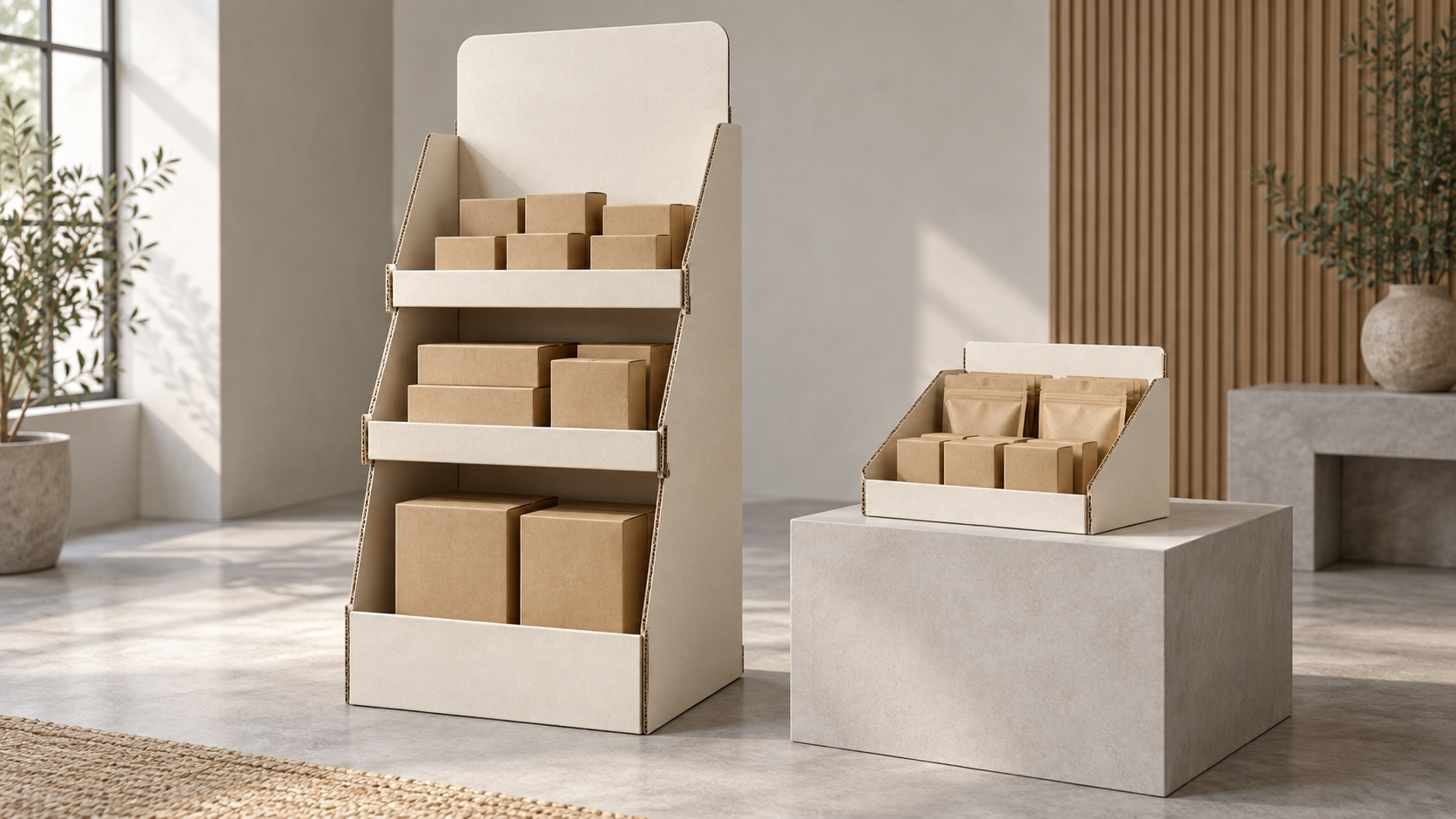
A retail display range built around your brand
A white-label cardboard display is a custom retail fixture supplied for another business to present under its own brand. The display partner leads the customer-facing offer; the manufacturer develops and produces the agreed structure. For an agency with the creative concept but no converting line, this separates the presentation work from the physical build.
Dongyang Shangle Paper Products Co., Ltd. on CNFX connects buyers to Shangle Display’s offering. Its published manufacturing scope covers corrugated floor displays, counter and PDQ trays, sidekick displays, pallet formats and dump bins. The company identifies its location as Dongyang, Zhejiang, China, and positions its service for trade partners.
A useful starting collection is one freestanding display for a larger product assortment and one small tray for a counter or shelf. They can share a campaign’s graphic language without being identical structures. The larger fixture creates a dedicated presentation; the tray keeps a smaller selection together where space is limited.
Floor display or countertop tray?
Choose by the store position and the products shoppers need to reach. More shelves are not automatically a better display: an accessible, easy-to-refill arrangement is often the clearer brief.
| Format to discuss | Useful merchandising role | What to show in the first sample |
|---|---|---|
| Freestanding floor display | A grouped assortment with a visible header and separate product rows | Actual packs in every shelf position, including the lowest row |
| Counter or PDQ tray | A compact selection beside a service point or on an existing shelf | Front-edge height, pack visibility and access to the last remaining item |
| Sidekick display | A narrow selection beside another retail fixture | The intended attachment arrangement and usable space around it |
These are planning scenarios, not a catalogue of tested configurations. Give the factory the permitted footprint and the product pack dimensions before choosing shelf counts. A heavier bottle, a light carton and a flexible pouch need different support and retention arrangements even if their front-facing dimensions look similar.
Shangle’s PDQ tray offering includes open-front and counter formats, with structure and pack-out reviewed around the project. Discuss whether a tray will arrive empty for local filling or travel with merchandise already inside. That choice changes the sample you need to review.
One campaign, two display sizes: a practical example
Imagine a packaging agency developing a launch for three boxed personal-care products. Larger stores have an approved floor position; smaller stores can offer only a countertop area. Instead of commissioning unrelated designs, the agency can define a shared header treatment, one color palette and the same product order across both formats.
For the floor unit, the sample brief can ask for three clearly separated product zones. For the countertop version, the brief can ask for a smaller selection with the same left-to-right sequence. Put real empty or filled packs into each sample as appropriate, check whether labels face forward, and remove items one by one to see how the presentation changes as stock sells down.
The deliverable is not simply “a stand plus a tray.” It is a pair of display layouts, a matching artwork set and an agreed way to assemble and replenish them. This example is an editorial planning exercise, not a claim about a Shangle customer campaign or a promised sales increase.
Keep the creative and manufacturing handoff simple
Shangle’s OEM partnership page describes structural review, sampling, printing, assembly and export pack-out support. It also describes neutral project materials and a white-label working model in which the partner retains the client relationship. Confirm the communication and branding arrangements for your own order.
| Project handoff | Agency or packaging partner supplies | Output to agree with the factory |
|---|---|---|
| Concept to structure | Product packs, store position and assortment | A dimensioned layout and sample scope |
| Structure to graphics | Approved brand files and message hierarchy | The matching dieline version and printable areas |
| Sample to production | One consolidated approval or change list | A recorded structure, artwork and packing revision |
| Production to store | Delivery destination and assembly responsibility | Carton labels, component list and setup instructions |
Keep the structure and artwork versions together. A small change in shelf height can move a graphic panel or change how a fold interrupts the design. Approving the print on an obsolete dieline creates avoidable rework; one named release package gives everyone the same reference.
Make the physical sample useful
Start with fit and access, then review the printed presentation. With the actual product loading agreed for the display, check shelf support, clearances, header position and the space needed for a shopper’s hand. Ask the manufacturer to propose an appropriate load and handling check for the structure and intended store use; do not borrow a capacity figure from a similar-looking stand.
For the printed sample, view the graphics from the intended shopping direction. Confirm that the main message remains visible when all products are loaded and that important text does not disappear behind a pack or fold. Photograph the approved arrangement and label the sample with its revision.
Finally, have someone who did not design the unit follow the assembly sheet. Record the steps that need clarification. This can reveal a missing orientation mark or an ambiguous shelf tab before the display reaches a store. If the unit is to be pre-assembled, review the packed unit and unpacking sequence instead.
Buyer questions
What is a cardboard display called?
Common names include corrugated display, POP display and POS display. A freestanding unit is often called an FSDU; a small shelf or counter unit may be described as a PDQ tray. Include a picture or sketch in the enquiry, because terminology alone does not define the structure.
Who manufactures the displays?
Shangle Display presents itself as the manufacturing partner for custom cardboard retail displays. CNFX’s linked profile identifies the registered enterprise as Dongyang Shangle Paper Products Co., Ltd. Discuss the exact production and delivery scope with that supplier.
Does white-label mean plain, unprinted cardboard?
No. It concerns whose brand faces the customer, not whether the display has graphics. A white-label project may use buyer-branded printing, while a plain structural sample is used earlier to review shape and fit.
How should I compare manufacturers?
Send the same product, placement, print and packing brief to each candidate. Compare the proposed sample and deliverables, not just a headline unit price. The most useful fit is a supplier that can explain how its proposed structure and handoff serve your particular campaign.
Discuss a branded display program
Bring your display concept to Shangle through CNFX. Include product dimensions and weight, the intended store position, approximate quantities by format, artwork status and delivery destination. Add whether you need flat-packed units, pre-assembly or a filling arrangement reviewed. That gives the factory a concrete starting point for a coordinated display proposal.
Sources and scope
Prepared by CNFX from the linked Shangle manufacturing, OEM partnership and PDQ tray pages, checked on 15 September 2026. The campaign example and review steps are editorial planning aids, not a tested customer project. Product specifications and commercial terms are agreed for the order. Suggest a correction.