What should you specify first?
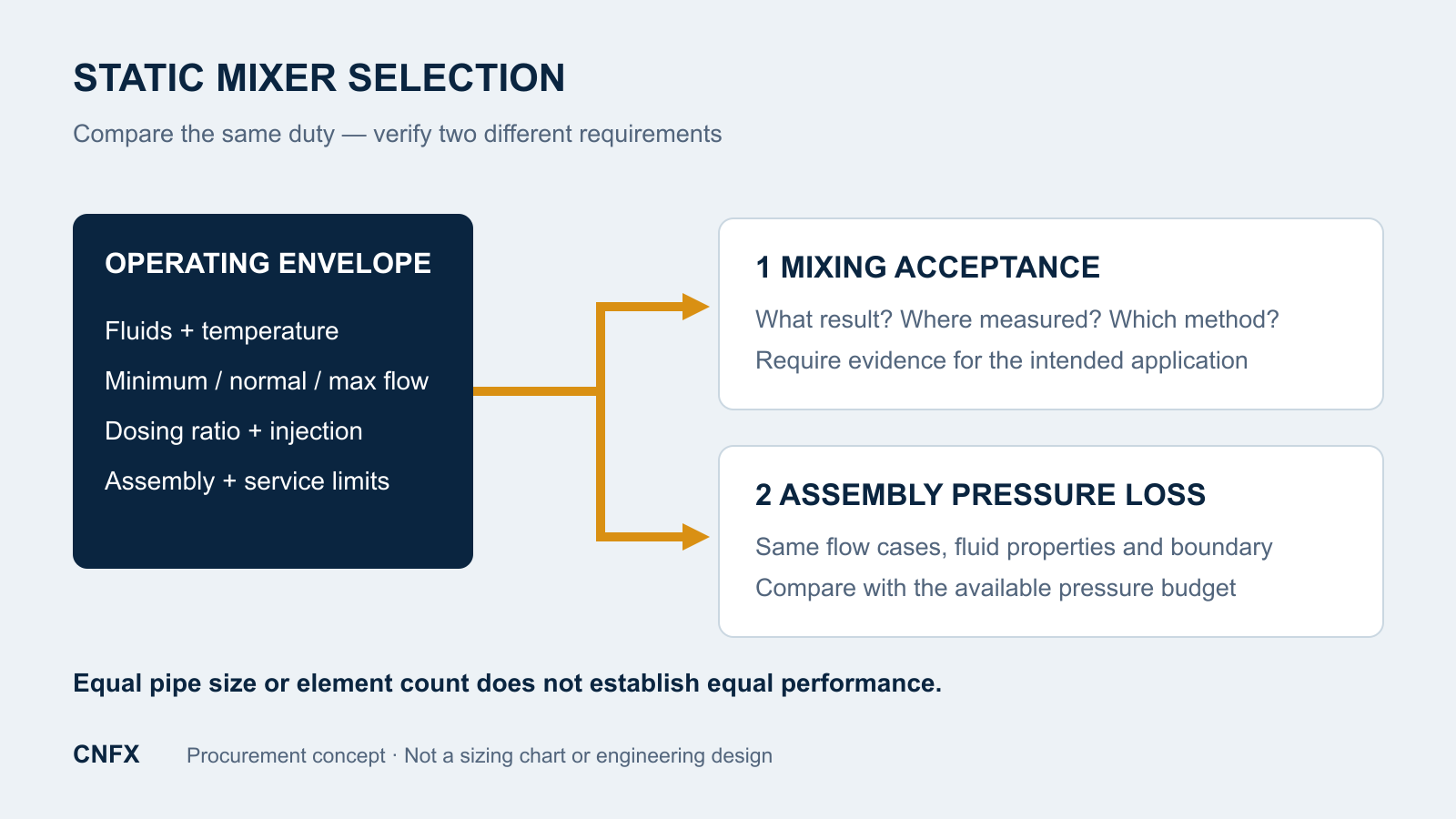
Specify the mixing result and the maximum acceptable pressure drop together, for a defined range of fluids, temperatures and flow rates. Then ask the supplier to identify the element design, quantity, actual flow passage and evidence supporting both requirements.
A static mixer uses fixed internal elements and energy from the flowing stream; “no moving parts” does not mean no pressure loss. ROSS’s selection procedure considers the flow regime, mixer model, diameter, element count and fluid properties rather than selecting by pipe size alone. ROSS selection guidance.
This checklist is for purchasing industrial liquid-blending equipment. It is not a sizing calculation, a pressure-vessel specification or permission to commission equipment. Gas service, two-phase flow, reactive mixtures, hazardous chemicals and hygienic duties require additional application-specific engineering review.
Keep three different requirements separate
| Requirement | What the quotation should establish | What it does not establish |
|---|---|---|
| Operating and design pressure | The service conditions and applicable mechanical rating of the assembly, connections and seals. | How much pressure is lost through the mixer. |
| Mixer pressure drop, ΔP | The pressure difference across a stated assembly boundary at a stated duty. | Whether the outlet mixture meets its quality target. |
| Mixing acceptance | A measurable outlet requirement, agreed sampling location, method and operating cases. | Whether the pump and the rest of the line can support the selected mixer. |
OMEGA’s model-specific selection guide explicitly treats mixing performance and maximum allowable pressure drop as separate selection considerations. Its charts and correction factors belong to the listed mixer range; they are not universal values for any static mixer. OMEGA static mixer selection guide, PDF.
For an existing line, have the responsible engineer establish the pressure-loss allowance available to the mixer after accounting for the remaining system. Do not offer the supplier the pump’s discharge pressure as if the mixer could consume all of it.
An eight-part RFQ information pack
Send every bidder the same revision of this pack. Write “to be confirmed” beside missing information and assign an owner; a blank field should not silently become a supplier assumption.
- Fluids and mixing task. Identify each stream, composition information needed for compatibility, and whether the objective is blending miscible liquids or a different process. State any solids, fouling tendency or non-Newtonian behavior known to the process team.
- Properties at service temperature. Provide density and viscosity for each relevant operating case, with units, temperature and the source of the values. If a property is uncertain, identify its range and ask how that uncertainty affects the selection.
- Flow and dosing envelope. List minimum, normal and maximum main-stream and added-stream flows, including the required mixing ratios. Flag start-up and intermittent dosing separately. A normal-flow quotation alone leaves the rest of the duty unverified.
- Mixing acceptance. Define the property to be measured and the permitted variation. Ask the supplier to propose a justified sampling location, sampling method and acceptance procedure where these are not yet established. “Thoroughly mixed” is not a complete acceptance criterion.
- Pressure-loss allowance. Specify the maximum acceptable ΔP for each required case. Identify whether the supplier’s figure includes the housing, elements, injection fitting and any transitions. Request a curve or a table over the agreed operating envelope.
- Physical and injection arrangement. Give the actual pipe inside diameter, connections, available length, orientation and inlet arrangement. Include the dosing port or injector in the scope discussion rather than treating it as an unrelated accessory.
- Materials and maintenance. Identify the wetted housing, elements, seals and fittings; disclose cleaning chemicals and conditions. Ask how the assembly will be inspected, cleaned and, where applicable, removed within the available space.
- Deliverables and responsibilities. Request the selected model and drawing, calculation or test basis, operating limitations, installation instructions, inspection documents, exclusions and the party responsible for each unresolved interface.
Injection geometry belongs in the discussion: the Komax brochure includes injection ports, spargers and diffusers alongside the mixer selection information. An element-only quotation should not be assumed to cover an effective dosing arrangement. Komax mixer brochure, PDF hosted by Oxidation Technologies.
Compare evidence, not just element count
Use the following table during quotation review. Record the supplier’s document reference in each row; mark missing evidence as an open item before placing the order.
| Review item | Evidence to request | Hold the decision when… |
|---|---|---|
| Same operating basis | A returned duty sheet identifying the fluid properties, temperatures, flow cases and ratios used. | One bidder uses water or nominal flow without explaining the relationship to the actual duty. |
| Same assembly boundary | A drawing showing the quoted housing, elements, injector, transitions and ΔP reference locations. | One loss figure covers elements only and another covers the complete assembly. |
| Mixing result | An agreed target and model-specific calculation, test evidence or proposed application test. | The only support is a generic “excellent mixing” statement. |
| Pressure budget | A pressure-loss curve or duty-point table with assumptions and applicable range. | The supplier supplies one unexplained number or a curve for a different geometry. |
| Service suitability | Written material, seal and cleaning compatibility review for the disclosed conditions. | A familiar alloy or plastic name is treated as blanket approval. |
| Acceptance and exclusions | A test plan, supplied-document list and explicit allocation of site work. | The buyer and supplier disagree about what will be measured or who supplies the injector. |
A lower purchase price is meaningful only after the duty and scope match. More elements, a larger nominal size or a lower stated ΔP do not independently demonstrate a better solution.
How to read a pressure-drop claim
Check the model, geometry, fluid properties, flow range and units printed beside the result. Ask whether it is a measured value, a manufacturer correlation or a prediction, and whether the quoted operating cases lie within its supporting data.
Pay particular attention to total assembly pressure loss versus loss per unit length. A 2026 experimental paper on Komax mixers examined specific element configurations in a 40 mm pipe using water under turbulent conditions. Its reported reduction in loss per unit length with increasing element count must not be read as a universal promise that a longer mixer has less total loss. The study’s geometry and test conditions limit what can be transferred to another installation. Zenati et al., pressure drop in Komax static mixers.
If the proposed mixer exceeds the allowance, return to the supplier with the same mixing acceptance requirement. Ask for a revised selection and its supporting evidence. Do not independently remove elements or transplant a coefficient from another mixer design to make the quotation fit.
Verification before order and before acceptance
- Close the design basis. Reconcile the returned duty sheet with your specification. Have the responsible process and mechanical reviewers resolve deviations, property uncertainties and system interfaces.
- Review both performance requirements. Check mixing evidence and the pressure-loss allowance for every required operating case. Where evidence does not cover the application, agree a representative test and its limitations before purchase.
- Check the supplied configuration. Compare the approved drawing and material documents with the delivered assembly. Confirm the element configuration, flow direction instructions, injector and access provisions without improvising changes.
- Use an approved site acceptance plan. Qualified personnel should verify mixing quality and pressure loss separately using the agreed methods and safe operating procedures. Record the actual fluids, temperatures, flows, sampling locations and instrument details with the results.
A pressure change during service is a reason to investigate operating conditions and equipment condition; it is not, by itself, proof of fouling or proof that the mixture has become unacceptable. Keep the original accepted operating data as the comparison baseline.
Common purchasing mistakes
- Ordering by nominal pipe size alone. Confirm the actual flow passage and the selected internals.
- Comparing different reference fluids. Ask each supplier to return results for the same agreed property and temperature cases.
- Ignoring low-flow and dosing conditions. Include the required operating envelope, not only the headline production rate.
- Treating “maintenance-free” as an inspection plan. Confirm access, cleaning compatibility and the supplier’s actual maintenance instructions.
- Accepting an undefined mixing percentage. Establish what is measured, where, how and against which acceptance limit.
Buyer questions
How many static mixer elements do I need?
There is no universal count. Ask for a selection that meets the defined mixing target and pressure-loss allowance over your operating envelope. Element geometry matters, so equal counts from different designs are not a like-for-like specification.
Is the mixer with the lowest pressure drop the best choice?
Only if it also meets the mixing requirement, service conditions and installation constraints. A low loss figure without matching mixing evidence is an incomplete comparison.
Can pressure-drop measurement prove that mixing is satisfactory?
No. It checks a hydraulic requirement. Verify the agreed mixture property separately at the agreed location; do not substitute a pressure reading for the mixing acceptance test.
Can I use a catalog chart to size a different manufacturer’s mixer?
Not without an engineering basis that establishes its applicability. Use the selected manufacturer’s model-specific method and disclose any operating condition outside its stated range.
Sources and editorial responsibility
Prepared by CNFX; original manufacturer documents and research checked on 13 September 2026. This is a document-based procurement guide, not a factory test or an engineer-approved design. The RFQ pack and review worksheet are CNFX’s editorial synthesis, not an engineering standard. Historical catalog documents establish the scope of their selection methods, not current prices or product availability.
Use the supplier’s current written selection and the project team’s approved specification for purchase decisions. Contact CNFX to report an error.