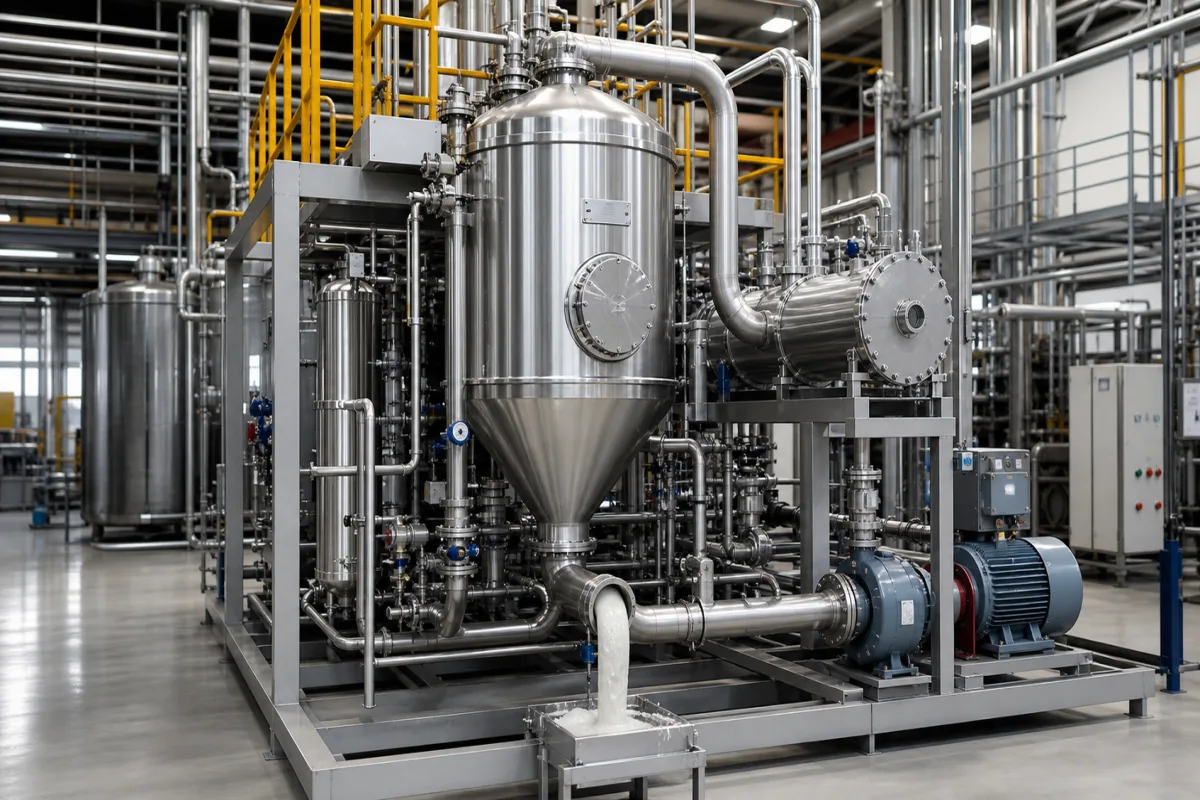
Solution crystallization · FC, DTB and OSLO crystallizers, supersaturation and crystal size, fines destruction, scale-up and fouling
An industrial crystallization unit recovers a dissolved product as solid crystals by making its solution supersaturated, through cooling, evaporation or reaction, and growing crystals in a vessel with circulation, heat exchange and slurry removal. Ask three things first: which crystallizer type and process option suit your product's crystal size and purity, how supersaturation and slurry density will be controlled at full scale, and what product and pilot tests the supplier will run first.
Industrial solution crystallizers for chemicals and similar products: forced-circulation, draft-tube-baffle and fluidized-bed (OSLO) types, cooling, evaporative and reaction crystallization. Continuous-casting moulds called crystallizers, laboratory glass crystallization reactors and melt crystallization are outside this page.
CNFX editorial research · Sources checked October 11, 2026 · 4 sources
GEA describes solution (mass) crystallization as forming solid crystals from a supersaturated solution to recover the dissolved substance in high purity and the desired granulometry, with achievable particle size from microns to millimetres depending on crystallizer type. It lists cooling, evaporative-cooling, evaporative and reaction crystallization as process options. [1]
GEA characterises its three solution crystallizer types this way: the forced-circulation (FC) crystallizer is simple in design and robust in operation; the draft-tube-baffle (DTB) crystallizer gives limited attrition and efficient fines destruction to produce coarse crystals with a narrow size distribution; and the OSLO fluidized-bed crystallizer grows the largest crystals at elevated retention time. [1]
On its OSLO page GEA explains that clarified solution carrying fine crystals is drawn from the baffle zone, the fines are dissolved by superheating it in an external heat exchanger, and the supersaturated solution is then guided down the draft tube to fluidise a crystal bed, where supersaturation is relieved through crystal growth. [2] GEA runs test centres and pilot plants for product trials. [1]
Give the supplier the product and solvent, feed concentration, impurities and temperature, required crystal size distribution, purity and moisture, capacity, preferred process (cooling, evaporative, reaction), available steam, cooling water and power, materials of construction, and whether samples can be sent for pilot tests.
02
Control supersaturation, slurry density and crystal size
In a Chemical Processing problem-solving column, crystallization consultant Wayne J. Genck lists the key variables that control crystal size and distribution: slurry density, supersaturation, crystallizer geometry including impeller-to-vessel diameter ratio, impeller tip speed, circulation rate, and pressure and temperature. For scale-up he advises keeping supersaturation and slurry density close to the original, scaling the agitator carefully, matching circulation rate and keeping pressure and temperature the same. [3]
Analysing a DTB borax crystallizer whose active volume had been raised 50% without more circulation, the column explains that the higher temperature rise around the draft tube boosted supersaturation and caused severe encrustation through the circuit; a poorly placed feed pipe let fines short-circuit; and abrasive borax crystals eroded pumps, impellers and heat-exchanger tubes. It states: "For many systems, the fines destruction circuit should have less than 1 wt-% solids." [3]
The column also warns that impulse-line differential-pressure and displacer level instruments are prone to plugging in slurry service, and that lower circulation and slow-velocity zones can cause scaling. [3] Editorial calculation: retention time is active slurry volume divided by product slurry flow, so a 20 m³ active volume discharging 5 m³/h gives about 4 hours; volume and flow are assumed for illustration.
03
DTB, MVR, multiple-effect, vacuum and reaction crystallizers from listed suppliers
Listings include DTB and MVR evaporation crystallizers, multiple-effect evaporation crystallizers, vacuum crystallizers and reaction or continuous crystallizers.
04
Check the DTB temperature rise, slurry density and fines removal
Swenson Technology explains on its draft-tube-baffle (DTB) crystallizer page that a large, slow-moving propeller lifts growing crystals to the boiling surface, where supersaturation is “most intense”, and that an annular baffle zone lets a stream of mother liquor carrying fine crystals settle out and leave the body. The fines are destroyed by heating or by mixing with dilute feed or water before the liquor returns to the propeller suction. [4]
Swenson gives figures a buyer can hold a DTB quotation against. Where feed or heated mother liquor mixes with the circulated magma at the eye of the propeller, the temperature rise is approximately 1 °F, which it says limits the supersaturation rate to very low values. It states that crystallizers of this type “typically operate with a suspension of solids ranging from 25-50% apparent settled volume”. In multiple-stage cooling duty, where cooling of the feed in each stage limits natural slurry density to a few percent, the baffle zone lets the operating slurry density be set by controlling the slurry underflow rate and removing the remaining mother liquor from the baffle section. [4]
Editorial calculation: a 1 °F rise equals about 0.56 °C (1 × 5/9). Ask the supplier for its design temperature rise at the propeller or heat exchanger, the design slurry density and how it is measured, and the underflow and clear-liquor flows, then compare them with the figures above. [4]
Design point
Swenson DTB figure
Ask the supplier for
Temperature rise at the propeller eye
Approximately 1 °F (about 0.56 °C, editorial calculation). [4]
Design temperature rise.
Suspension solids
“Typically … 25-50% apparent settled volume” in Swenson's words. [4]
Design slurry density and test method.
Slurry density in staged cooling
A few percent naturally; set by underflow control and baffle liquor removal. [4]
Crystallizer body, draft tube and agitator, baffle zone, heat exchanger, condenser and instruments
The baffle zone and heat exchanger work as a pair for fines destruction: in GEA's OSLO design, fine crystals drawn from the baffle zone are dissolved by superheating in the external exchanger before the liquor returns. [2]
Part
Role
Fix in the order
Crystallizer body
Holds the crystal suspension; type sets crystal size. [1]
Working volume, agitation, temperature control, heat transfer area and materials for a crystallizer quotation
Working volume and circulation have to be sized together: in the Chemical Processing case, raising a DTB unit's active volume by 50% without more circulation raised the temperature rise and caused severe encrustation. [3]
9 companies list this product among what they make. Company figures are quoted from each
company's own website; every card states where the relationship came from.
Shandong Tianli Energy Co., Ltd.
Manufacturing site to be confirmed for the order
Lists DTB crystallizers and MVR evaporation crystallizers with evaporators.
Explore company information and manufacturing capabilities, then discuss the scope of your project with a relevant supplier.
Share this page
Compiled and source-reviewed by the CNFX editorial team.
Each manufacturer above links to the page on that company's own website where the product is listed, with the date we checked it. How we source and review
· Page last updated 13 October 2026
Buyer questions
What is the difference between FC, DTB and OSLO crystallizers?
GEA describes FC as simple and robust, DTB as producing coarse crystals with narrow size distribution through fines destruction, and OSLO as growing the largest crystals in a fluidized bed. [1]
What controls crystal size in an industrial crystallizer?
A consultant writing in Chemical Processing lists slurry density, supersaturation, geometry, impeller tip speed, circulation rate, pressure and temperature. [3]
Why do crystallizers foul?
High local supersaturation, such as from too little circulation for the volume, and slow-velocity zones lead to encrustation and scaling. [3]
What slurry density and temperature rise does a DTB crystallizer run at?
Swenson Technology says its DTB crystallizers “typically operate with a suspension of solids ranging from 25-50% apparent settled volume”, with a temperature rise of approximately 1 °F where feed mixes at the propeller eye. [4]
Sources and what still needs a direct check
Sources checked 2026-10-11. GEA is a crystallizer maker describing its own types, and Swenson Technology describes its own DTB crystallizer; the Chemical Processing column is an independent consultant's analysis of a reader's problem. Crystallizer design should be confirmed by tests on your product.