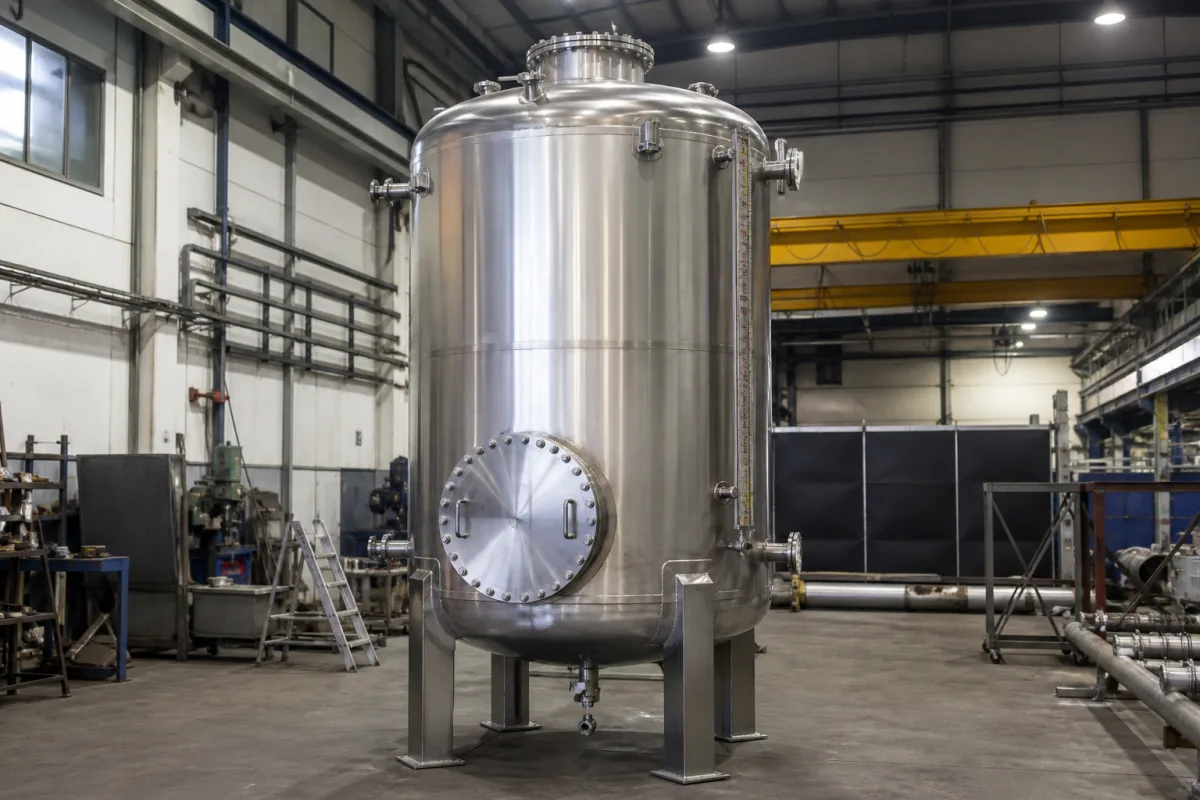
'Storage tank' covers a 200-litre plastic dosing tank, a bolted municipal water tank, a 10,000 m³ welded oil tank, a vacuum-insulated LNG tank and a jacketed stainless dairy vessel. They are built to different codes by different suppliers. Start from the contents, the pressure and temperature, and the rules that apply where the tank will stand.
Atmospheric and low-pressure storage tanks for water, oil, chemicals and food, bolted and welded steel tanks, plastic tanks, cryogenic tanks for liquefied gases, and sanitary process storage tanks. Tanks operating at significant pressure are pressure vessels with their own codes.
CNFX editorial research · Sources checked October 10, 2026 · 9 sources
Pick the tank family from the contents and conditions
A 1,000–10,000 m³ API 650 tank erected on site and a plastic dosing tank share only the name; pick the row that matches your contents before comparing any prices.
Family
What suppliers publish
Ask for
Large field-erected welded steel
Vertical atmospheric tanks to API 650 named by suppliers, e.g. 1,000–10,000 m³, with design, fabrication and on-site erection. [2][3]
Design code and edition, shell and bottom plate thickness, roof type, foundation design and erection scope.
Bolted factory-coated steel
Glass-fused-to-steel, fusion-bonded epoxy, stainless and galvanised bolted tanks; the supplier names ISO 28765, NSF 61, WRAS and EN 1090. [4]
Coating type and test records, sealant, roof, and the approval certificates for the actual coating and sealant.
Plastic tanks
Plastic water-storage, dosing, conical and IBC tanks. [5]
Resin, wall thickness, UV protection, temperature limit, and chemical compatibility with the contents.
Cryogenic and liquefied-gas
Vacuum-insulated storage tanks to ASME or GB standards, ISO tank containers and microbulk tanks; LNG and industrial gas storage. [6][7]
Design pressure and temperature, insulation performance (boil-off), pressure-vessel code and relief devices.
Sanitary process storage
Single-layer, double-layer jacketed and three-layer cooling/heating mixing tanks in stainless steel. [8]
Material grade, internal surface finish, jacket and insulation, agitator, and cleaning (CIP) design.
A tank that operates above atmospheric pressure, or stores liquefied gas, is designed as a pressure vessel. Sinocleansky, for example, lists medium-pressure (3–20 MPa) and high-pressure (above 20–30 MPa) gas storage alongside its cryogenic tanks. Confirm the code that applies to the offered design. [6]
02
Check the US rules if the tank holds oil
In the US, EPA's Spill Prevention, Control and Countermeasure rule (40 CFR Part 112) covers a facility with more than 1,320 US gallons of aggregate aboveground oil storage, or more than 42,000 gallons completely buried, where an oil discharge could reach navigable waters. Capacity is counted as the shell capacity of each container of 55 gallons or more, not the amount stored. [1]
What the rule expects of the tank installation
EPA lists containers suitable for the oil stored, overfill prevention such as a high-level alarm or audible vent, sized secondary containment for bulk storage containers that holds the full container capacity plus possible rainfall (an earth or concrete dike, remote impoundment, or a double-walled tank may suffice), general containment at transfer areas, and periodic inspection and testing of pipes and containers to industry standards. [1]
The SPCC Plan must be certified by a Professional Engineer unless the facility qualifies to self-certify, which requires total aboveground oil storage of 10,000 gallons or less and no reportable discharges above set amounts in the previous three years. [1]
Put the containment in the purchase
Decide whether containment will be a dike, a bund or a double-walled tank before ordering, and include high-level alarms, vents and inspection access in the tank specification. Other countries have their own storage and containment rules; ask the supplier which they have built to.
03
Ask for approvals that cover the materials in contact with drinking water
For drinking water the approval belongs to the coating, sealants and other wetted materials, not to the tank shape. Center Enamel lists NSF 61 and WRAS among the standards its bolted tanks comply with, and ISO 28765 for glass-fused-to-steel. [4]
Ask for the certificate numbers and the listed products and sizes, and check that the sealant, gaskets and any internal coatings are covered. Specify the water quality and chlorine levels the tank will see.
The same supplier discusses chilled-water thermal storage for data centres and notes that choosing a pressurised or atmospheric tank is a hydraulic decision before it is a vessel decision. Define how the tank connects to the system before choosing its type. [4]
04
Specify process tanks by finish, jacket and cleaning
Sanitary storage tanks for dairy, beverage and food are offered as single-layer, double-layer jacketed and three-layer cooling/heating mixing vessels, and as part of larger lines such as chocolate production. [8][9]
For these tanks the critical items are the stainless grade, internal surface finish (Ra), weld finish, drainability, jacket for heating or cooling, insulation, agitation and the clean-in-place spray system. State the product, cleaning chemicals and temperatures, and ask for the finish measurement and weld documentation.
05
Shell, roof, vents, level alarm, containment and jacket across tank families
Part
Role
Fix in the order
Tank body (shell and bottom)
Contains the product; welded, bolted, moulded or double-walled. [2][4][5]
Material, thickness, coating and design code.
Roof or head
Closes the tank; cone, dome or flat; aluminium dome roofs are offered for bolted tanks. [4][7]
Roof type and design loads.
Inlet and outlet nozzles and valves
Fill and draw the product.
Size, position, material and valve type.
Vent and pressure/vacuum relief
Let the tank breathe and protect it from over-pressure; an audible vent can serve as overfill warning. [1]
Capacity, design pressure, wall thickness, finish and insulation for a tank order
Shell capacity matters twice for an oil tank: it sets the size you buy and counts toward EPA's 1,320-gallon aggregate SPCC threshold. The pressure, finish and insulation rows depend on which family you chose above.
Field
What it means and published values
Ask the supplier for
Capacity (L or m³)
Shell capacity counts for oil-storage thresholds. [1] Welded tanks of 1,000–10,000 m³ are offered. [2]
Nominal and working capacity.
Operating pressure (MPa)
Above atmospheric pressure the tank becomes a pressure vessel. [6]
Design pressure and vacuum, and the code used.
Design temperature (°C)
Sets materials, coating and insulation.
Minimum and maximum design temperature.
Wall thickness (mm)
From the design code and corrosion allowance.
Shell and bottom thickness with corrosion allowance.
Material grade
Carbon steel, stainless, coated steel, plastic or cryogenic alloys by family. [4][5]
Field-erected welded steel, bolted coated steel, plastic, cryogenic and sanitary process tanks come from different makers here; compare suppliers within one family.
AGICO Large Storage Tank
Location not checked for this product
Designs and builds large vertical steel tanks to API 650, 1,000–10,000 m³, and water storage tanks, from design to field construction.
Makes bolted glass-fused-to-steel, fusion-bonded epoxy, stainless and galvanised tanks and aluminium dome roofs, naming ISO 28765, NSF 61, WRAS and EN 1090.
Explore company information and manufacturing capabilities, then discuss the scope of your project with a relevant supplier.
Share this page
Compiled and source-reviewed by the CNFX editorial team.
Each manufacturer above links to the page on that company's own website where the product is listed, with the date we checked it. How we source and review
· Page last updated 13 October 2026
Buyer questions
When does the US oil-spill rule apply to my tanks?
EPA's SPCC rule covers a facility with more than 1,320 US gallons of aboveground oil storage (counting shell capacity of containers of 55 gallons or more) or more than 42,000 gallons buried, where a discharge could reach navigable waters. [1]
How big must secondary containment be?
For bulk storage containers EPA describes sized containment holding the full capacity of the container plus possible rainfall; a dike, remote impoundment or a double-walled tank may suffice. [1]
Is a 'food-grade' or 'drinking-water' tank approved by default?
No. Ask for the certificate covering the actual coating, sealant and wetted materials; Center Enamel, for example, names NSF 61 and WRAS for its bolted tanks. [4]
Sources and what still needs a direct check
Sources checked 2026-10-10. EPA's brochure summarises the US SPCC rule; it is not the regulation text. Supplier pages describe their own products and the standards they name; API 650, ISO 28765, NSF 61 and WRAS documents were not read for this page.