Oilseed expellers · Full press or pre-press, residual oil in cake, seed preparation, cold pressing, screw and cage
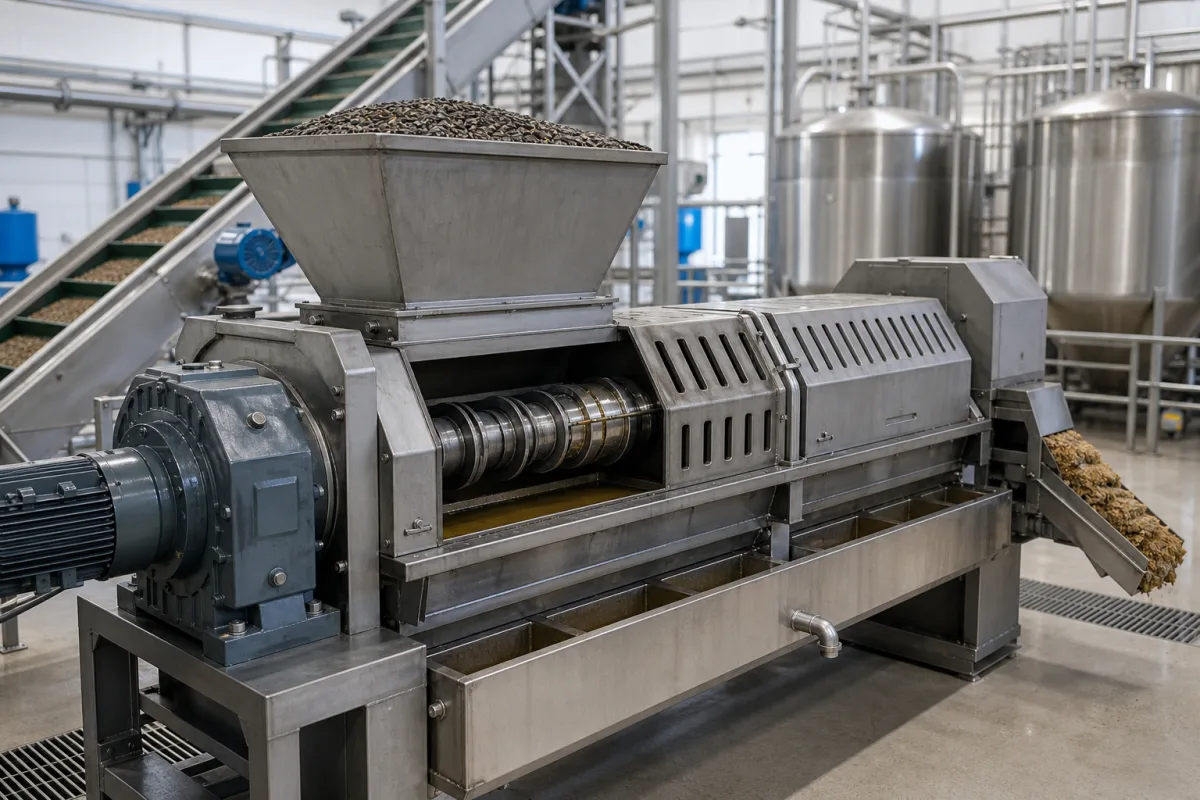
A continuous screw press (expeller) is a machine in which a rotating worm shaft drives prepared oilseed through a perforated barrel or cage of rising compression, so oil drains out through the cage while the pressed cake leaves at the discharge end. Ask three things first: whether you need full pressing or pre-pressing before solvent extraction, what residual oil in cake the supplier commits to for your seed and preparation, and what seed preparation and heat treatment the press assumes.
Continuous screw presses (expellers) for vegetable oilseeds and nuts, for full pressing, pre-pressing and cold pressing, with their feeders and drives. Solvent extraction plants, hydraulic batch presses, oil filters and refining equipment are outside this page.
CNFX editorial research · Sources checked October 18, 2026 · 4 sources
Anderson International, which says its founder invented the continuous mechanical screw press in 1900, describes full pressing as running the shaft slowly with maximum compression to leave 6–8% residual oil in the meal as Anderson’s stated average, used for seeds such as copra, peanut, corn germ and palm kernel, and says its presses reach residual oil as low as 5%. Pre-pressing runs the shaft faster with lower compression, leaving about 16–20% oil for downstream solvent extraction, which it says is designed around soybeans at 16–22% oil; any press can be converted to pre-pressing by raising shaft speed and reducing compression. [1] Its pre-press flow diagram on the same brochure page instead labels the output 18–20% residual oil. Both printed ranges are retained; ask Anderson which process configuration and measurement basis apply to the quoted press. [1]
Anderson lists pre-press applications for oil-rich seeds such as canola (40–45% oil), sunflower (45–64%), peanut (46–56%) and copra (60–65%). It argues against double pressing in series except possibly above 500 tons per day (as printed; that sentence does not define the ton basis), because, in Anderson's words, double pressing "increases energy costs and typically results in higher residual oil levels". [1]
The University of Ulster patent describes 8–12% residual oil in commercial-expeller press cake as a “typical” range. It distinguishes feed, compression and discharge sections and describes lower-pressure pre-pressing to obtain a porous cake for solvent percolation. This background statement and Anderson’s full-press figures describe their respective contexts; neither is a guarantee for another seed or machine. [2][1]
Editorial calculation: assuming 1 t of moisture-free seed with 42% oil, all 0.58 t of non-oil solids remaining in the cake, no other material losses and cake oil fraction r on that same mass basis, cake mass is 0.58/(1 − r). At an assumed r = 7%, cake mass is about 0.624 t, retaining about 0.0437 t oil; recovery of the assumed 0.42 t initial oil is about 89.6%. In a separate assumed r = 12% case, recovery is about 81.2%. The feed composition, residual fractions and loss assumptions define illustrative cases, not manufacturer-published yields or measured operation. Residual oil as a share of cake and recovery as a share of initial seed oil use different denominators. [1][2]
Give the supplier the seed types and oil content, capacity, full press or pre-press, target residual oil, upstream preparation (cleaning, flaking, cooking or extrusion), cold or hot pressing, power supply, oil clarification, cake handling and materials for food contact.
02
Prepare the seed before it reaches the press
Anderson describes a complete line as storage, seed cleaning (screeners, aspirators, magnets, de-stoners), size reduction (cracking, flaking, grinding), heat treatment to rupture oil cells, deactivate enzymes and reduce moisture and oil viscosity, pressing, oil clarification (screening tanks, decanters, centrifuges, filters with foots returned to the press), and cake cooling and grinding. For full pressing it says seeds should be flaked and heat-conditioned to the optimal size, structure, moisture and temperature. [1]
For cold pressing, without heat treatment, Anderson says mechanical heat processing can recover up to 95% of the oil while "most cold presses only recover 80-85% at best", and that "many cold-press oil mills" run multiple presses or passes to compensate. It describes high-shear dry extrusion cooking seeds in about 20 seconds against about 20 minutes in conventional cookers before pressing, and claims residual oil under 8% for seeds such as soybean, cottonseed, sunflower and canola. [1]
03
Specify the seed route and the supplied press package
A seed-oil press may be offered separately or with preparation, clarification and cake-handling equipment. Identify which equipment is included in the quoted pressing route. [1]
The retained suppliers list screw oil presses or pressing lines. Confirm the seed and the full-press/pre-press configuration in the offer; do not transfer a palm-fruit or another feedstock’s performance to an oilseed trial.
04
Run a press trial that logs seed moisture, oil per cage section and temperature
A trial by the Czech University of Life Sciences Prague, published in Scientia Agriculturae Bohemica (2010), shows what a press acceptance run can measure. The press had 44 lamellas divided into 7 pressing positions, a maximum input of 180 kg/hr, a 16 kW motor and screw speed adjustable between 25–40 min⁻¹. Two seed groups each weighing 1000 ± 3 kg of jatropha seed at 8.9 ± 0.6% and 11.1 ± 0.9% moisture (dry basis) were each pressed for one hour, repeated five times, with oil collected in a beaker under each position and temperature read every ten minutes. [3]
The drier seed gave 57.7 ± 0.8 kg/hr of oil against 52.9 ± 0.8 kg/hr for the wetter lot. No oil flowed at position 1, and position 4 gave the highest flow (16.1 kg/hr at 8.9% moisture). Temperature rose along the cage from 20 °C to 68 °C, and the authors found the oil yield per position was lower above or below the 45–48 °C recorded at position 4. The press was heated for 15 minutes and primed with flax seed before feeding, which the authors say helps prevent jamming. [3] Editorial calculation: comparing only these reported mean flows, (57.7 − 52.9)/57.7 ≈ 8.3% lower flow for the higher-moisture group. This arithmetic comparison assumes the two means are the comparison basis; it is not an additional measured performance value, a manufacturer guarantee or a universal oil-output change per moisture point. [3]
The paper also cites earlier work recommending that rapeseed oil temperature should not rise above 40 °C, because higher temperature raises phosphorus in the oil, discussed there in the context of fuel quality. This is the paper’s secondary citation, not a food-oil standard or a universal press-temperature limit. [3] Editorial note: ask the supplier to run the acceptance trial on your seed at a stated moisture, and to report oil flow, cake output and cage temperature by position along with the screw speed and warm-up procedure used.
A 2026 Central Queensland University study in Molecules pressed sesame in a temperature-controlled laboratory oil press (600–1,500 W) at a fixed shaft speed of 58 rpm, a feed rate of 20 g/min and a stated conditioning target of approximately 5.3% seed moisture in Methods section 3.6, at nine press temperatures from 40 to 200 °C. Against Soxhlet-measured total oil of 50.9% (white) and 48.1% (black), the press gave 18.5–36.8% and 11.6–32.6%, which the authors put at about 36–72% and 24–68% recovery; yield rose with press temperature up to 150 °C and fell slightly at 200 °C (36.6% white, 31.1% black). Seeds roasted at 200 °C for 15 min yielded less oil than unroasted seed (white 12.7% at 40 °C to 32.5% at 200 °C), which the authors discuss as a possible moisture effect. Discussion section 2.2.2 says unroasted seed contained about 6% moisture and roasting likely reduced it below 2%; Methods section 3.6 instead describes conditioning to approximately 5.3%. The below-2% statement is a hypothesis, not a measured moisture result. Retain these separately located statements and ask the authors which sample sets and moisture bases they describe before applying a conditioning recommendation. [4]
The sesame paper reports recovered oil relative to total Soxhlet-extractable seed oil, whereas Anderson’s residual percentage is oil remaining as a share of press cake. Those quantities and the different feedstocks/equipment do not establish comparable industrial press performance. Specify the denominator, seed preparation and sample/test method with every acceptance target. [4][1]
05
Identify the shaft, drainage cage and cake restriction
The press separates oil through cage openings while the shaft advances solids toward the discharge restriction. Preparation and oil clarification are separate steps in the line. [1][2]
State the residual-oil basis with seed moisture and preparation
A residual-oil target needs its cake basis and preparation conditions. Anderson’s industrial pressing descriptions and the named laboratory trial describe different feeds and apparatus. [1][4]
Field
What it means and published values
Ask the supplier for
Processing capacity (tonnes/hour)
Seed throughput.
Rated capacity per seed.
Main motor power (kW)
Drive power.
Power and torque.
Residual oil in cake (%)
Anderson states an average 6–8% for full pressing and about 16–20% for pre-pressing. [1] The pre-press flow diagram separately prints 18–20%; confirm the applicable route and basis. [1]
Guaranteed value and test method.
Screw diameter (mm)
Press size.
Dimension.
Operating pressure (bar)
Compression in the cage.
Design basis.
Machine weight (kg)
Foundation.
Weight.
Screw speed (rpm)
Lower for full press, higher for pre-press; 58 rpm in one laboratory trial. [1][4]
Range.
Cage temperature (°C)
Cold or hot pressing; sesame yield rose to 150 °C and fell slightly at 200 °C in one trial. [1][4]
Range and cooling.
Electrical supply (V/Hz)
Site supply.
Voltage and frequency.
Noise level (dB(A))
Workplace.
Value.
Material of contact parts
Food-contact parts.
Materials.
Footprint (L×W×H, mm)
Layout.
Drawing.
07
Send the seed, mode and plant data together
Paste it into your enquiry below or into an email to a maker, then replace every bracket.
Seed: [type; oil content; moisture]
Capacity: [tonnes per hour or day]
Mode: [full press; pre-press; cold press]
Target: [residual oil in cake; oil quality]
Preparation: [cleaning; flaking; cooking or extrusion]
Scope: [press; preparation; clarification; cake handling]
5 companies list this product among what they make. Company figures are quoted from each
company's own website; every card states where the relationship came from.
Huatai Intelligent Equipment Group
TBC
Lists screw oil presses, including palm fruit double screw presses, and oil pressing equipment.
Explore company information and manufacturing capabilities, then discuss the scope of your project with a relevant supplier.
Share this page
Compiled and source-reviewed by the CNFX editorial team.
Each manufacturer above links to the page on that company's own website where the product is listed, with the date we checked it. How we source and review
· Page last updated 13 October 2026
Buyer questions
How much oil stays in the press cake?
Anderson gives an average 6–8% for full pressing and about 16–20% for pre-pressing; the University of Ulster patent calls 8–12% a “typical” commercial-expeller range. These describe their source contexts, not a universal guarantee. Anderson’s pre-press flow diagram instead prints 18–20%; confirm which route and basis apply. [1][2]
What is the difference between full pressing and pre-pressing?
Full pressing runs slowly with high compression for maximum oil; pre-pressing runs faster with less compression ahead of solvent extraction. [1]
How much oil does cold pressing recover?
Anderson says "most cold presses only recover 80-85% at best", against up to 95% with heat processing. [1]
Does seed moisture change screw press output?
In the cited jatropha experiment, seed groups at 8.9 ± 0.6% and 11.1 ± 0.9% moisture on a dry basis gave mean flows of 57.7 ± 0.8 and 52.9 ± 0.8 kg/hr respectively. The trial does not establish a universal change in output per moisture point. [3]
Does a hotter press always give more oil?
In the cited fresh-sesame trial, mean oil yield increased up to 150°C and fell slightly at 200°C. The roasted comparison gave lower mean yield; the authors’ proposed below-2% moisture explanation is explicitly tentative, with sample conditioning requiring clarification. [4]
Sources and evidence scope
Sources checked 2026-10-18. Anderson International is a screw press maker describing its own experience and products; the University of Ulster patent is a research invention describing an expeller design; the Czech University of Life Sciences Prague and Central Queensland University papers report press trials.