Industry-Verified Manufacturing Data (2026)

Electrode Paste Column

Based on aggregated insights from multiple verified factory profiles within the CNFX directory, the standard Electrode Paste Column used in the Basic Metal Manufacturing sector typically supports operational capacities ranging from standard industrial configurations to heavy-duty production requirements.

Technical Definition & Core Assembly

A canonical Electrode Paste Column is characterized by the integration of Carbon Aggregate Matrix and Pitch Binder. In industrial production environments, manufacturers listed on CNFX commonly emphasize Calcined Anthracite construction to support stable, high-cycle operation across diverse manufacturing scenarios.

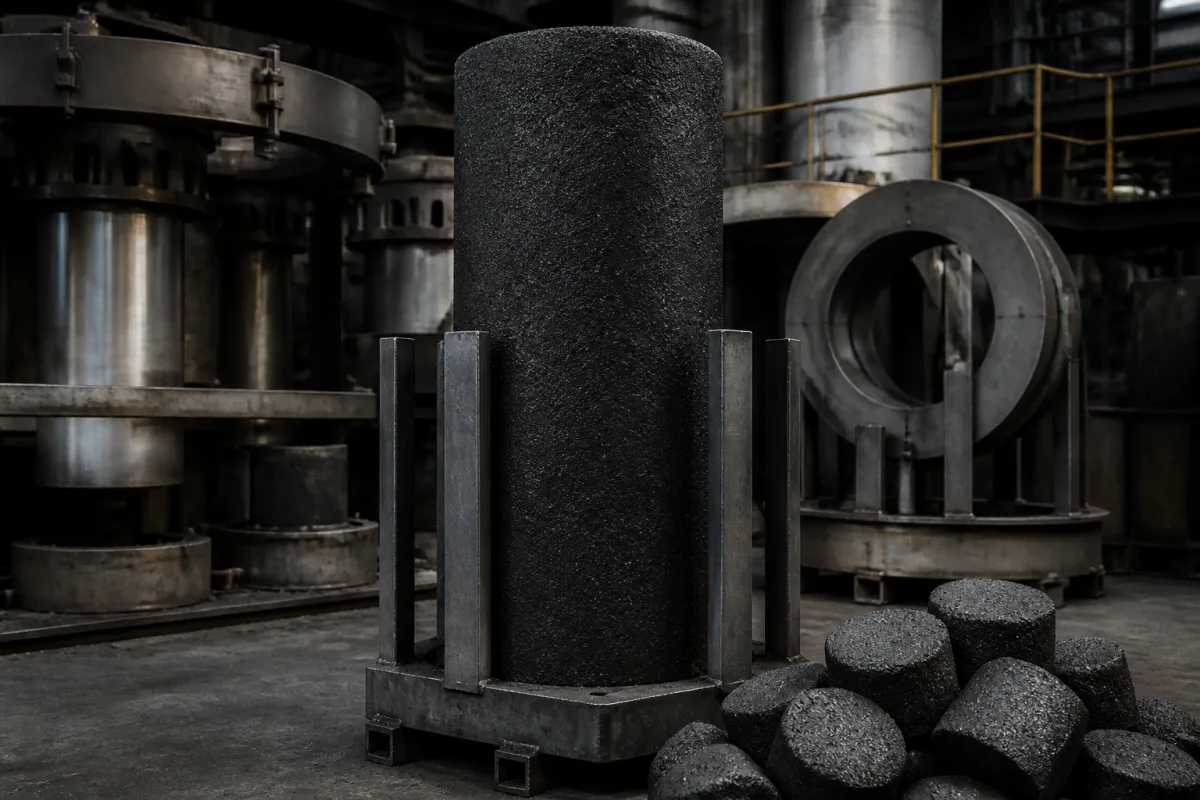
Preformed carbon electrode component for submerged arc furnaces in ferroalloy production.
Product Specifications

Technical details and manufacturing context for Electrode Paste Column

Definition
Electrode paste columns are preformed cylindrical components made from calcined anthracite, petroleum coke, and coal tar pitch binders. They serve as consumable electrodes in submerged arc furnaces for producing ferroalloys like ferrosilicon, ferromanganese, and ferronickel. These components are critical for maintaining consistent electrical conductivity and thermal stability during high-temperature reduction processes. In B2B supply chains, they represent a specialized consumable material with strict quality requirements for metallurgical operations.
Working Principle
The column conducts electrical current into the furnace charge, generating intense heat through resistance to melt and reduce metal oxides while gradually consuming itself through oxidation and sublimation at the tip.
Common Materials
Calcined Anthracite, Petroleum Coke, Coal Tar Pitch
Technical Parameters
  • Standard diameter for furnace compatibility (mm) Standard Spec
  • Electrical resistivity at operating temperature (Ω·m) Standard Spec
Components / BOM
  • Carbon Aggregate Matrix
    Provides electrical conductivity and structural integrity
    Material: Calcined anthracite and petroleum coke blend
  • Pitch Binder
    Bonds carbon particles and provides plasticity during baking
    Material: Coal tar pitch with controlled softening point
  • Reinforcing Fibers Optional
    Improves mechanical strength and crack resistance
    Material: Carbon or ceramic fibers
Engineering Reasoning
1.2-1.8 MPa compressive load, 1200-1800°C thermal exposure, 0.5-1.5 m/s descent rate
Compressive strength < 15 MPa at 1500°C, thermal expansion mismatch > 0.002 m/m differential, electrical resistivity > 80 μΩ·m
Design Rationale: Boudouard reaction (C + CO₂ → 2CO) at >800°C causing structural weakening, thermal stress from 1500°C gradient exceeding graphite's 4.5 MPa tensile strength, oxidation at >600°C consuming 0.5 mm/hour
Risk Mitigation (FMEA)
Trigger Insufficient baking at <800°C leaving 8% volatile content
Mode: Gas explosion fracturing column at 2.5 MPa internal pressure
Strategy: Controlled baking cycle: 24h ramp to 1200°C with <50°C/hour gradient
Trigger Current density > 8 A/cm² exceeding 0.25 V/cm voltage drop
Mode: Localized overheating to >2000°C causing graphitization
Strategy: Current distribution rings with 0.15 Ω·m resistivity grading

Industry Taxonomies & Aliases

Commonly used trade names and technical identifiers for Electrode Paste Column.

Industrial Ecosystem & Supply Chain DNA

Complementary Systems
Downstream Applications
Specialized Tooling

Application Fit & Sizing Matrix

Operational Limits
pressure: Atmospheric to 5 bar (handles furnace pressure fluctuations)
other spec: Electrical resistivity: 50-80 μΩ·m, Ash content: <5%, Volatile matter: <1.5%
temperature: Ambient to 1500°C (operational in submerged arc furnace environment)
Media Compatibility
✓ Ferroalloy smelting (FeSi, FeMn, SiMn) ✓ Calcium carbide production ✓ Phosphorus production
Unsuitable: Oxidizing atmospheres above 400°C (rapid consumption)
Sizing Data Required
  • Furnace power rating (MW)
  • Electrode current density (A/cm²)
  • Required electrode consumption rate (kg/ton product)

Reliability & Engineering Risk Analysis

Failure Mode & Root Cause
Thermal degradation and cracking
Cause: Excessive temperature gradients during operation or improper baking cycles, leading to thermal stress fractures and loss of structural integrity.
Oxidation and erosion
Cause: Exposure to oxidizing atmospheres at high temperatures, combined with mechanical abrasion from raw materials, causing material loss and weakened column structure.
Maintenance Indicators
  • Visible cracks or spalling on the electrode surface, indicating thermal stress failure
  • Abnormal voltage fluctuations or increased electrical resistance readings during operation
Engineering Tips
  • Implement controlled baking and cooling protocols to minimize thermal shock and ensure proper carbonization of the paste
  • Maintain proper sealing and inert atmosphere control around the column to prevent oxidation and contamination

Compliance & Manufacturing Standards

Reference Standards
ISO 9001:2015 - Quality management systems ASTM D5289 - Standard Test Method for Rubber Property—Vulcanization Using Rotorless Cure Meters CE Marking - Conformity with EU directives for safety and performance
Manufacturing Precision
  • Diameter tolerance: +/- 0.5 mm
  • Length tolerance: +/- 2.0 mm
Quality Inspection
  • Chemical composition analysis via X-ray fluorescence (XRF)
  • Dimensional verification using coordinate measuring machine (CMM)

Factories Producing Electrode Paste Column

Verified manufacturers with capability to produce this product in China

✓ 97% Supplier Capability Match Found

S Sourcing Manager from Canada Jan 08, 2026
★★★★★
"The technical documentation for this Electrode Paste Column is very thorough, especially regarding Diameter (mm)."
Technical Specifications Verified
P Procurement Specialist from United States Jan 05, 2026
★★★★☆
"Reliable performance in harsh Basic Metal Manufacturing environments. No issues with the Electrode Paste Column so far. (Delivery took slightly longer than expected, but technical support was excellent.)"
Technical Specifications Verified
T Technical Director from United Arab Emirates Jan 02, 2026
★★★★★
"Testing the Electrode Paste Column now; the Diameter (mm) results are within 1% of the laboratory datasheet."
Technical Specifications Verified
Verification Protocol

“Feedback is collected from verified sourcing managers during RFQ (Request for Quote) and factory evaluation processes on CNFX. These reports represent historical performance data and technical audit summaries from our B2B manufacturing network.”

16 sourcing managers are analyzing this specification now. Last inquiry for Electrode Paste Column from Germany (20m ago).

Supply Chain Commonly Integrated Components

Signal Processor

Electronic device that conditions, amplifies, filters, and converts raw sensor signals into standardized outputs for temperature measurement systems

Explore Specs →
Purge Air System

A system that provides controlled airflow to clear optical paths and protect sensors in molten metal temperature measurement applications.

Explore Specs →
Degassing Chamber

A specialized vessel within a molten metal degassing system where dissolved gases are removed from molten metal through controlled processes.

Explore Specs →
Gas Control System

A system that regulates and controls the flow, pressure, and composition of gases used in molten metal degassing processes.

Explore Specs →

Frequently Asked Questions

What are the key specifications for electrode paste columns in ferroalloy production?

Critical specifications include ash content (%), bulk density (g/cm³), compressive strength (MPa), diameter (mm), length (mm), and volatile matter (%) to ensure optimal performance in submerged arc furnaces.

What materials are used in manufacturing electrode paste columns?

Electrode paste columns are manufactured using calcined anthracite and petroleum coke as carbon aggregates, bound together with coal tar pitch, and may include reinforcing fibers for structural integrity.

How do electrode paste columns function in submerged arc furnaces?

Electrode paste columns serve as conductive carbon components that deliver electrical current to create high-temperature arcs for smelting ferroalloys, with the paste gradually baking into solid electrodes during furnace operation.

Can I contact factories directly on CNFX?

CNFX is an open directory, not a transaction platform. Each factory profile provides direct contact information and production details to help you initiate direct inquiries with Chinese suppliers.

Get Quote for Electrode Paste Column

Request technical pricing, lead times, or customized specifications for Electrode Paste Column directly from verified manufacturing units.

Your business information is encrypted and only shared with verified Electrode Paste Column suppliers.

Thank you! Your message has been sent. We'll respond within 1–3 business days.

Need to Manufacture Electrode Paste Column?

Connect with verified factories specializing in this product category

Add Your Factory Contact Us
Previous Product
Electrode Holding Mechanism
Next Product
Electrolytic Cell Cathode Bar