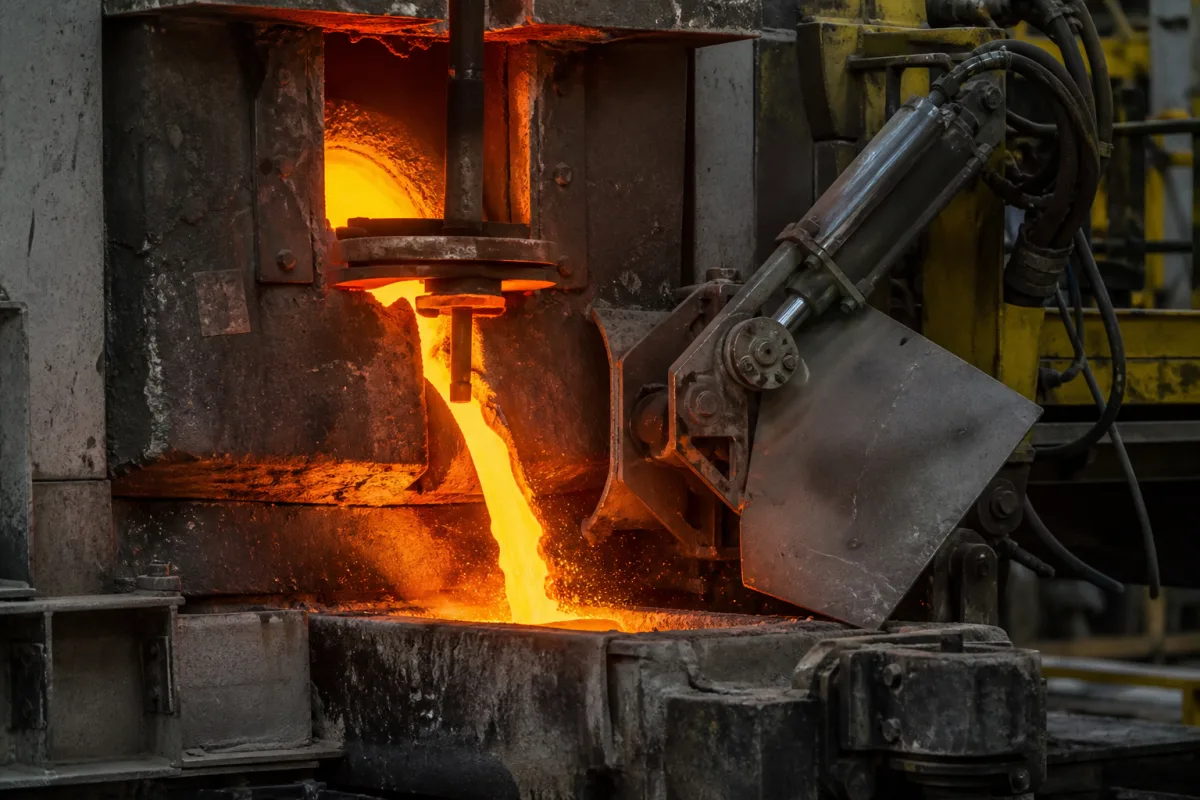
Stopper-rod pouring valve for foundry pouring furnaces and bottom-pour launders
Foundry pouring into moulds · stopper rod over a bottom nozzle, pneumatic or servo drive, seating force, sprue-cup level feedback
On an automatic moulding line the iron is not poured by tilting a ladle. It sits in a pressurised pouring furnace or a heated launder with a nozzle in its floor, and a refractory stopper rod standing in the melt opens and closes that nozzle for every mould that passes underneath. The drive that lifts and seats the rod is what decides how fast the stream starts and stops, how tightly the nozzle seals, and whether the sprue cup stays full without overflowing.
Stopper-rod valves that dose molten iron and other cast metals from pressure pouring furnaces, stopper ladles and bottom-pour launders into individual sand moulds, including the rod drive, rotation and nozzle-cleaning devices, and sprue-cup level control that moves the rod. Tundish stopper rods for continuous casting of steel are covered on the Tundish stopper rod and stopper mechanism page; slide gates on the Slide gate flow control page; the refractory nozzles themselves on the Molten metal flow control nozzle page; continuous-casting mould level control on the Molten metal level control system page; and robot-held and tilting ladles on the Robotic pouring systems page.
CNFX editorial research · Sources checked October 12, 2026 · 4 sources
Pneumatic cylinder or servo ball screw: how the stopper is lifted and seated
The nozzle has to be shut tight enough to stop the stream yet not so hard that the rod tip and nozzle edge are crushed. The two drive designs below handle that limit in different ways.
Inductotherm's 1990 patent lists what it found wrong with earlier air-cylinder mechanisms from other makers: no way to align a mismatched rod and nozzle, rods that were hard to replace, no position or velocity control of the rod, and a seating force that could not be varied. [3] ABP's paper takes the opposite view on hydraulics and air: it argues that a pneumatic drive with a proportional valve is fast enough and keeps oil away from the melt. [1]
Editorial note: neither source gives a stroke length or a positioning accuracy; ask the supplier for the rod stroke, the closing force or torque setting range, and the time from full open to closed.
Design point
ABP pneumatic stopper drive
Inductotherm servo stopper mechanism
Actuator
Pneumatic cylinder with proportional valve, torsionally rigid arm [1]
AC servomotor driving a high-pitch ball screw that raises an inner tube and boom [3]
Closing force
Limited to 750 N to reduce stopper wear while still sealing [1]
Seating force varied through motor torque, so slag can be crushed off the nozzle [3]
Speed
Stated as about 2.5 times faster than a hydraulic cylinder sized for the same limits [1]
Small screw rotations give large vertical rod movement; ball-screw pitch preferably about 15° to 45° [3]
Weight of boom lets the rod fall into the nozzle (described as a preferred safety feature) [3]
Anti-leak and cleaning
Rod rotated about 60° while closing; cleaning rod passes through the hollow stopper and nozzle [1]
Nitrogen can be fed through a bore to the rod tip to stop oxide build-up in the nozzle [4]
State the metal (grey iron, Mg-treated ductile iron, other), the nozzle bore, the moulding line rate, whether hydraulic oil is permitted near the pouring station, and whether the rod must rotate or carry a cleaning rod.
02
Holding the sprue-cup level with laser or camera feedback to the stopper
In automatic mode the stopper is moved by what a sensor sees in the mould's pouring cup, not by a fixed time curve.
ABP distinguishes two control modes: a "Teach-In" pre-programmed pouring curve that does not react to wear of the rod and nozzle, and closed-loop control in which a laser or camera measures the sprue-cup level and the stopper drive keeps it constant, lowering it at the end of filling to reduce returns. It states that the system stops pouring within a set time if a mould breaks, and that an add-on module for vertically parted, rapid-indexing moulding lines reaches a cycle of less than 8 seconds per mould. [1]
At MAT Foundry Group's Eurac Poole plant the two pressurised pouring furnaces each hold 8 tonnes, run at up to 340 kW at 180 to 250 Hz, and use a laser sensor on the pouring cup to adjust the stopper rod position, while a PLC sets the air pressure in the metal chamber. The company says an operator has to check that stopper, nozzle and laser are aligned, and that the front pouring box is pre-heated and the laser calibrated to the top of the mould. [2]
Editorial calculation: at ABP's stated cycle of under 8 s per mould, a line runs at more than 3,600 / 8 = 450 moulds per hour, so the stopper opens and closes at least 450 times an hour; ask how the supplier rates rod and nozzle life in pour cycles.
Give the sprue-cup diameter and height above the nozzle, the mould cycle time, the pouring weight per mould, and whether one or two moulds are filled at once.
03
What the stopper is mounted on: pressure pouring furnace, stopper ladle or bottom-pour launder
ABP gives the unchanging static pressure in a pressurised pouring system as the reason quantity portioning is reproducible, because the flow speed through the nozzle does not vary. [1]
Vessel
What changes for the stopper valve
Unheated pressurised vessel
ABP states melt temperature drop is limited to max. 1.5 K/min; vessel change takes approx. 1 to 2 h, and the stopper mechanism stays on the furnace frame. [1]
Heated pressurised furnace
Channel or crucible inductor in the base; same stopper design as the unheated version. [1]
Stopper ladle
Bottom pouring keeps the stream from migrating and holds slag back while the level stays above the nozzle. [1]
Bottom-pour launder, single or dual nozzle
One servo stopper per nozzle; a dual nozzle block can be swapped to match sprue-cup spacing on the mould line, and the servo housing can sit on an X-Y table for centring. [4]
04
What to send for a foundry stopper valve
Paste it into your enquiry below or into an email to a maker, then replace every bracket.
Metal: [grey iron; ductile (Mg-treated); other; pouring temperature]
Vessel: [pressure pouring furnace heated or unheated; stopper ladle; launder; capacity]
Nozzle: [bore; material; single or dual]
Drive: [pneumatic or servo; closing force; rotation; cleaning rod; gas through rod]
Control: [teach-in or closed loop; laser or camera; sprue-cup size]
Line: [moulding machine; cycle time; pour weight per mould]
Explore company information and manufacturing capabilities, then discuss the scope of your project with a relevant supplier.
Share this page
Compiled and source-reviewed by the CNFX editorial team.
Each manufacturer above links to the page on that company's own website where the product is listed, with the date we checked it. How we source and review
· Page last updated 13 October 2026
Buyer questions
How hard does a foundry stopper rod press on the nozzle?
ABP Induction limits its pneumatic stopper drive to 750 N to reduce wear while still sealing; Inductotherm's servo design varies the seating force through motor torque. [1][3]
Why is the stopper rod rotated when it closes?
ABP rotates the stopper by about 60° during closing, before full closing pressure is applied, to prevent leakage. [1]
How is the sprue cup kept full automatically?
A laser or camera measures the cup level and the stopper drive adjusts the rod; ABP and MAT Foundry Group both describe laser feedback. [1][2]
Sources and what still needs a direct check
Sources checked 2026-10-12. ABP Induction describes its own pouring systems in a 2010 journal paper; MAT Foundry Group describes the pouring furnaces at one of its plants; the two Inductotherm patents describe servo stopper mechanisms as claimed designs, not as current catalogue products.