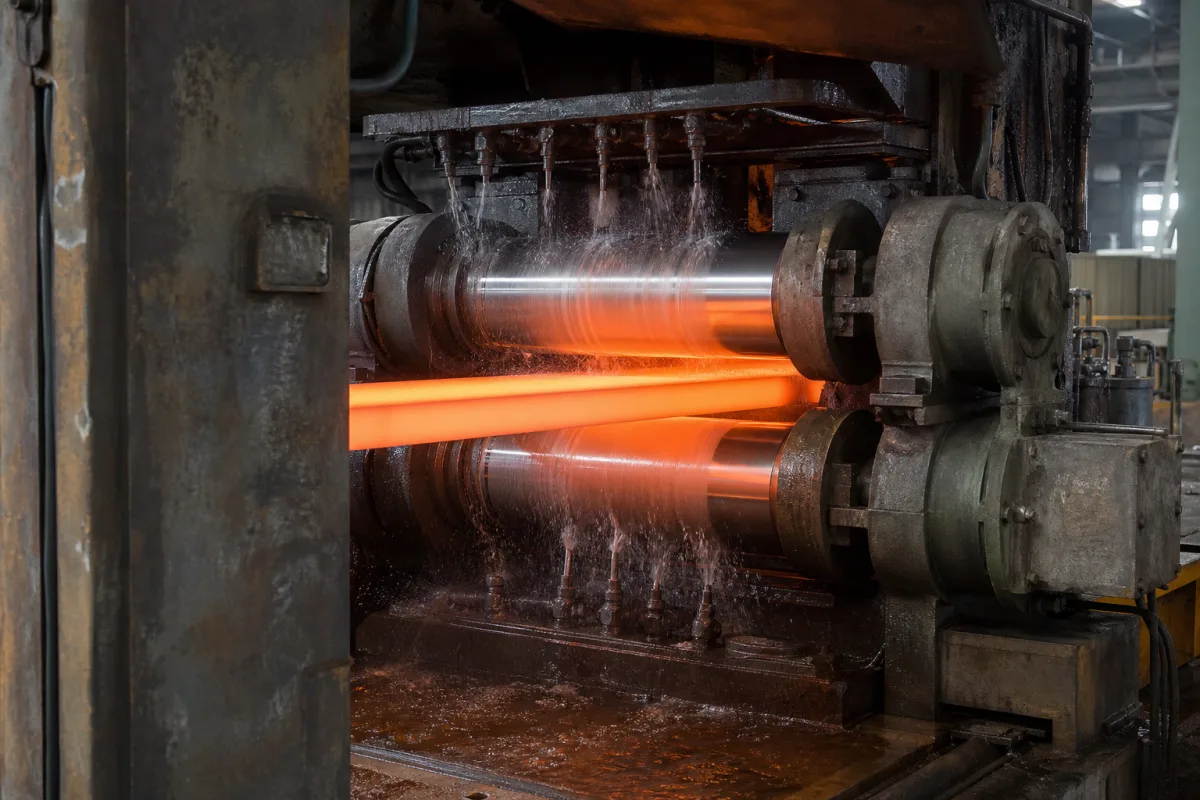
Work rolls under spray cooling in hot strip finishing stands: header layout, water pressure and thermal crown
Hot strip finishing-stand work rolls in service · water-spray headers, header pressure, strip-width zoning and the roll surface temperature that sets thermal crown and strip shape
In a hot strip mill the work roll touches strip at around rolling temperature for a fraction of each revolution and is then sprayed with water before it reaches the bite again. The heat it keeps swells the barrel, and that thermal crown adds to or fights the ground roll profile, deciding whether the strip comes out flat, centre-buckled or edge-wavy. This page deals with the work roll as a cooled component: where the sprays hit, at what pressure, over what width, and how the result is measured.
Hot strip mill work rolls considered together with their spray cooling: entry- and exit-side headers, nozzle types, header pressure, width-zoned and movable headers, wipers, roll surface temperature measurement and thermal crown. Work roll grades, hardness and hardened depth for hot, plate, section and cold mills are covered on the Rolling mill work roll page; backup rolls on the Backup rolls page, strip cooling after the last stand on the Run-out table for a hot strip mill and Laminar cooling system pages, and high-pressure scale removal on the Hydraulic descaling system page.
CNFX editorial research · Sources checked October 13, 2026 · 3 sources
Cooling only the heated width: barrel temperature spread cut from 10–15 °C to 3–5 °C on high-speed-steel rolls
Sumitomo Metal Industries' patent application JPH06170420A starts from finishing stands that had moved to high-speed-steel work rolls, with molybdenum, vanadium and tungsten in the shell, but kept the fixed full-length spray headers used for Ni-grain and high-chromium rolls. On a narrow strip those headers also cool the barrel ends that never touch the strip, so the thermal crown is not uniform along the roll. [1]
Editorial calculation: converting with 1 kg/mm² = 9.807 MPa, the patent's moduli are about 216–226 GPa for HSS and 177 GPa for Ni-grain rolls; the roughly 25 % stiffer HSS roll bends less for the same bending force, which is why the patent turns to cooling rather than the work roll bender to control shape.
The patent also reports that a two-tier layout with movable headers only gave almost the same effect. [1]
Point in JPH06170420A
What the patent states
Without initial crown
Insufficient cooling lets the roll expand and the strip centre-buckles in continuous rolling, so HSS rolls were ground with a negative crown [1]
With negative crown
Edge waves appear at the start of a rolling campaign [1]
Work roll bending
Less effective on HSS: Young's modulus 22–23 × 10³ kg/mm² against 18 × 10³ kg/mm² for Ni-grain rolls, so the roll deflects less [1]
New header layout
A fixed header covering the minimum strip width, with movable headers below it in two tiers positioned along the roll axis to the strip width [1]
Control signal
Roll surface temperature from a thermocouple on the wiper plate sets the water to fixed and movable headers [1]
Result after rolling
Barrel temperature variation across the strip width 10–15 ° with the old headers, about 3–5 ° with the new; yield 99.1 % rising to 99.3 % [1]
Give the roll grade (HSS, high-chromium iron or Ni-grain), barrel length, the narrowest and widest strip rolled, the ground roll crown, and whether roll surface temperature is measured in the stand.
02
Flat jets at 13 bar or solid jets at 3–4 bar: header pressure, the pool above the wiper and pump energy
Primetals Technologies describes work-roll cooling headers on the entry and exit side of the stand that apply coolant, in variable quantities if needed, to limit roll temperature and thermal expansion; its earlier dynamic system used flat-jet headers on both sides of the stand at a system pressure that the company says is "usually 13 bar". [2]
Lowering the pressure of flat-jet headers reduced their effect above the top-side wiper, where water that has to drain sideways forms a pool the lowest jets must spray through; Primetals notes that raising the flow would enlarge the pool. Its Power Work-Roll Cooling header uses solid-jet nozzles fed from a 4 bar low-pressure water system, one header replacing two or three per side, divided into a centre chamber and two outer chambers on separate flow-control valves so the flow profile across the roll width can be shaped. [2]
In laboratory tests at Brno University of Technology, solid-jet nozzles at 3 bar cooled at least as well as flat-jet nozzles at 10 bar at the same flow. On stand F1 of Arvedi ESP line No. 2 at Hebei Taihang Iron & Steel, a 10 bar and a 3 bar variant were run with the same nominal flow, the low-pressure header having more nozzles; average work roll temperature was about the same, with high-chromium iron rolls and strip down to 0.8 mm. Compared with line No. 1, the F1-to-F2 roll temperature difference differed by 1 °C. [2]
Primetals puts the energy saving at about 70 % against conventional systems at equal flow. Editorial calculation: pump power at a fixed flow scales with pressure, and 4 bar is 31 % of 13 bar, a saving of about 69 %, consistent with that figure.
State the header pressure available, the flow per header, nozzle type, the number of headers per side and whether flow can be zoned across the roll width.
03
Less water on the F1 top roll at the same roll temperature: 34 % and 46 % in the laboratory, 40 % in the mill
Hnízdil and Franco report a study by Danieli and the Heat Transfer and Fluid Flow Laboratory of Brno University of Technology on the top work roll of the first finishing stand (F1) of a hot strip mill, with a target of cutting water by more than 25 % at equal or better cooling. [3]
Editorial note: both this study and the Primetals trial judge a new header by measured work roll temperature in the mill, not by flow or pressure alone; ask for the same evidence when a cooling change is offered with new rolls or a stand upgrade.
Phase
What was done and found
1. Existing layout
Rotary test stand with embedded sensors; a segment heated to 320 °C and cooled to ambient to measure heat transfer coefficients for different roll diameters and water pressures [3]
2. Parameters
Pressure, nozzle size and position and spray distance studied; two exit-side designs proposed with two and three headers [3]
Laboratory result
34 % water saving for the first design and up to 46 % for the second [3]
3. Mill installation
Built by Danieli in a finishing stand with in-line work roll temperature measurement; 40 % less cooling water with work roll temperature during rolling unchanged [3]
Say which stand and which roll (top or bottom, entry or exit side) the change concerns and how roll temperature will be measured before and after.
04
What to send when buying hot-mill work rolls and their cooling
Paste it into your enquiry below or into an email to a maker, then replace every bracket.
Stand: [mill type; stand number; top or bottom roll]
Roll: [grade; barrel diameter and length; ground crown]
Strip: [width range; minimum thickness; temperature]
Cooling: [headers per side; nozzle type; pressure; flow; width zoning]
Measurement: [roll surface temperature method]
Targets: [thermal crown; strip flatness; water or energy reduction]
Explore company information and manufacturing capabilities, then discuss the scope of your project with a relevant supplier.
Share this page
Compiled and source-reviewed by the CNFX editorial team.
Each manufacturer above links to the page on that company's own website where the product is listed, with the date we checked it. How we source and review
· Page last updated 13 October 2026
Buyer questions
Why zone work roll cooling to the strip width?
In Sumitomo Metal's JPH06170420A, full-length headers also cooled barrel ends outside narrow strip; width-positioned headers cut the barrel temperature spread from 10–15 ° to about 3–5 °. [1]
What pressure do work roll cooling headers run at?
Primetals says its conventional flat-jet system pressure is "usually 13 bar"; its solid-jet Power Work-Roll Cooling runs from a 4 bar supply, and 3 bar solid jets matched 10 bar flat jets in laboratory tests. [2]
How much cooling water can a redesigned F1 header save?
Danieli and Brno University of Technology measured 34 % and up to 46 % in the laboratory and achieved 40 % in the mill with work roll temperature unchanged. [3]
Sources and what still needs a direct check
Sources checked 2026-10-13. Width-zoned headers and HSS roll behaviour come from Sumitomo Metal Industries' JPH06170420A; header pressure and the solid-jet trial from Primetals Technologies' Metals Magazine; the F1 water reduction from Hnízdil and Franco (Brno University of Technology with Danieli).