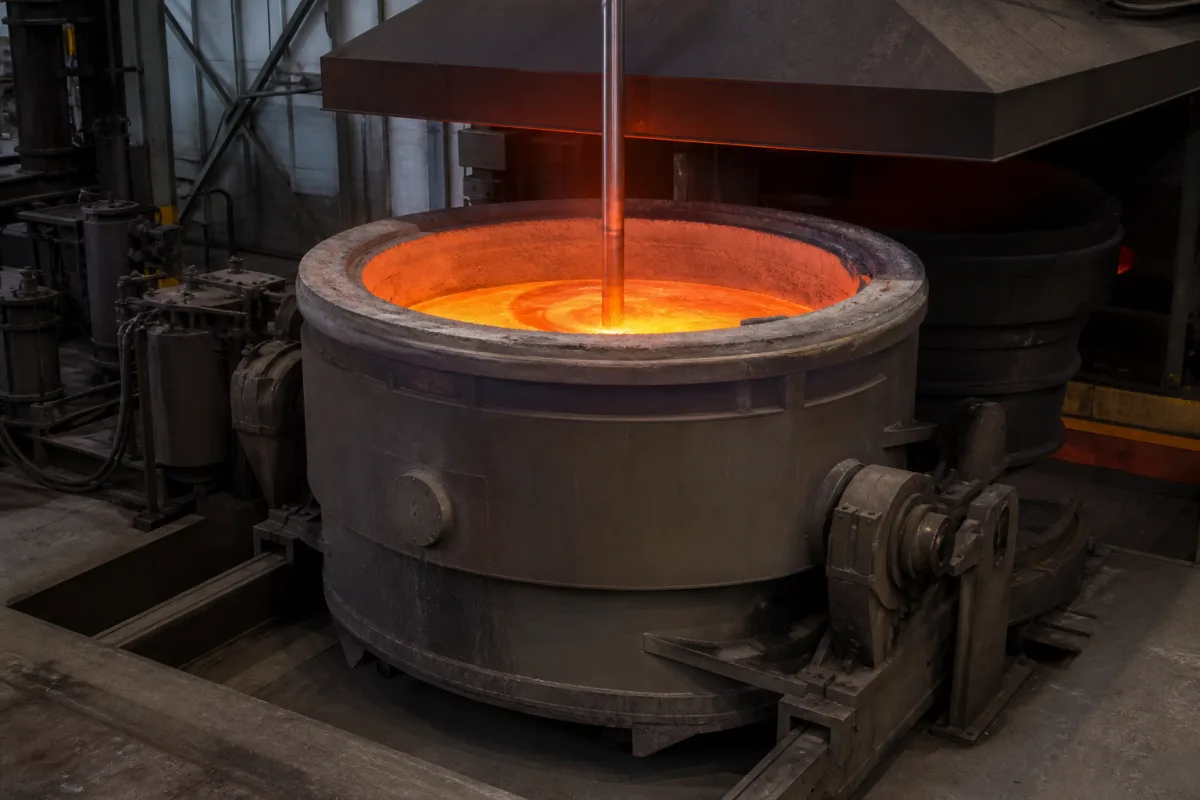
Lead refining kettle: the open pot in which lead bullion is drossed, softened and alkali-refined in temperature steps
Pyrometallurgical lead refining kettle · open pot of 100 t of bullion stepped through copper drossing, oxidation and alkaline refining, with a top-entry stirrer, skimming gear and a fume hood
Crude lead from a blast furnace, a battery-recycling smelter or an electrolytic cell still carries copper, tin, antimony, arsenic and other metals. In fire refining it is held in a kettle: a round open pot heated from a furnace setting underneath, filled with tens of tonnes of molten lead. Each impurity group is removed by setting a temperature, adding a reagent, stirring a vortex into the bath and skimming the dross or slag that floats up. The kettle's job is therefore defined by those temperature steps, the stirrer and skimming gear on its rim, how fume is captured, and how the refined lead is taken out.
Open refining kettles (refining pots) for pyrometallurgical refining of crude lead and lead alloys: copper drossing, oxidation and alkaline (Harris-type) refining, alloying, with their stirrers, skimmers, covers and tapping. Rotary degassing and fluxing units for molten aluminium are covered on the Molten aluminium degassing system (rotary degasser) page; vacuum induction degassing of steel on the Vacuum induction degassing unit page; gas metering to degassing rotors and porous plugs on the Gas control system for molten metal treatment page; and steel degasser pumping on the Vacuum pumping system for steel degassing page. Steel and foundry ladles, including the Refractory-lined steel ladle and the Magnesium treatment ladle for ductile iron, are separate pages.
CNFX editorial research · Sources checked October 13, 2026 · 5 sources
From 327 °C copper drossing to 510–530 °C oxidation refining: the temperature steps one kettle runs through
The same pot is held at different temperatures for different impurities, so the burner setting and the pot's tolerance for heat govern what it can refine. Two patents give the steps from opposite ends of the industry: a Chinese refinery refining electrolytic cathode lead, and a US secondary-lead process. [3][2]
Stannum Group's patent puts a cost on running the pot hot: air refining needs the kettle at 575–650 °C, which consumes more fuel and shortens kettle life, takes more than eight hours, and sends a nominal ten percent of the lead in each kettle to the recycle loop as oxide. [2]
Editorial calculation: the 593–649 °C de-tinning step is about 140–195 °C hotter than the 454 °C upper end of the patent's low-temperature route, and 266–322 °C above the 327 °C melting point at which copper drossing is done in the same kettle.
Step
Kettle temperature and what happens
Source
Melting the charge
Heated to 330–480 °C; at 480 °C skimming of the oxide dross begins [3]
Hunan Yuteng, CN202730209U
Copper drossing
Bullion held just above its melting point (327 °C for pure lead); copper dross rises as a powdery or granular solid and is skimmed; sulfur can be added [2]
Stannum Group, US8500845B2
Tellurium and selenium removal
Metallic sodium or calcium added to form a caustic tellurium slag [2]
Stirred about 45 minutes at 490–520 °C, giving national-standard No. 1 lead [3]
Hunan Yuteng, CN202730209U
Conventional de-tinning with air
593–649 °C; 10–14 % of the lead in the kettle is oxidised to a fine dust that has to be removed [2]
Stannum Group, US8500845B2
Low-temperature tin removal
399–454 °C with lead oxide and sodium hydroxide fed in stoichiometric amounts while a vortex is kept [2]
Stannum Group, US8500845B2
Tell the kettle supplier the hottest step you will run and for how long (for example air de-tinning at up to 649 °C, or alkaline refining at 490–520 °C), the charge in tonnes, and whether the crude lead is blast-furnace bullion, secondary (battery) lead or cathode lead.
02
A vortex at 50–250 rpm, skimming when slag reaches 5–10 cm, and hoods that let the operator work the bath
Every refining step depends on mixing reagent into the bath and getting the dross off the surface, so the kettle rim carries a stirrer, skimming gear and a hood that must not block either. [1][2]
Commonwealth Smelting's GB1572928A deals with bullion run from a blast-furnace forehearth into a transfer ladle before the copper-drossing kettle, where copper in the bullion can reach 15 % by weight. Plate-like solids and heavy dross that form during the transfer have to be broken up in the kettle for drossing, which is done by vigorous stirring with sawdust or coke fines. The patent stirs the ladle while it fills, with an open-bladed or turbine impeller run at 50 to 250 rpm to form a controlled vortex, under a hinged cover that carries the motor and a suction hood. [1]
In Stannum Group's process the kettle has a top-mounted stirrer forming a vortex. Slag is allowed to load until impurities exceed 10 % of its weight, preferably 25–35 %, and in a kettle holding one hundred tons of bullion the slag is removed whenever the layer approaches 5–10 cm. Hydrogen burning on the surface signals that the lead oxide feed is running out. The patent gives the feed for tin removal as 1.38 kg of lead oxide and 1.46 kg of sodium hydroxide per 0.45 kg of tin recovered. [2]
Editorial calculation: per kilogram of tin, those figures are 1.38 / 0.45 = 3.07 kg of lead oxide and 1.46 / 0.45 = 3.24 kg of sodium hydroxide. The patent's pound figures (3.7 lb and 3.9 lb) do not convert to the same kilogram values, so confirm the feed ratio with the process owner before sizing feeders.
03
Capturing lead fume without uncovering the pot: mixer covers with operation windows and sealed skimming frames
Hunan Yuteng Nonferrous Metals describes the problem directly: a fume duct over a refining pot cannot cover the whole surface because operators must skim and stir, so fume escapes. [3]
In Hunan Hongfei's skimming frame the front section of the screw is 20 % larger in outside diameter than the rear, using the density difference between lead and dross to separate them, and the slewing ring that drives the scraper has a bore larger than the stirring impeller so the stirrer can be lifted out through it. [4]
Design
How the kettle face is closed
Patent
Mixer cover with operation window
Motor, belt pulley and stirring shaft mounted on a pot cover lifted onto the kettle mouth; the shaft passes through the cover centre; skimming and stirring go on through a window, with the cover connected to the dust duct [3]
Hunan Yuteng, CN202730209U
Sealed skimming frame
Circular frame on the pot face carrying the stirrer, lead pump and a skimming drive between left and right seal covers; a reciprocating scraper feeds a screw dross remover raised and lowered by an electric push rod [4]
Hunan Hongfei Machinery, CN203999760U
Closed pot with bottom tap
Pot cover sealed to the pot spigot, with a hinged charging door, a smoke outlet to dust removal and a stirrer on the cover [5]
Jiangsu New Chunxing, CN215947372U
04
Taking refined lead out: lead pump over the rim or a bottom pipe angled 5–10° through the hearth
Jiangsu New Chunxing Resource Recycling notes that pumping refined lead from the kettle into ingot moulds gives no steady, metered flow, and that the falling stream oxidises the lead, raises dross and burns off easily oxidised alloying elements. [5]
Its refining pot instead has a discharge pipe at the bottom, rising at 5–10° from the pot bottom and lying inside the furnace hearth so the lead in it stays above its melting point. A tapered plug valve on the pipe is turned by a wrench to set the flow into the casting mould, and floating oxide stays behind on the surface. The patent lists antimony, tin, arsenic, iron, cadmium, copper, silver and bismuth as the impurities removed in the pot, and calcium, aluminium, tin, selenium and rare earths as alloying additions made in it. [5]
Hunan Hongfei's skimming frame keeps a lead pump on the pot face to pump out the decoppered lead after skimming. [4]
State how lead leaves the kettle (pump, bottom tap or tilting), the casting machine it feeds, and which alloying elements are added in the pot.
05
What to give a lead refining kettle supplier
Paste it into your enquiry below or into an email to a maker, then replace every bracket.
Feed: [blast-furnace bullion, secondary lead or cathode lead; impurities to remove]
Charge: [tonnes per kettle; kettles per refining line]
Steps: [copper drossing, oxidation, alkaline, de-tinning, alloying; hottest temperature and hold time]
Heating: [fuel; burner setting under the pot]
Rim equipment: [stirrer speed and impeller; skimmer; lead pump]
Fume: [cover type; duct connection]
Tapping: [lead pump or bottom valve; casting machine]
Explore company information and manufacturing capabilities, then discuss the scope of your project with a relevant supplier.
Share this page
Compiled and source-reviewed by the CNFX editorial team.
Each manufacturer above links to the page on that company's own website where the product is listed, with the date we checked it. How we source and review
· Page last updated 13 October 2026
Buyer questions
At what temperatures is lead refined in a kettle?
Hunan Yuteng's CN202730209U melts at 330–480 °C, oxidation-refines at 510–530 °C for 2 hours and alkali-refines at 490–520 °C for about 45 minutes; Stannum Group's US8500845B2 drosses copper just above 327 °C and gives 593–649 °C for conventional air de-tinning. [3][2]
How fast is the bath stirred?
Commonwealth Smelting's GB1572928A runs an open-bladed or turbine impeller at 50 to 250 rpm to form a controlled vortex in the bullion. [1]
Why tap refined lead from the bottom of the kettle?
Jiangsu New Chunxing says pumping gives an uneven flow and oxidises the stream; its bottom pipe, angled 5–10° and kept hot inside the hearth, feeds moulds through a tapered plug valve and leaves floating oxide behind. [5]
Sources and what still needs a direct check
Sources checked 2026-10-13. All five sources are patents: Commonwealth Smelting (UK) on stirring bullion before the copper-drossing kettle, Stannum Group (US) on kettle refining temperatures and slag handling, and three Chinese refinery and machinery patents on fume covers, skimming and bottom tapping.