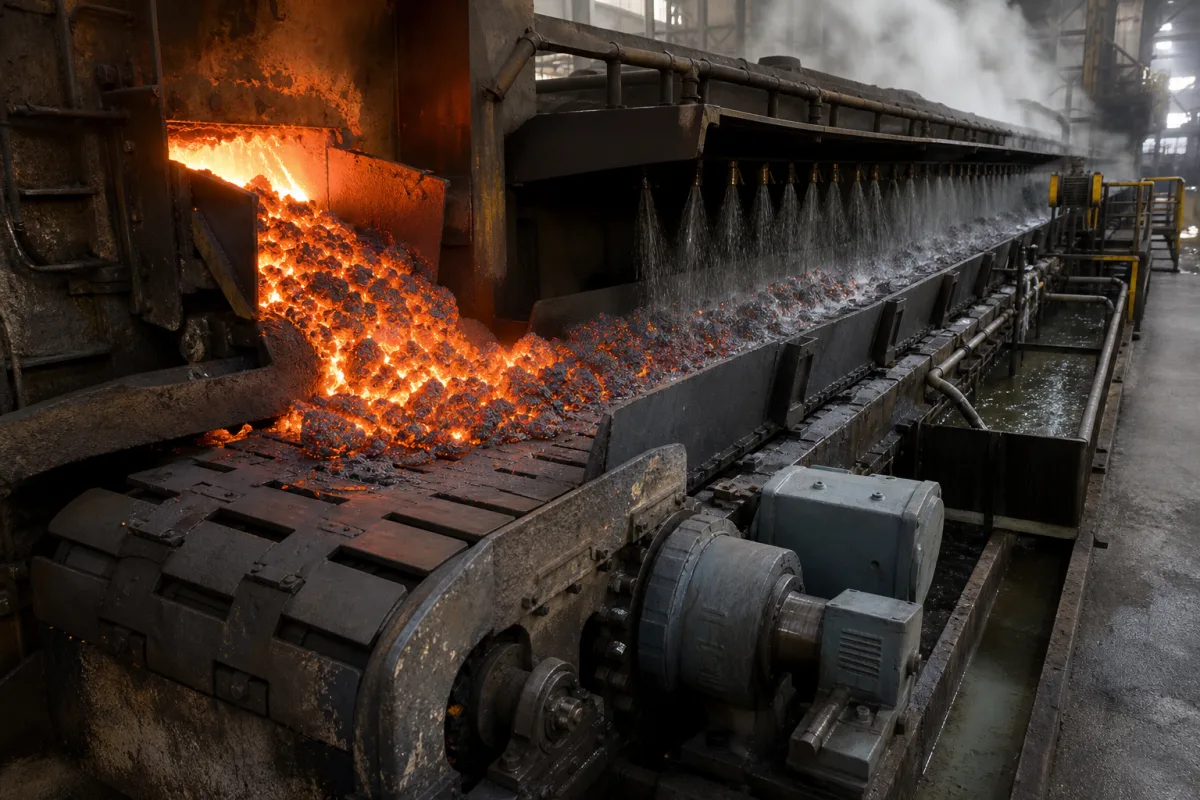
Slag cooling conveyor: conveyors that cool hot slag with direct water, by sprays and lances on a mould chain, a quench tank in a vibrating trough, or a water-filled drag-chain trough
Slag cooling conveyor with direct water contact · water-sprayed mould chains for steelworks slag, vibratory quench-tank conveyors for cupola slag, submerged drag-chain conveyors that quench and dewater
Some slag conveyors only carry hot slag; on a slag cooling conveyor the cooling happens on the conveyor itself, with water sprayed onto the slag or its carriers, injected into the pouring stream, or held in the trough the slag falls into. The picture shows the spray version: glowing slag tipping onto a chain of steel pans, then passing under a row of spray nozzles that throw up steam. This page covers three published ways of building such a conveyor, what each does to the slag, and the figures the patents and suppliers give for strip thickness, quench temperature, chain speed and dewatering slope.
Conveyors on which hot metallurgical slag or furnace residue is cooled by direct water contact while moving: water-sprayed mould and pan chains, vibratory conveyors forming a quench tank, and submerged drag-chain (scraper) conveyors with a dewatering incline. Steel plate (pan) and apron conveyors that carry hot slag dry, and troughs cooled from underneath without water touching the slag, are covered on the Slag conveyor (steel plate and apron conveyor for hot slag) page; plant-wide belt, roller, chain and screw conveyor types on the Conveyor systems page; conveyor drive packages on the Conveyor drive unit page. Slag pots, ladles and slag granulation plants are outside this page.
CNFX editorial research · Sources checked October 13, 2026 · 4 sources
Casting steelworks slag 3–5 cm thick on a moving mould chain, with water lanced into the pour and sprayed on the returning moulds
Heckett Multiserv's US 7,381,365 is aimed at slag from LD converters, electric arc furnaces and AOD or VOD refining, which has a higher lime content and an unstable structure; the patent says only a tiny fraction of it can be used after the treatments developed for blast furnace slag. [1]
The cooling rate is the point of the design. Slow cooling of the thin strip avoids instantaneous solidification and keeps the C3S and C2S calcium-silicate phases crystalline, and the water introduced before cooling leaves a porous structure that makes the solid slag friable, so it breaks into recoverable particles stable at ambient temperature for use in cement or aggregate. [1]
The patent contrasts this with two older routes: pouring molten slag into a large water-filled vessel, where it bursts by thermal shock and the plant must protect operators from slag explosions, and the dry route of WO 97/43455, where blast furnace slag above 1,350 °C is spread on cooling slabs on an endless belt or on a cooling roller without water spraying. [1]
Editorial calculation: a 1 m wide strip 4 cm thick holds 0.04 m³ of slag per metre of conveyor; the mould chain's advance rate sets how many metres per minute are filled, so pour rate in m³/min divided by 0.04 m² gives the chain speed in m/min needed to hold that thickness.
Element of the conveyor
What the patent describes
Feed
Slag and residual steel poured into a tundish; the denser steel settles and is separated; slag above 1,000 °C runs through an inclined pouring chute [1]
Conveyor
Continuous conveyor of cast iron or steel moulds articulated in pairs between a leading and a led roller [1]
Strip thickness
Advance rate chosen so the slag strip is about 3 to 5 cm thick, giving slow cooling [1]
Water into the slag
Lances along the pouring spout inject water into the slag stream; it vaporises on contact and agitates the slag [1]
Water on the conveyor
Fine water spray on the moulds during their return path to cool them [1]
Variants
Moistened slag fines of 0–6 mm spread on the conveyor before pouring, or fine-mesh steel screens instead of moulds with water sprayed on their inside face [1]
Ask for the mould material and pitch, the strip thickness the chain speed is set for, where water is introduced (pour stream, slag surface, mould return) and the water flow at each point.
02
Cupola slag at about 2,000 °F dropped into the water held in a vibrating trough, then carried up and out until its own heat dries it
General Kinematics' US 4,171,948 turns a vibratory conveyor into its own quench tank. The trough's carrying surface slopes upward from a lower to an upper end; with its sidewalls and an end wall it forms a watertight tank, open at the upper end, that holds water to quench molten slag running from a cupola, where the patent puts slag temperature in the neighbourhood of 2,000 °F. [2]
An inlet and a drain hold the water at a set level below the upper end of the carrying surface, so the vibrating trough lifts the fragmented slag out of the water; in the last few feet before discharge the residual heat of the slag evaporates the moisture it carries, and dry fragmented slag leaves the upper end. The drive is a motor turning an eccentric through a V-belt, with the trough frame on links and springs above a base on isolation springs. [2]
Editorial calculation: 2,000 °F is about 1,093 °C.
Give the supplier the slag source and tapping rate, the drop height into the tank, the water level and make-up flow, and the moisture accepted at discharge.
03
Submerged drag-chain conveyors: a water seal under the furnace, flights at 2–18 ft/min and a dewatering slope up to 35°
In Combustion Engineering's US 4,533,856, residue falling from a furnace is quenched in water held in an upper trough to an overflow level; the water also seals the furnace from atmosphere so it can run at other than atmospheric pressure. Flights on a drag chain scrape the settled material along the trough floor and up a dewatering slope, where water drains back into the trough, and dump it over the head sprocket. The patent describes this for boiler bottom ash. [3]
Its controller varies chain speed with headshaft torque between about 2 and 18 ft per minute, and the space between two flights is designed to be about 65 % full at design torque, so chain speed follows the rate at which residue arrives. [3] Metso, which names pulp and paper mills, waste-to-energy facilities and coal-fired power plants as applications, gives its submerged chain conveyors a speed of 2.4 to 3.7 m (8 to 12 ft) per minute on inclines of up to 35° to dewater material. [4]
Editorial calculation: 2 to 18 ft/min is 0.6 to 5.5 m/min. At Metso's 3.7 m/min, material on a 20 m dewatering slope spends about 5.4 minutes draining before discharge.
State the residue rate (peak and average), the furnace pressure the water seal has to hold, the dewatering slope length and angle, and the moisture limit at discharge.
04
What to send for a water-cooled slag conveyor
Paste it into your enquiry below or into an email to a maker, then replace every bracket.
Slag: [source furnace; chemistry; temperature at the conveyor; tapping or flow rate]
Cooling method: [sprayed mould or pan chain; quench tank; submerged drag chain]
Water: [spray or lance points; tank level; make-up and overflow flow; treatment]
Conveyor: [length; width; slope; speed range; mould or flight material]
Discharge: [particle size; moisture limit; temperature]
Safety: [steam venting; operator shielding; furnace seal]
Explore company information and manufacturing capabilities, then discuss the scope of your project with a relevant supplier.
Share this page
Compiled and source-reviewed by the CNFX editorial team.
Each manufacturer above links to the page on that company's own website where the product is listed, with the date we checked it. How we source and review
· Page last updated 13 October 2026
Buyer questions
Why cast steel slag in a thin layer on a conveyor?
Heckett Multiserv's patent sets the conveyor speed for a 3–5 cm strip so the slag cools slowly, keeping the C3S and C2S phases crystalline and giving a friable slag stable at ambient temperature. [1]
How does a vibratory slag quench conveyor deliver dry slag?
General Kinematics' design holds the water level below the upper end of the sloping trough; in the last few feet the residual heat of the slag evaporates the moisture it carries. [2]
How fast does a submerged drag-chain conveyor run?
Combustion Engineering's patent varies it between about 2 and 18 ft/min with torque; Metso gives 8 to 12 ft (2.4 to 3.7 m) per minute on inclines up to 35°. [3][4]
Sources and what still needs a direct check
Sources checked 2026-10-13. The mould-chain design comes from Heckett Multiserv's US 7,381,365, the vibratory quench tank from General Kinematics' US 4,171,948, and the submerged drag chain from Combustion Engineering's US 4,533,856 and Metso's chain conveyor page.