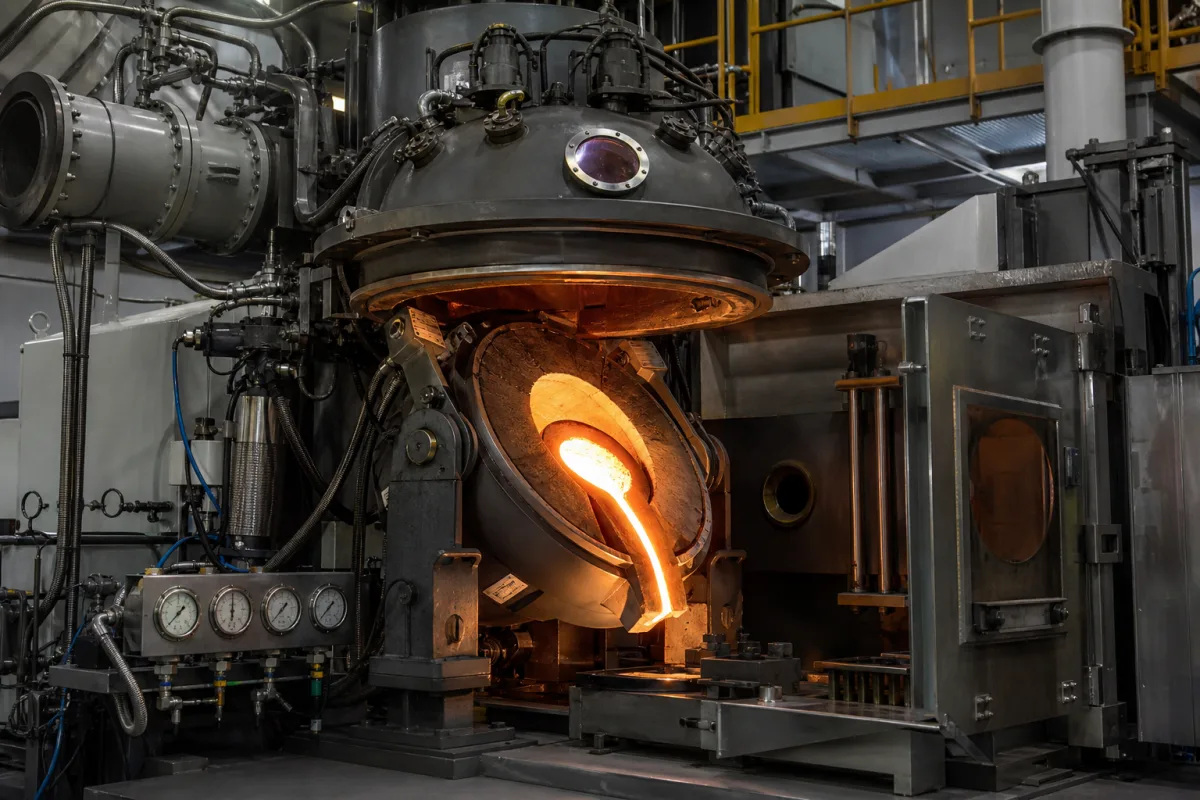
Vacuum induction degassing unit: VID furnace that melts and degasses steel under vacuum, then pours in air
Vacuum induction degassing (VID) furnaces for steels and alloys · Melting and degassing under vacuum with pouring in air, 1–30 t heats, VID Pro and VID Oxy variants, and what vacuum melting does to oxygen and nitrogen
This page covers vacuum induction degassing furnaces: an induction-heated crucible inside a vacuum chamber in which steel or alloy is melted, refined and degassed under vacuum or inert gas, after which the melt is poured in air or under protective gas. Ask three things first: the heat size and which steel grades the furnace must produce, whether pouring in air is acceptable or a protective-gas or full vacuum-casting design is needed, and what vacuum, refining and decarburisation steps the process includes.
Vacuum induction degassing (VID) and related vacuum induction melting furnaces for steels, Ni-base and Co-base alloys, with heat sizes from about 1 to 30 t. Rotary degassing and fluxing units for aluminium alloys are covered on the Molten metal degassing system page. Ladle vacuum degassers (VD/VOD), RH units and drilling-mud or resin vacuum degassers are outside this page.
CNFX editorial research · Sources checked October 12, 2026 · 3 sources
Choose between a VID furnace and a full VIM casting furnace
ALD Vacuum Technologies describes its VID furnaces as compact, simplified vacuum induction melting furnaces for charge weights up to 30 t, for steels and other alloys needing melting, liquid metal refining and degassing in vacuum while still allowing the melt to be poured in air. It lists melting and liquid metal treatment in vacuum or under inert gas with pouring in air, temperature control, vacuum refining, decarburisation and slag treatment, and a simplified design with no mould chamber, and offers sizes from 1 to 30 t. [1]
ALD names three variants: VID for pouring in ambient air, VID Pro for pouring under protective gas, and VID Oxy for carbon removal by introducing oxygen into the melt through a lance with slag treatment. It presents VID as an alternative to ladle-furnace and vacuum-degassing (LF/VD) systems for heats up to 30 t, letting mini mills and foundries make vacuum-treated steels in one step and removing the risk of metal freezing during liquid metal transfer; grades it lists include tool and high-speed steels, heat-treatable, austenitic and martensitic steels, steels for energy technology and Ni-base and Co-base alloys. [1]
Where the melt must also be cast under vacuum, ALD's VIM 100–4000 line covers chamber-type and compact VIM-VIDP furnaces with melt capacities of 1–30 t, producing ingots, electrodes for ESR or VAR remelting and bar-sticks for precision casting and powder; its variants include front-door (VIM-F), side-door (VIM-S), ladle (VIM-L) and rope-tilting crucible (VIM-R) designs. ALD dates the first industrial-scale VIM furnace built by its parent company to 1928 in Hanau. [2]
Give the supplier the alloys and grades, heat size in tonnes, charge materials, target oxygen, nitrogen, hydrogen and carbon levels, whether pouring in air, under protective gas or in vacuum is required, the downstream route (ingot, electrode, bar-stick), and power and cooling-water available.
02
Judge the metallurgical result: oxygen, nitrogen and inclusions
A 2025 Materials study compared H13 hot-work die steel made by electroslag remelting (ESR) with steel made by vacuum induction melting followed by vacuum arc remelting (VIM+VAR), melted at 1,450 °C in the VIM and refined at 1,600 °C in the VAR. The VIM+VAR steel had 0.0008 wt% total oxygen and 0.001 wt% nitrogen against 0.0016 wt% and 0.015 wt% for the ESR steel, and 0.005 wt% phosphorus against 0.016 wt%. [3]
The same study reports a fatigue strength at 10⁷ cycles of 1,040 MPa for the VIM+VAR steel against 967 MPa for the ESR steel, a mean inclusion size about 55% and a maximum inclusion size about 44% of the ESR steel's, with oxides or oxide-sulfide composites as the main crack-initiation sites. [3] Editorial calculation: 0.0008 wt% is 8 ppm and 0.001 wt% is 10 ppm; 1,040 ÷ 967 ≈ 1.075, the about 7.5% fatigue gain the authors report.
Editorial note: these results are for a VIM+VAR route on one steel, not for a VID furnace alone; ask the supplier for oxygen, nitrogen and hydrogen results from its furnaces on grades like yours.
03
VID, VID Pro, VID Oxy and VIM-VIDP furnace designs
The designs below come from one furnace builder's published range.
Explore company information and manufacturing capabilities, then discuss the scope of your project with a relevant supplier.
Share this page
Compiled and source-reviewed by the CNFX editorial team.
Each manufacturer above links to the page on that company's own website where the product is listed, with the date we checked it. How we source and review
· Page last updated 13 October 2026
Buyer questions
What is a VID furnace?
ALD describes it as a compact vacuum induction melting furnace that melts, refines and degasses in vacuum or inert gas and then pours in air, for heats of 1 to 30 t. [1]
How does VID differ from LF/VD?
ALD presents VID as a one-step alternative to ladle-furnace and vacuum-degassing lines for heats up to 30 t, avoiding metal freezing during transfer. [1]
How much lower are oxygen and nitrogen after vacuum melting?
In a 2025 H13 study, VIM+VAR steel had 0.0008 wt% total oxygen and 0.001 wt% nitrogen against 0.0016 wt% and 0.015 wt% for ESR steel. [3]
Sources and what still needs a direct check
Sources checked 2026-10-12. ALD describes its own furnaces; the Materials paper is a peer-reviewed study of H13 steel made by two remelting routes.