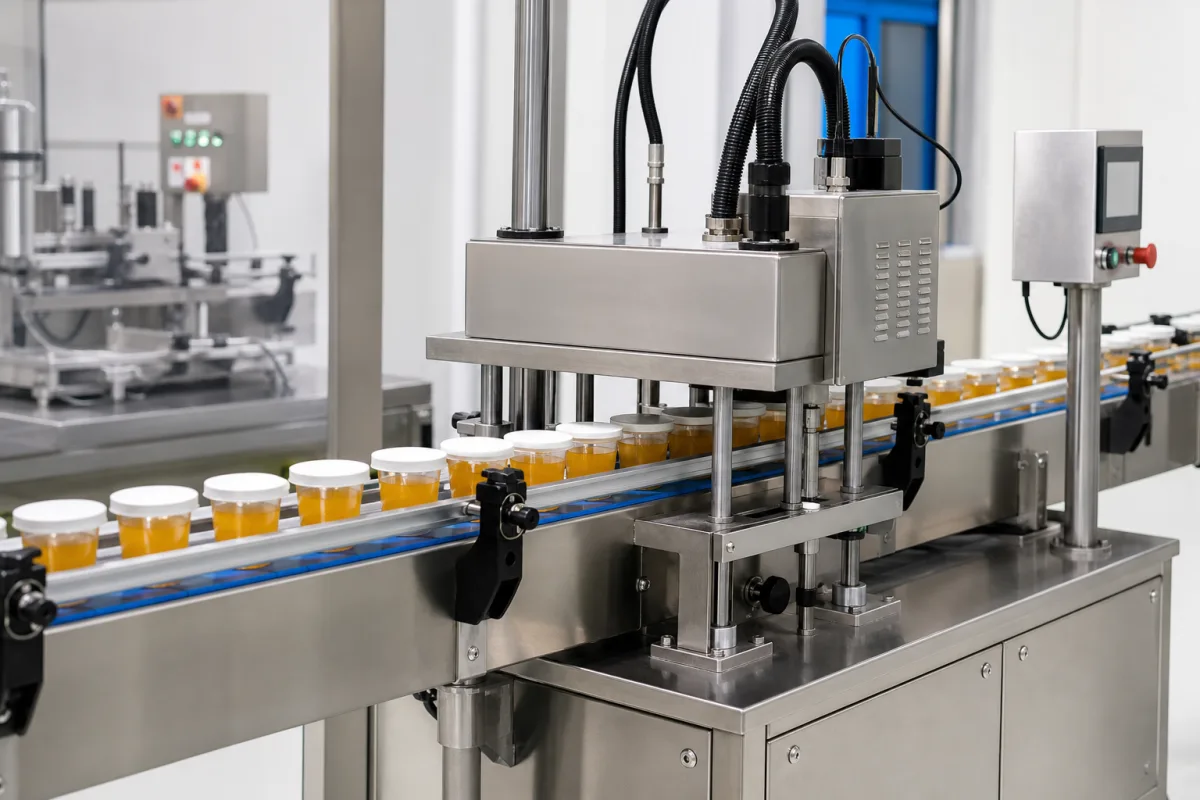
Automated beverage container foil sealing machine (induction cap sealer)
Induction cap sealing for bottles and jars · Foil liner structure, power supply and sealing heads, air gap, cap torque and conveyor speed, finding the operating window, air versus water cooling, closure diameter and line rate
An automated foil sealing machine for beverage containers is an induction cap sealer: filled bottles or jars, capped with closures that carry a foil heat-induction liner, pass on a conveyor under a sealing head whose electromagnetic field heats the foil so that its polymer layer bonds to the container rim, leaving a hermetic, tamper-evident seal under the cap. Ask three things first: what closure diameter and liner the packs use, what line speed the sealer must hold, and how the capper torque, head height and power will be set and checked.
Conveyor-mounted induction cap sealers for beverage and liquid-food bottles and jars with foil-lined closures: power supplies, flat, tunnel and combination sealing heads, cooling and container sensing. Conduction (heat-plate) cup lidding machines, foil-lid die-cut sealing for cups and trays, cappers (see high-speed rotary bottle capping machine) and handheld sealers are outside this page except where compared.
CNFX editorial research · Sources checked October 11, 2026 · 6 sources
Container & Packaging describes a heat-induction liner of four layers — pulp board against the cap, a wax layer, aluminium foil and a polymer film that bonds to the container — and explains that during sealing the field makes the foil heat, the wax melts and is absorbed into the board, releasing it, and the polymer melts onto the container lip, leaving the foil sealed over the opening and the board in the cap. It says every induction sealer has a power supply and a sealing head, and names three standard heads: flat heads for wide sealing areas and closures of 53 mm and larger, tunnel heads that concentrate the field as small containers pass through, and all-in-one heads with four size options for closures from 28 mm to 120 mm. [1]
Accutek's specification sheet for its automatic induction sealer states that the process needs a compatible foil seal and a non-metallic cap, and gives 3 kW maximum on a single-phase 220 V ±10%, 10 A, 60 Hz supply, air cooling, 60–80 kHz oscillating frequency, a sealing diameter of 20–80 mm (60–120 mm with an upgrade head), a capacity of 80–200 bottles per minute (150 per minute for 60–100 ml plastic bottles), an indoor ambient of 41–77 °F below 80% RH and dimensions of 29 × 27 × 54 in; its feature list also cites caps up to 60 mm as standard, so confirm the head range for your closure. [5]
Enercon's Super Seal Max page describes a high-speed induction cap sealer with bottle and foil counts, internal monitoring and fault information, remote and local control, network connectivity, a stainless IP55 enclosure for wash-down, 200–240 V input, and optional sensors that switch the sealer off when a container stalls under the head and help operators centre containers under it. [4]
Give the supplier the container and closure drawings (diameter, height, material, deep-well caps), the liner specification from the liner supplier, products and fill temperatures, line speed in containers per minute and conveyor speed, conveyor height and width, supply voltage and frequency, wash-down needs, rejection and stalled-container sensing, and data or network connections.
02
Set cap torque, air gap, power and cooling
Enercon's method for finding the operating window is to verify the sealing-head air gap and container alignment, the conveyor speed and the cap torque, then, from the power that first gives a good seal, raise power in 5% steps until the liner burns or wrinkles and step back 1% at a time to set the top of the window, and lower power in 5% steps until the seal is imperfect and step up 1% at a time to set the bottom; the running level is chosen inside that window. [2]
Enercon demonstrates that application torque decides the seal: it recommends a target of half the cap size in inch-pounds — about 41 in·lb for an 83 mm cap — and shows that a cap torqued to half that value bonded only in places and lifted, calling insufficient torque the leading cause of seal failure and pointing first to the capper when seals lift or are incomplete. [3]
Editorial calculation: by that rule a 38 mm closure needs about 19 in·lb, and 19 × 0.113 ≈ 2.1 N·m; confirm the torque with the closure and liner suppliers. [3]
US patent 6,633,480 explains that sealing heads heat up and are cooled either by water or by air across heat sinks, and describes an air-cooled head that drives air through openings in the ferrite core and its mounting plate, with a litz-wire coil directing the field toward the closure, to avoid thermally conductive inserts and finned heat sinks that can crack or break. [6]
03
Compare sealing heads and cooling
Head choice follows the closure diameter: flat heads from 53 mm upward, the all-in-one head across 28–120 mm in four sizes. [1]
Power supply, sealing head, cooling, air-gap adjustment, container sensing and controls
The air-gap and power settings are what Enercon's operating-window method adjusts, container sensing is what stops sealing on a stalled bottle, and the cooling row is the problem US 6,633,480 addresses. [2][4][6]
1 company lists this product among what they make. Company figures are quoted from each
company's own website; every card states where the relationship came from.
Hangzhou Shengde Machinery Co., Ltd.
Manufacturing site to be confirmed for the order
Its website lists the SED-LF continuous electromagnetic induction cap sealing machine.
Explore company information and manufacturing capabilities, then discuss the scope of your project with a relevant supplier.
Share this page
Compiled and source-reviewed by the CNFX editorial team.
Each manufacturer above links to the page on that company's own website where the product is listed, with the date we checked it. How we source and review
· Page last updated 13 October 2026
Buyer questions
How does an induction sealer bond the foil?
The field heats the foil; the wax releases the board into the cap and the polymer layer melts onto the container lip. [1]
How tight should the cap be before induction sealing?
Enercon recommends about half the cap size in inch-pounds, for example about 41 in·lb on an 83 mm cap; low torque is the leading cause of failures. [3]
How is the sealer power set?
Find the top and bottom of the operating window by stepping power in 5% then 1% increments after fixing air gap, speed and torque. [2]
Sources and what still needs a direct check
Sources checked 2026-10-11. The Enercon pages and Accutek sheet describe their own equipment, the Container & Packaging article is a closure supplier's explainer, and the patent describes one head design; settings for your closure must come from the liner, closure and sealer suppliers.