Industry-Verified Manufacturing Data (2026)

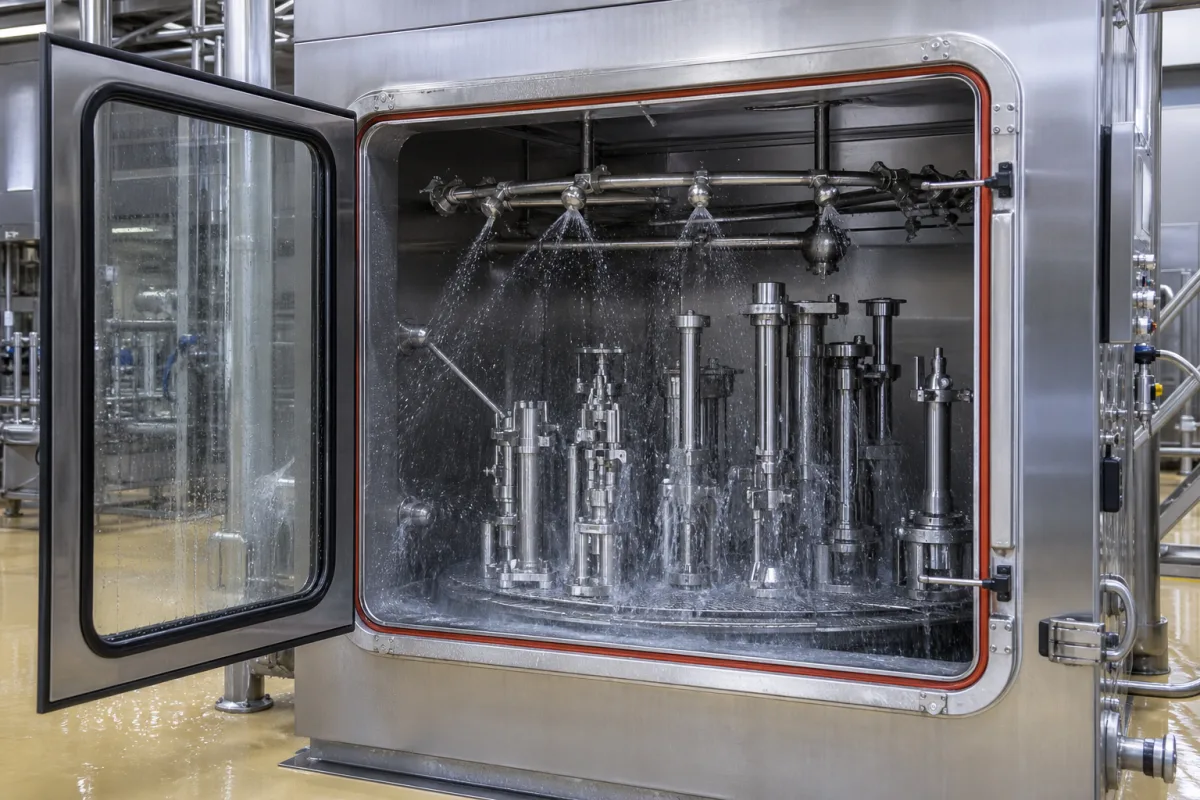
Chemical Sanitization Chamber

Based on aggregated insights from multiple verified factory profiles within the CNFX directory, the standard Chemical Sanitization Chamber used in the Beverage Manufacturing sector typically supports operational capacities ranging from standard industrial configurations to heavy-duty production requirements.

Technical Definition & Core Assembly

A canonical Chemical Sanitization Chamber is characterized by the integration of Spray Nozzle Array and Drainage System. In industrial production environments, manufacturers listed on CNFX commonly emphasize Stainless Steel 316L construction to support stable, high-cycle operation across diverse manufacturing scenarios.

A sealed enclosure within a sterilization system where beverage containers undergo chemical disinfection using sanitizing agents.

Product Specifications

Technical details and manufacturing context for Chemical Sanitization Chamber

Definition
The Chemical Sanitization Chamber is a critical component of the Automated Beverage Container Sterilization System, designed to expose containers to controlled chemical agents that eliminate microorganisms, pathogens, and contaminants. It operates as an intermediate or final stage in the sterilization process, ensuring containers meet hygiene standards before filling.
Working Principle
Containers enter the chamber via a conveyor system, where they are exposed to a mist, spray, or immersion of chemical sanitizers (e.g., chlorine-based solutions, peracetic acid, or hydrogen peroxide). The chamber maintains controlled temperature, pressure, and exposure time to optimize sanitization efficacy, followed by rinsing or neutralization stages to remove residual chemicals.
Common Materials
Stainless Steel 316L, Food-Grade Plastics
Technical Parameters
  • Chamber capacity for holding containers during sanitization (liters) Customizable
Components / BOM
  • Spray Nozzle Array
    Distributes chemical sanitizer evenly over containers
    Material: Stainless Steel
  • Drainage System
    Removes used chemical solutions and rinse water
    Material: PVC or Stainless Steel
  • Sealed Door
    Maintains containment of chemicals and safety during operation
    Material: Stainless Steel with Gasket
Engineering Reasoning
0.5-3.0 bar (gauge pressure), 20-80°C, 0.1-5.0% sanitizer concentration
Seal failure at 4.2 bar internal pressure, material degradation above 95°C, corrosion initiation at pH <2.0 or >12.5
Design Rationale: Polymer seal extrusion beyond 4.2 bar, stainless steel 316L chloride stress corrosion cracking above 60°C at >1000 ppm Cl-, chemical degradation of PTFE gaskets above 150°C
Risk Mitigation (FMEA)
Trigger Sanitizer concentration sensor drift exceeding ±0.5% accuracy
Mode: Insufficient microbial reduction (log10 reduction <5.0)
Strategy: Redundant conductivity sensors with 4-20 mA HART protocol and automated calibration every 24 hours
Trigger Thermal expansion differential of 0.15 mm between 304SS chamber body and 316L spray headers at ΔT>50°C
Mode: Header weld fatigue cracking leading to 0.5 L/min chemical leakage
Strategy: Expansion bellows with 12.7 mm stroke capacity and Inconel 625 weld overlay on header connections

Industry Taxonomies & Aliases

Commonly used trade names and technical identifiers for Chemical Sanitization Chamber.

Applied To / Applications

This component is essential for the following industrial systems and equipment:

Industrial Ecosystem & Supply Chain DNA

Complementary Systems
Downstream Applications
Specialized Tooling

Application Fit & Sizing Matrix

Operational Limits
pressure: 0-2 bar (0-29 psi) operating, 3 bar (43.5 psi) max
flow rate: 50-500 L/min (13-132 gal/min)
temperature: 10-60°C (50-140°F)
exposure time: 15-120 seconds
slurry concentration: 0.5-5% sanitizer by volume
Media Compatibility
✓ Peracetic acid solutions ✓ Hydrogen peroxide-based sanitizers ✓ Chlorine dioxide solutions
Unsuitable: High-viscosity fluids or abrasive slurries
Sizing Data Required
  • Container dimensions and throughput (units/hour)
  • Required sanitization cycle time
  • Available chemical supply pressure and flow rate

Reliability & Engineering Risk Analysis

Failure Mode & Root Cause
Corrosion-induced leakage
Cause: Chemical attack from sanitizing agents (e.g., chlorine, peracetic acid) degrading seals, gaskets, and chamber walls, exacerbated by temperature cycling and improper pH control.
Sensor/control system failure
Cause: Moisture ingress or chemical exposure compromising temperature, pressure, or chemical concentration sensors, leading to inaccurate readings and improper sanitization cycles.
Maintenance Indicators
  • Visible corrosion, pitting, or weeping at seams, seals, or welds on the chamber interior or exterior.
  • Audible hissing or irregular pump/valve operation indicating pressure loss or flow restriction.
Engineering Tips
  • Implement a routine inspection and replacement schedule for seals and gaskets using chemically compatible materials (e.g., EPDM, PTFE) based on exposure cycles, not just time.
  • Install redundant or fail-safe sensors with protective housings and regular calibration, and use water quality monitoring to maintain optimal pH and chemical concentrations to reduce corrosive conditions.

Compliance & Manufacturing Standards

Reference Standards
ISO 15883-1:2006 - Washer-disinfectors ANSI/AAMI ST79:2017 - Comprehensive guide to steam sterilization and sterility assurance in health care facilities DIN EN 285:2015 - Sterilization - Steam sterilizers - Large sterilizers
Manufacturing Precision
  • Chamber Leak Rate: ≤ 1.0 mbar/min at test pressure
  • Temperature Uniformity: ±2°C across all monitoring points during sterilization phase
Quality Inspection
  • Pressure Decay Leak Test
  • Biological Indicator (BI) Challenge Test with Geobacillus stearothermophilus

Factories Producing Chemical Sanitization Chamber

Verified manufacturers with capability to produce this product in China

✓ 94% Supplier Capability Match Found

T Technical Director from United Arab Emirates Jan 06, 2026
★★★★★
"The Chemical Sanitization Chamber we sourced perfectly fits our Beverage Manufacturing production line requirements."
Technical Specifications Verified
P Project Engineer from Australia Jan 03, 2026
★★★★☆
"Found 14+ suppliers for Chemical Sanitization Chamber on CNFX, but this spec remains the most cost-effective. (Delivery took slightly longer than expected, but technical support was excellent.)"
Technical Specifications Verified
S Sourcing Manager from Singapore Dec 31, 2025
★★★★★
"The technical documentation for this Chemical Sanitization Chamber is very thorough, especially regarding Exposure Time (seconds)."
Technical Specifications Verified
Verification Protocol

“Feedback is collected from verified sourcing managers during RFQ (Request for Quote) and factory evaluation processes on CNFX. These reports represent historical performance data and technical audit summaries from our B2B manufacturing network.”

7 sourcing managers are analyzing this specification now. Last inquiry for Chemical Sanitization Chamber from India (1h ago).

Supply Chain Compatible Machinery & Devices

Automated Beverage Filling and Capping Machine

Automated machine for filling and sealing beverage containers at high speed.

Explore Specs →
Automated Beverage Batch Blending System

Automated system for precise multi-ingredient beverage batch preparation.

Explore Specs →
Automated Beverage Container Sterilization System

Automated system for sterilizing beverage containers before filling.

Explore Specs →
Automated Beverage Labeling and Coding System

Integrated system for applying labels and printing codes on beverage containers.

Explore Specs →

Frequently Asked Questions

What materials are used in the chemical sanitization chamber to ensure food safety?

The chamber is constructed from Stainless Steel 316L and food-grade plastics, both compliant with beverage industry standards for corrosion resistance and safe contact with sanitizing agents.

How does the chamber control the chemical disinfection process for beverage containers?

It precisely regulates chemical concentration (in ppm), exposure time (in seconds), and temperature (in °C) through integrated systems, ensuring consistent and effective sanitization.

What components are included in the chamber's Bill of Materials (BOM)?

The BOM includes a drainage system for chemical removal, a sealed door to maintain enclosure integrity, and a spray nozzle array for uniform agent distribution across containers.

Can I contact factories directly on CNFX?

CNFX is an open directory, not a transaction platform. Each factory profile provides direct contact information and production details to help you initiate direct inquiries with Chinese suppliers.

Get Quote for Chemical Sanitization Chamber

Request technical pricing, lead times, or customized specifications for Chemical Sanitization Chamber directly from verified manufacturing units.

Your business information is encrypted and only shared with verified Chemical Sanitization Chamber suppliers.

Thank you! Your message has been sent. We'll respond within 1–3 business days.

Need to Manufacture Chemical Sanitization Chamber?

Connect with verified factories specializing in this product category

Add Your Factory Contact Us
Previous Product
Chemical Dosing Unit
Next Product
CIP Cleaning Module