Editorial Technical Reference

Diaphragm Valve Body

This page explains how Diaphragm Valve Body is classified within Beverage Manufacturing. Technical values and manufacturer relationships are research references; confirm the current specification and supplier evidence for each order.

Technical Definition & Core Assembly

Diaphragm valve body for beverage manufacturing, DN15–DN100, PN10/16, with EPDM/PTFE/FPM diaphragm options.
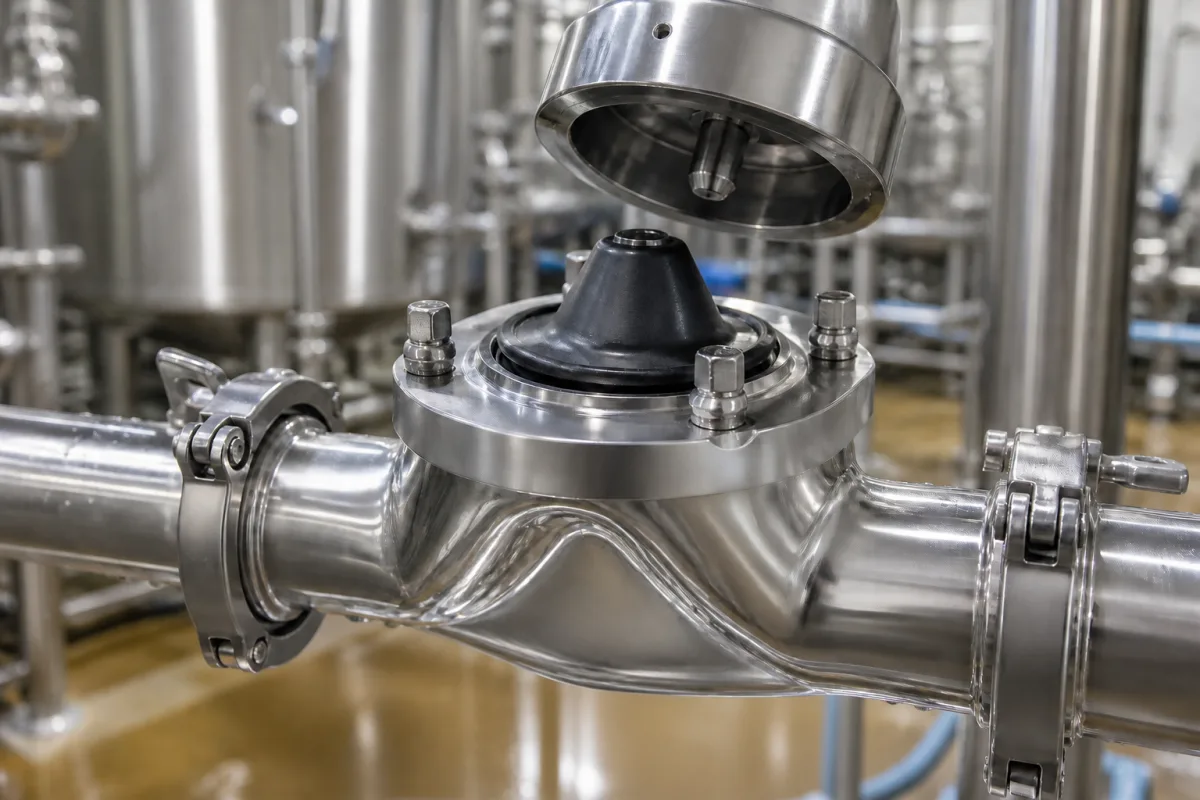
Representative product image. Confirm appearance and specifications with the manufacturer.

Product Specifications

Technical details and manufacturing context for Diaphragm Valve Body

Definition
The diaphragm valve body is a component used in beverage manufacturing systems to control the flow of process media. It is designed to be fitted with a diaphragm and an actuator (manual or automated) to form a complete diaphragm valve. The body provides the pressure-containing envelope and the flow path, while the diaphragm isolates the actuator from the process fluid, making the valve suitable for hygienic applications.

This directory entry covers common technical parameters for diaphragm valve bodies intended for use in beverage processing lines. Nominal diameters range from DN15 to DN100 per ISO 6708. The operating pressure range is 1.0–1.6 MPa (ISO 5208), with a note that below 1.0 MPa the seat load may be insufficient for reliable shutoff. Operating temperature is -10 to 80 °C, depending on the diaphragm material. Body materials include stainless steel grades CF8 and CF8M (ASTM A351) and carbon steel WCB (ASTM A216). Diaphragm materials include EPDM, PTFE, and FPM (ASTM D1418), selected based on chemical compatibility with the process media. End connections are flanged (per PN10/16, ISO 7005, GB/T 9113), threaded, or clamp type. The leakage rate is ≤0.01% (Rate A) per ISO 5208 for shutoff. Flow coefficient (Kv) ranges from 5 to 100 m³/h, varying with size. Weight ranges from 2 to 30 kg, depending on size and material. Face-to-face dimensions are 130–350 mm per ISO 5752 (Series 1 for flanged valves).

These values are reference ranges for directory purposes. Actual product specifications must be confirmed with the legal manufacturer or supplier for the specific model and application. Standards listed are procurement references and do not imply certification or compliance of any particular product. Always verify model-specific values and standards before purchase or installation.
Working Principle
The diaphragm valve body works by providing a sealed chamber where a flexible diaphragm is pressed against a weir or seat to control flow. When the actuator lifts the diaphragm, media flows through the body; when the diaphragm is lowered, it seals against the seat, stopping flow. The body's design ensures that the diaphragm isolates the process fluid from the actuator, preventing contamination and allowing hygienic operation. The operating pressure must be sufficient to ensure proper seat loading; below 1.0 MPa, the seat load may be inadequate for tight shutoff. The diaphragm material must be compatible with the process media and temperature range to maintain integrity and sealing performance.
Technical Parameters
ParameterTypical rangeNotes & selection driver
Nominal DiameterDN15–DN100 mmCommon sizes for diaphragm valvesISO 6708
Operating Pressure1.0–1.6 MPaBelow 1.0 MPa the seat load is insufficientISO 5208
Operating Temperature-10–80 °CDepends on diaphragm material
Body MaterialCF8, CF8M, WCBStainless steel or carbon steelASTM A351, A216
Diaphragm MaterialEPDM, PTFE, FPMSelect based on chemical compatibilityASTM D1418
End ConnectionFlanged, Threaded, ClampFlanged per PN10/16ISO 7005, GB/T 9113
Leakage Rate≤0.01 %Rate A for shutoffISO 5208
Flow CoefficientKv 5–100 m³/hVaries with size
Weight2–30 kgDepends on size and material
Face-to-Face Dimension130–350 mmSeries 1 for flanged valvesISO 5752

Ranges are indicative industry figures for RFQ preparation, not a supplier commitment. Confirm every value and standard with the legal manufacturer before ordering.

Applied To / Applications

This component is essential for the following industrial systems and equipment:

Industrial Ecosystem & Supply Chain Structure

Complementary Systems
Downstream Applications
Specialized Tooling

Application Fit & Sizing Matrix

Operational Limits
pressure: Up to 16 bar (232 psi)
flow rate: Dependent on valve size and Cv value
temperature: -20°C to 150°C
slurry concentration: Up to 40% solids by weight
Media Compatibility
✓ Abrasive slurries ✓ Corrosive chemicals ✓ High-purity fluids
Unsuitable: High-temperature steam (>150°C)
Sizing Data Required
  • Required flow rate (Cv/Kv)
  • Pipe size/connection type
  • Actuation method (manual/pneumatic/electric)

Reliability & Engineering Risk Analysis

Failure Mode & Root Cause
Diaphragm fatigue cracking
Cause: Cyclic flexing from repeated actuation exceeding material fatigue limits, often accelerated by chemical degradation or temperature extremes
Body corrosion/pitting
Cause: Chemical attack from process media on valve body material, particularly at crevices or where protective coatings are compromised
Maintenance Indicators
  • Visible weeping or leakage around the valve body-diaphragm interface during operation
  • Abnormal flow restriction or pressure drop across valve despite normal positioning
Engineering Tips
  • Implement regular diaphragm inspection/replacement schedule based on actual cycle counts rather than time intervals
  • Select body materials compatible with process media and install corrosion monitoring coupons upstream for predictive maintenance

Indicative industry ranges for design and RFQ preparation. Confirm the exact figures and applicable standard with the manufacturer before specifying.

Compliance & Manufacturing Standards

Applicable Standards
ISO 5208:2015 (Industrial valves - Pressure testing of valves) ANSI/ASME B16.34:2017 (Valves - Flanged, Threaded, and Welding End) DIN EN 12266-1:2012 (Industrial valves - Testing of metallic valves)

Quoted from the published standard.

Manufacturing Precision
  • Bore diameter: +/-0.05 mm
  • Face-to-face dimension: +/-1.5 mm
Quality Inspection
  • Hydrostatic pressure test (shell and seat)
  • Dye penetrant test for surface defects

Manufacturers of Diaphragm Valve Body

Manufacturer profiles associated with Diaphragm Valve Body.

Sourcing Diaphragm Valve Body from China?
Tell us your specification and target quantity — we will match it against manufacturer records and come back with the factories that fit.
Request manufacturers We manufacture this

Manufacturer listings support early research and capability understanding. They are not certification, ranking, or transaction guarantees.

Technical documentation
Request current drawings, revision history, and a signed specification sheet.
Manufacturing capability
Verify equipment lists, process limits, capacity, and representative production evidence.
Inspection readiness
Confirm test methods, calibrated equipment, sampling plans, and traceable reports.
Supplier transparency
Check the legal entity, factory address, ownership, certifications, and direct contacts.

CNFX does not score or rank suppliers. Buyers must verify all claims and documents with the legal manufacturer before ordering.

Supply Chain Compatible Machinery & Devices

Automated Beverage Container Leak Detection System

The Automated Beverage Container Leak Detection System is an industrial device designed for integration into bottling or canning lines.

Explore Specs →
Automated Beverage Container Depalletizing Machine

Industrial machine that automatically removes beverage containers from pallets for production line feeding

Explore Specs →
Regeneration Section

A dedicated section within an industrial system designed to restore or renew the functional properties of materials, media, or components through controlled processes.

Explore Specs →
High-Speed Rotary Bottle Filling Machine

Automated industrial machine for precise liquid filling of beverage containers at high production rates.

Explore Specs →

Frequently Asked Questions

What are the common sizes for this diaphragm valve body?

Common nominal diameters are DN15 to DN100 per ISO 6708. The exact size required depends on the flow rate and piping system design.

What is the operating pressure range?

The operating pressure range is 1.0–1.6 MPa per ISO 5208. Note that below 1.0 MPa, the seat load may be insufficient for reliable shutoff, so verify the minimum pressure for your application.

Which diaphragm materials are available?

Diaphragm materials include EPDM, PTFE, and FPM (per ASTM D1418). Selection should be based on chemical compatibility with the process media and temperature requirements.

What end connections are available?

End connections include flanged (per PN10/16, ISO 7005, GB/T 9113), threaded, and clamp types. Choose based on your piping system and hygiene requirements.

Data Basis

Editorial classification, named public sources where available, and source-reviewed manufacturer records.

Preliminary Technical Classification
This page supports structured research, RFQ preparation, and supplier evaluation. It does not replace buyer-led supplier qualification, standards review, or technical approval.
Buyer enquiry

Request manufacturing insight for Diaphragm Valve Body

Ask for use case, specification boundaries, supplier type, and RFQ preparation information for this product.

Where it goes
Straight to the CNFX editorial desk, and to the manufacturer if this product is linked to a claimed profile. Nothing is broadcast to a supplier list.
Your details stay here
We do not sell or rent enquiry data, and we do not add you to a mailing list. Used only to answer this request.
No commission, no middleman
CNFX is a directory. We take no cut of any order and never negotiate on a supplier's behalf.
What we don't claim
A listing is not an endorsement. Qualify every supplier and verify every figure yourself before ordering.

Your business information is used only to process this request.

Thank you! Your message has been sent. We'll respond within 1–3 business days.
Sorry, we couldn't send your message. Please try again, or email us at contact@cnfx.com.

Need to Manufacture Diaphragm Valve Body?

Compare manufacturer profiles with relevant product and process capability.

Previous Product
Vacuum Gripper End-Effector
Last Product
Get QuotesChat