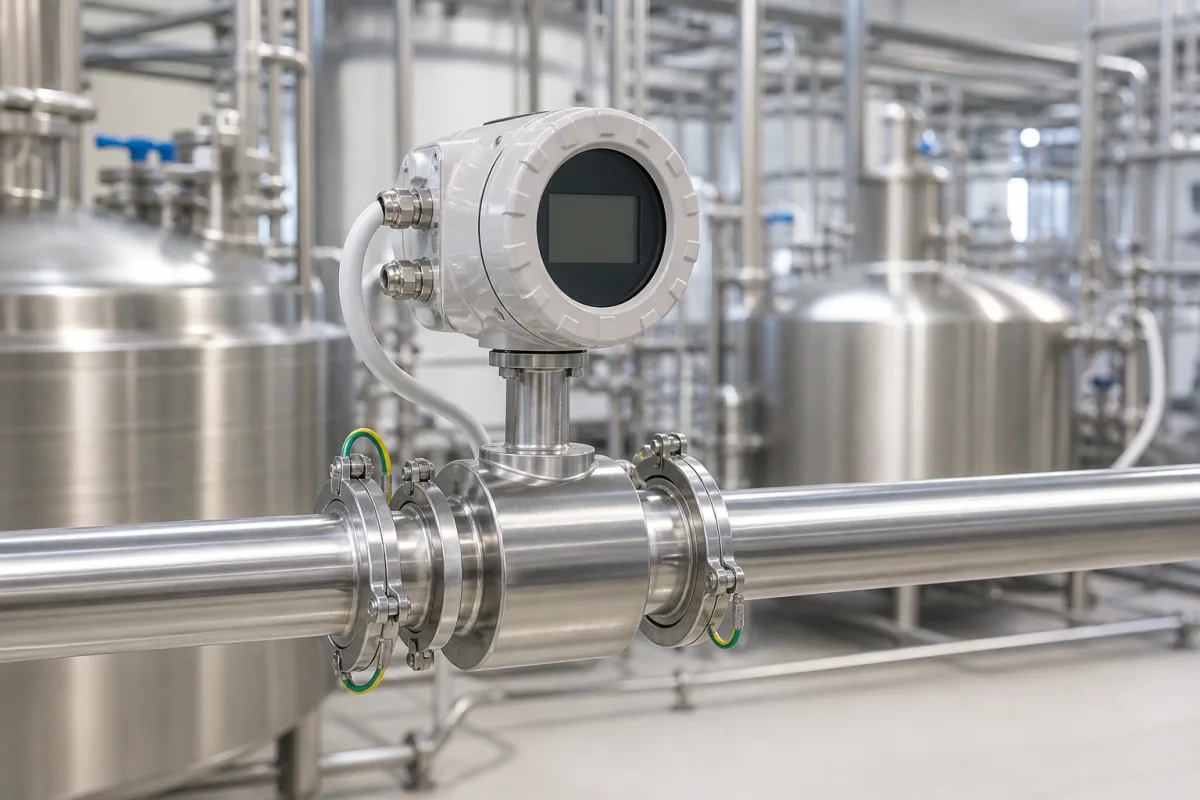
Sanitary flow meter (hygienic electromagnetic flowmeter with PFA liner and clamp or aseptic connections for CIP/SIP lines)
Hygienic electromagnetic flowmeters for dairy, beverage and pharmaceutical lines · PFA liner, 3-A and EHEDG certification, Tri-Clamp and aseptic connections, CIP/SIP temperature, minimum conductivity, surface roughness
A sanitary flow meter here is an electromagnetic flowmeter built for hygienic pipework: a stainless sensor with a PFA liner, no crevices, clamp or aseptic process connections and seals that survive cleaning- and sterilisation-in-place, with certificates such as 3-A and EHEDG. Ask three things first: whether your liquid is conductive enough, what temperature the CIP and SIP cycles reach at the process connection you choose, and which seal material suits the product.
Hygienic electromagnetic flowmeters for conductive liquids in dairy, beverage, food and pharmaceutical plants: PFA-lined sensors with 3-A/EHEDG certification, Tri-Clamp, DIN 11851 and aseptic connections and CIP/SIP capability. Flow meters of all principles for water, process liquids, gases and steam are covered on the Flow meter page; fertigation flow sensors and turbine meter pickoffs have their own pages; Coriolis and other hygienic principles are outside this page.
CNFX editorial research · Sources checked October 12, 2026 · 2 sources
Will it read your liquid: conductivity limit and low-flow accuracy
Endress+Hauser's Promag H 300 requires a conductivity of "≥5 μS/cm for liquids in general" and states a maximum volume-flow error of ±0.5% of reading ± 1 mm/s, optionally ±0.2% ± 2 mm/s, over a measuring range of "typically" 0.01 to 10 m/s. [1] KROHNE's OPTIFLUX 6000 data sheet gives a lower limit: "Standard: ≥ 1 μS/cm" and "Water: ≥ 20 μS/cm", with errors down to 0.2% to 0.5% of the measured value ± 1 mm/s depending on the signal converter and size. [2]
Editorial calculation: the fixed part of the error matters at low velocity. At 0.1 m/s, 1 mm/s is 1% of reading, so ±0.5% ± 1 mm/s becomes about ±1.5%; at 2 m/s it is ±0.55%. A flow of 10 m³/h in a pipe of 50 mm bore runs at about (10 ÷ 3,600) ÷ (π × 0.025²) ≈ 1.4 m/s. The flow and bore are assumed examples. [1]
Both makers ask for straight runs of at least 5 × DN upstream and 2 × DN downstream. [1][2] E+H can also measure the liquid's conductivity and temperature; its conductivity error is ±20% from 5 to 20 μS/cm and above 20,000 μS/cm, and ±10% in between, with ±5% optional for DN 15 to 150 from 50 to 10,000 μS/cm. [1]
Give the meter maker the liquid and its conductivity (lowest expected, including rinse water), flow range, pipe standard and bore, process connection type, CIP and SIP temperatures and times, product fat content and chemicals for seal selection, required certificates (3-A, EHEDG, FDA, EC 1935/2004), surface finish, output and housing, and quantity.
02
Liner, seals, clamp connections and the temperature they allow
KROHNE describes the OPTIFLUX 6000 as having "no crevices, gaps or blind spots", full CIP/SIP capability, wetted materials conforming to FDA and EC 1935/2004, EHEDG and 3A certification and PMO certification, with a PFA liner "reinforced with embedded stainless steel grid for vacuum resistance" and an L-shaped gasket that does not protrude into the measuring tube. Its process temperature is -40 to +140 °C for the separate sensor, but "for ISO 2852 and Tri-clamp versions: -40...+120°C", so the connection, not only the liner, sets the CIP/SIP limit. [2]
Endress+Hauser's Promag H 300 has a PFA liner, a 3-A and EHEDG (Type EL Class I) sensor, a medium temperature range of -20 to +150 °C, electrodes in 316L, Alloy C22, tantalum or platinum, and seals in EPDM, FKM, Kalrez or silicone depending on size. It warns that "EPDM is not a suitable seal material for fluids with a fat content > 8 %". Its 316L Tri-Clamp and other hygienic connections have a surface roughness of Ra max 0.76 μm, or 0.38 μm electropolished as an option. [1]
03
PFA liner, electrodes, gaskets, grounding and housing
Explore company information and manufacturing capabilities, then discuss the scope of your project with a relevant supplier.
Share this page
Compiled and source-reviewed by the CNFX editorial team.
Each manufacturer above links to the page on that company's own website where the product is listed, with the date we checked it. How we source and review
· Page last updated 13 October 2026
Buyer questions
How is this different from a general flow meter?
This page covers hygienic electromagnetic meters for conductive liquids in CIP/SIP lines; meters of all principles for water, gas and steam are on the Flow meter page. [1][2]
What conductivity does a sanitary magmeter need?
Endress+Hauser gives ≥5 μS/cm for its Promag H 300; KROHNE gives ≥1 μS/cm for the OPTIFLUX 6000, with ≥20 μS/cm for water. [1][2]
Does the clamp connection change the temperature limit?
KROHNE limits its ISO 2852 and Tri-clamp versions to +120 °C against +140 °C for the sensor. [2]
Which gasket for fatty products?
Endress+Hauser says EPDM is not suitable for fluids with more than 8% fat. [1]
Sources and what still needs a direct check
Sources checked 2026-10-12. Endress+Hauser publishes its Promag H 300 technical information; KROHNE its OPTIFLUX 6000 data sheet (distributor copy).