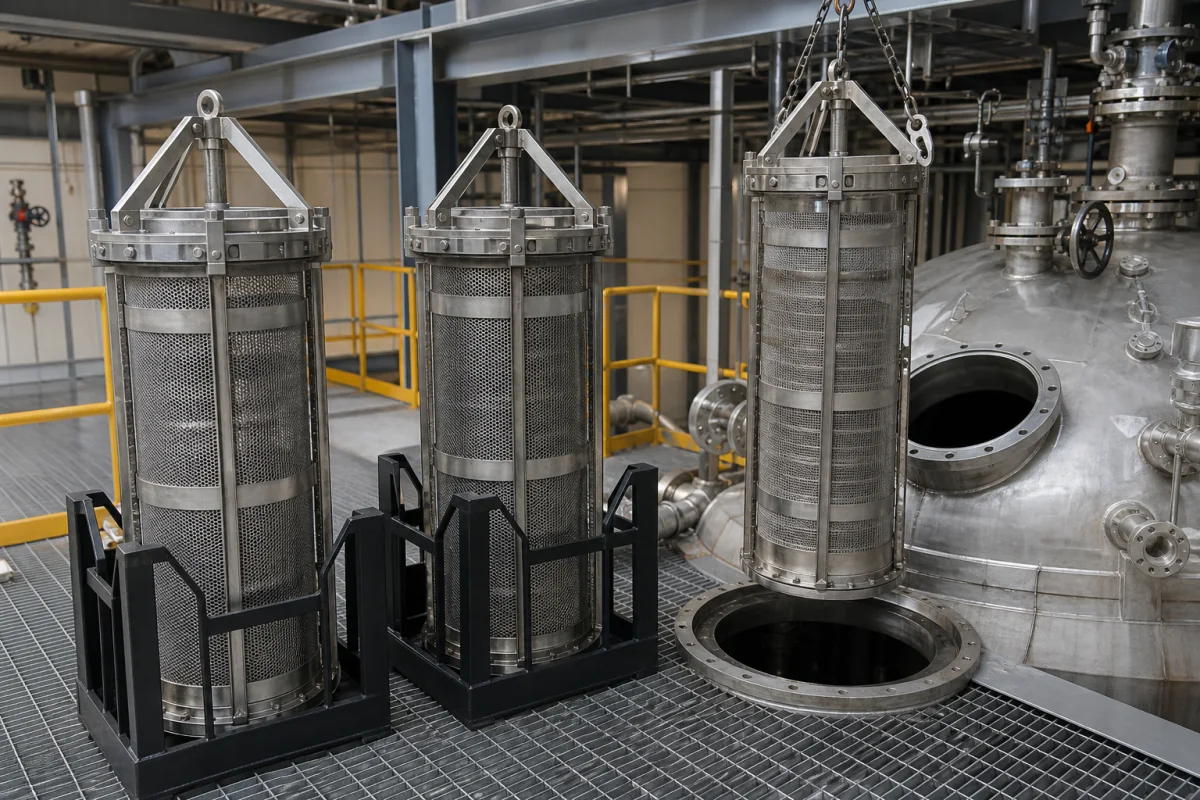
Catalyst baskets for radial-flow reactors: outer basket, scallops and centerpipe around an annular catalyst bed
Radial-flow reactor internals · Outer baskets, scallops and centerpipes in wedge wire or perforated plate for catalytic reforming, dehydrogenation and other thin annular beds
In a radial-flow reactor the gas crosses a thin annular bed sideways instead of passing down through a deep one. The catalyst is held between two concentric screens: an outer screen, built as a single self-standing basket or as a ring of scallops against the vessel wall, and an inner screen or centerpipe that collects or distributes the flow. These screens decide how much of the vessel the catalyst can use, whether fines blind the slots, and whether the internals survive repeated heating and cooling. Johnson Screens lists catalytic reforming, styrene dehydrogenation, hydrodesulphurising, isomerisation and ammonia converters among the processes that use them.
Outer baskets, scallops, centerpipes, cover decks and related screens that retain the annular catalyst bed of radial-flow fixed-bed and moving-bed reactors in refining and petrochemical service, in wedge wire or perforated plate. Removable catalyst cartridges of ammonia and methanol synthesis converters and catalyst baskets for stirred laboratory reactors are covered on the Reactor core page; flat support grids of axial-flow ammonia beds on the Ammonia synthesis catalyst bed support grid page; steam-reformer tubes on the Catalyst tubes page. Catalysts themselves are outside this page.
CNFX editorial research · Sources checked October 17, 2026 · 3 sources
Andritz describes the outer basket as a single piece installed over the full vessel cross-section and standing on a support ring attached to the shell. Because it stands clear of the wall it allows a wider gap to the vessel surface and therefore higher flow capacity, keeps a constant annular gap whichever way the flow goes, and must carry the full mechanical load of the catalyst bed itself. Scallops are instead hollow conduits set side by side against the vessel wall, introduced through the top manhole and resting on a support ring; each carries flow along its own axis and the reactor capacity is the sum of the scallops. [2]
Johnson Screens frames the trade-off from the installation side: compared with a single large outer basket, individual scallop screens make installation and repair faster and simpler, and its OptiMiser scallops are offered to combine the process efficiency of an outer basket with the installation and maintenance advantages of scallops, keeping a uniform bed thickness. [1] Andritz offers a segmented cylindrical outer screen (SSR-Flow) that is assembled through the manhole and needs no expander ring, noting that expander rings disturb the circulation of catalyst in the radial bed. [2]
Flow can run inward or outward. Andritz writes that "generally, the center pipe is on the high temperature or high concentration side of the process flow", because that puts less stress on the vessel shell and leaves more room for thermal expansion along the axis. [2]
Outer screen
How it is installed
What the makers point out
Outer basket
One piece over the full cross-section, self-standing on a shell ring. [2]
Constant annulus; carries full bed load; higher flow capacity. [2]
Scallops (wedge wire or perforated)
Individual conduits through the top manhole, against the wall. [2]
Faster installation and repair than one large basket. [1]
Segmented cylindrical screen
Elements joined through the manhole, pinned male/female joints. [2]
Stands on a support; installed through the top manhole. [2]
Blank top section equal to bed thickness prevents bypass if the bed settles. [1]
02
Slot width against the smallest catalyst particle, and vertical slots
Johnson Screens builds its Vee-Wire screens by welding V-shaped profile wire to support rods at every intersection. It offers slots from 250 μm upward in 25 μm increments, orients the slots vertically so catalyst can slide along the screen without abrasion, and describes outwardly enlarging slots that give two-point particle contact so fines pass rather than lodge. [1]
UOP's patent US 6,224,838 states that the slot width, which must keep gas and catalyst apart at the scallop face, is governed by the minimum catalyst particle size, which it says is "generally about 1.2 mm" in its reforming context. [3]
Johnson cites a screen of 24 ft diameter and 40 ft height built with a slot width tolerance of ± 0.002 in. Editorial calculation: 24 ft ≈ 7.3 m, 40 ft ≈ 12.2 m and ± 0.002 in = ± 0.002 × 25.4 = ± 0.05 mm. Those are Johnson's example figures, not a general tolerance; state the tolerance required for the catalyst being loaded. [1]
Give the screen maker the catalyst's smallest particle (and the fines expected after attrition), the flow direction, design temperature and pressure drop, and whether catalyst moves through the bed in a continuous-regeneration unit.
03
Thermal cycling and buckling of tall scallops
US 6,224,838 addresses scallops that buckle under the stresses of temperature changes and thermal-expansion differences in a reactor, citing catalytic reforming as a process where transient and discontinuous operation produces such stresses. Its design joins a curved profile-wire front to a flatter back by connection flaps, holding the front at least 3 mm, and preferably 6 to 25 mm, from the back so the conduit can flex without permanent damage; support bars are spaced at 0.1 % to 10 % of the length of the front edges. In its test the Type PRI scallop, offset 12 mm, flexed considerably more than a conventional profile-wire scallop without structural failure. [3]
Johnson lists 321 and 347 stainless steel as the usual materials for its radial-flow internals, with 304, 316, 410S, alloys 600 and 800 also possible, and says it follows ASME code requirements on carbon content for material at elevated temperature; screens can be made in sections to pass through the manway. [1]
04
Describe the vessel, the bed and the flow before the screens
Paste it into your enquiry below or into an email to a maker, then replace every bracket.
Vessel: [ID; tangent length; manway size; existing support rings]
Bed: [annulus thickness; catalyst size and shape; moving or fixed bed]
Flow: [inward or outward; design temperature and pressure; allowable pressure drop]
Outer screen: [basket / scallops / segmented]; centerpipe; cover deck
Screen: [wedge wire or perforated; slot width and tolerance; material]
Service: [new build or retrofit; installation supervision]
Explore company information and manufacturing capabilities, then discuss the scope of your project with a relevant supplier.
Share this page
Compiled and source-reviewed by the CNFX editorial team.
Each manufacturer above links to the page on that company's own website where the product is listed, with the date we checked it. How we source and review
· Page last updated 17 October 2026
Buyer questions
What is the difference between an outer basket and scallops?
Andritz describes the outer basket as one self-standing piece over the full cross-section with a constant annulus, and scallops as individual conduits against the vessel wall installed through the manhole. [2]
How narrow can the screen slots be?
Johnson Screens offers Vee-Wire slots from 250 μm upward in 25 μm increments. [1]
Why do scallops buckle?
UOP's patent attributes it to stresses from temperature changes and thermal-expansion differences, and offsets the profile-wire front 6–25 mm from the back to let it flex. [3]
Sources and what still needs a direct check
Sources checked 2026-10-17. Two screen makers' brochures, Johnson Screens (Aqseptence Group, 2017) and Andritz Euroslot, describe their own radial-flow internals; UOP's US 6,224,838 gives the design reasoning and test result for flexible scallops.