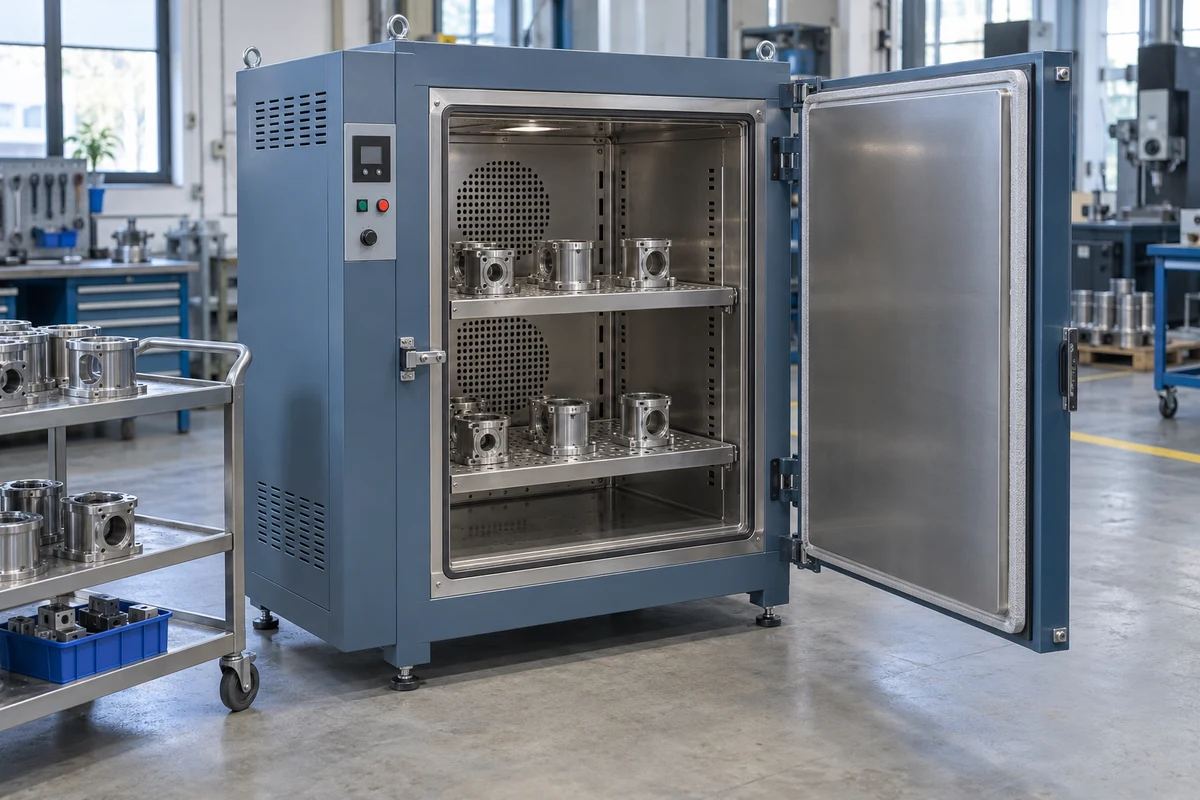
A forced-air oven heats a batch by moving hot air around the parts. Explore its components, compare chamber sizes and separate temperature stability from spatial uniformity. Yuanyao YPO data provide a model reference; the test definition and load conditions still need agreement.
CNFX editorial research · Sources checked October 12, 2026 · 6 sources
The YPO specification identifies electric heaters and centrifugal air circulation [1]. Heating adds energy; circulation moves that heated air around the load. In Memmert UF ovens, a rear fan, preheating space, side slots and an adjustable air flap illustrate how recirculation and air exchange work together. That is the UF arrangement, not a verified YPO duct drawing [4].
Functional structure / BOM reference
Role in drying
Published material or configuration
Heaters
Supply heat to the circulating air.
YPO lists a stainless-steel heater; element alloy and electrical power are not specified [1].
Circulation fan
Moves heated air through the working chamber.
YPO identifies centrifugal circulation, without fan material, flow rate or motor rating [1].
Controller and profile functions
Set and regulate the heating process.
YPO lists a button-operated digital controller, with a touchscreen in its features. A PLC or programmable ramp/soak capability is not established [1].
Temperature sensing and monitoring
Feed the controller and detect excessive temperature.
YPO lists overtemperature protection but no sensor type or independent limiter architecture. Memmert monitoring options are model-specific [1][4].
Chamber, enclosure and insulation
Contain the load and limit heat loss.
YPO: SUS201 chamber, SUS304 for versions above 200 °C; powder-coated cold-rolled exterior and fibreglass wool. Insulation thickness is unspecified [1].
Shelves and door
Support and give access to the batch.
YPO includes two height-adjustable shelves. Shelf load rating, shelf alloy and door-seal material are not given [1].
Fresh-air and exhaust path
Exchange chamber air rather than merely recirculate it.
Memmert UF uses an adjustable flap; YPO exhaust hardware, flow and duct requirements are not specified [4][1].
This describes functions and documented configurations, not an orderable manufacturing BOM. Obtain the supplied model’s parts list and air-path drawing; do not infer internal quantities, fan alloy or a PLC from the scene image.
02
Fluctuation and uniformity are different numbers
Memmert’s explanation of DIN 12880:2007-05 distinguishes variation over time from the difference between the time-averaged hottest and coldest measurement points [2]. Yuanyao uses a signed percentage for uniformity without defining that calculation [1].
A percentage needs a reference and a definition
If the percentage were based on the Celsius setpoint, 1% of 200 is 2 and 2% of 300 is 6. These are conditional arithmetic examples, not verified YPO acceptance limits. A ± deviation around a reference is not the same as the full hottest-to-coldest span. Require the supplier’s formula and a result in kelvin [1][2].
A stable sensor does not map the chamber
The published ±0.3 °C fluctuation figure does not by itself establish spatial uniformity or product temperature. Test the positions occupied by the batch, with the stated air and loading conditions [1][2].
Term on a data sheet
What it describes
Example from the Chinese oven reviewed
Temperature fluctuation (consistency)
How much the temperature at a point swings over time [2]
DIN 12880 is a laboratory heating-oven and incubator test reference, not proof of suitability for every industrial process. DIN Media currently lists the 2007 edition and its planned replacement in November 2026; agree the edition for the order. The method below follows the 2007 explanation [5][6][3].
Size matters for the test
The YPO-072 dimensions imply a geometric chamber volume of 72 litres (40 × 45 × 40 cm ÷ 1000). If the 2007 method is agreed for that working chamber, Memmert’s explanation calls for 27 points. This calculation does not prove that Yuanyao has performed that test [1][2].
Measuring points
9 points for working chambers up to 50 litres; 27 points above 50 litres. The 1980 edition used 9 points for all sizes [2].
Heat-up time
Ends when the centre of the chamber stays permanently within the permitted deviation, not when it first reaches 98% of the setpoint as in the old method [2].
Recovery after door opening
At the highest test temperature, the door is opened for 30 seconds and recovery is timed until the centre stays permanently within the permitted deviation [2].
Reporting
Memmert notes that comparing heat-up, homogeneity, consistency and recovery figures between makers only makes sense on the same test standard [3].
04
Read a real specification line by line
Yuanyao lists six YPO sizes for drying, curing and ageing. The dimensions below are its published W × H × D values; they describe the chamber and cabinet, not the usable volume of a packed batch [1].
Headline: ambient +25 °C to 200 / 300 / 400 °C. Table: ambient +25 °C to 200 (300) °C. Features offer customisation to 500 °C. Confirm the selected version; 500 °C is not a standard rating for all six models [1].
Heat-up
The table says 30 minutes; the headline says it depends on size and temperature. Start temperature, end criterion and load are not stated [1].
Button digital controller in the table, digital or touchscreen in the features; two adjustable shelves. No shelf capacity or program-profile specification is published [1].
A drying/curing application label does not establish approval for flammable solvent release. The YPO page gives no exhaust rate or solvent-load safety design. Memmert’s UN/UF manual explicitly excludes combustible/explosive loads; that restriction belongs to those ovens and is not a YPO approval. Establish the required process-specific design before ordering a solvent-bearing batch [1][4].
05
Match each parameter to the batch and the cabinet
The original specification fields describe four different decisions: space for the parts, heat input, temperature evidence and installation. Keep them attached to the delivered model.
Parameter
Unit / meaning
Model evidence or order requirement
Temperature range
°C / selected version
YPO lower setting is ambient +25 °C; resolve the headline/table maximums rather than assigning one range to all models [1].
Chamber volume
L or m³ / geometric space
YPO-072 dimensions calculate to 72 L = 0.072 m³. Usable batch envelope depends on shelves and air clearance [1].
Heating power
kW / heaters and total input
Not stated in the YPO page; require heater and connected-load ratings, maximum current and supply details.
Temperature uniformity
K / defined spatial statistic
Request the full test definition and sensor map; do not silently convert the YPO signed percentage into a DIN span [1][2].
Heat-up time
min / start, end and load
The published 30-minute value lacks a matched test condition; specify the endpoint and batch [1].
Operating pressure
Pressure / process configuration
No pressure rating is established for this hot-air range. If vacuum, pressure or controlled atmosphere is required, specify that equipment type separately.
Maximum operating temperature
°C / actual version
A 500 °C custom option does not upgrade a quoted 200 or 300 °C oven [1].
Temperature control accuracy
K / defined error and reference
The 0.1 °C resolution is a display step, and ±0.3 °C is fluctuation. Neither establishes calibrated accuracy [1].
Electrical supply
V, phase, Hz, current
Page lists single-phase 220 V and three-phase 380 V, 50/60 Hz. Require the nameplate for the chosen oven [1].
Insulation thickness
mm / specified material
Fibreglass wool is listed, without thickness; require the supplied construction specification [1].
Interior material
Grade / selected temperature version
YPO lists SUS201, with SUS304 above 200 °C; specify chemical compatibility and the delivered grade [1].
Exterior material
Material / finish
YPO lists powder-coated cold-rolled sheet; no sheet thickness is published [1].
Weight
kg / equipment, batch and shipping
No YPO weight is established by this page. Require cabinet and maximum shelf/total load separately.
Footprint and envelope
Dimensions / named axes
YPO dimensions above use W×H×D in cm. Floor footprint is W×D; include door opening, exhaust and service space rather than relabelling the three axes [1].
These are fields with scoped examples, not a generic range of industrial-oven capabilities. Unpublished power, mass, pressure and insulation thickness remain unassigned.
06
Write the acceptance test into the order
Agree whether the report applies to an empty chamber or your representative load. Airflow, shelf layout and batch placement can change the result; Memmert’s UF instructions specifically caution against dense loading [4].
Name the setpoints
Give the temperatures you will actually run, not only the maximum.
Fix the method
State the test standard, for example DIN 12880:2007-05, and the number of measuring points [2].
Fix the load and air settings
State batch mass, rack arrangement, occupied working zone, fan and exhaust settings. Separate chamber-air tests from product-temperature acceptance.
Define the temperature statistics
State spatial span and time variation separately, in kelvin, with reference, sample duration and the calculation used. A ± tolerance requires a stated centre.
Include door recovery
Ask for recovery time after a 30-second door opening at your highest setpoint [2].
Ask for the report
A test report with sensor positions and calibration certificates of the logger used.
07
Preserve the air path when loading and maintaining it
Memmert’s UN/UF manual gives a useful operating example: avoid dense loading, keep parts away from the chamber floor, sides and ceiling, and use the permitted shelves. These are model instructions, not a YPO clearance or shelf-load rating [4].
Cleaning
Keep residues from accumulating; use cleaning products compatible with the actual chamber and seals. Cool the oven before handling it and isolate power before opening electrical covers [4].
Temperature checks
Use a calibrated reference instrument. Memmert recommends annual calibration for UN/UF; obtain Yuanyao’s own maintenance plan rather than adopting that interval for YPO [4].
Faults and protection
Record the failed temperature or airflow condition and follow the delivered service instructions. A listed overtemperature device does not establish independent shutdown architecture or solvent safety [1].
08
Copy this RFQ and fill in the brackets
Paste it into your enquiry below or into an email to a maker, then replace every bracket.
Product: forced-air batch oven, complete model/temperature version [ ], quantity [ ]
Process: [drying / curing / ageing]; material [ ], batch mass [kg], moisture/solvent release [ ]
Chamber and rack: W×H×D [ ], usable working zone [ ], shelves [ ], load per shelf [kg], batch arrangement [ ]
Temperature: ambient [°C], actual setpoints [°C], rated maximum [°C], product-temperature requirement [ ]
Test: standard and edition [ ], sensor map/points [ ], empty or representative load [ ], fan/exhaust settings [ ]
Performance: spatial span [K], time variation [K], reference and calculation [ ], recording period [ ]
Heat-up: starting condition [ ], permanent-stability endpoint [ ], maximum time [min]; door recovery protocol [ ]
Materials: chamber grade [ ], shelf/door seal [ ], insulation material/thickness [ ]
Installation: external W×H×D [ ], door/service/exhaust space [ ], oven mass [kg], floor limits [ ]
Electrical: voltage/phase/frequency [ ], heater kW [ ], total connected load/current [ ]
Protection: independent limiter and shutdown [ ], ventilation/fan-loss response [ ], load-specific safety design [ ]
Documents: matched manual, calibrated test report and sensor map, drawings, applicable conformity evidence [ ]
Delivery destination [ ], date [ ], service/spares [ ]
2 companies list this product among what they make. Company figures are quoted from each
company's own website; every card states where the relationship came from.
Yuanyao Technology
Dongguan, Guangdong (contact address), CN
Lists the six YPO hot-air sizes shown above. Confirm the temperature and controller version: headline, parameter table and customisation features differ. Its drying/curing labels do not establish solvent-load safety, pressure service or a validated sterilisation cycle.
The current drying-oven catalogue lists standard, laboratory, custom and walk-in KOV products. Battery-test or explosion-proof labels refer to separate configurations; confirm solvent-oven suitability for the quoted model.
Explore company information and manufacturing capabilities, then discuss the scope of your project with a relevant supplier.
Share this page
Compiled and source-reviewed by the CNFX editorial team.
Each manufacturer above links to the page on that company's own website where the product is listed, with the date we checked it. How we source and review
· Page last updated 13 October 2026
Buyer questions
What is the difference between temperature fluctuation and uniformity?
Fluctuation is the swing over time at a point. Uniformity is the spread between the hottest and coldest points in the chamber. [2]
How many sensors does DIN 12880 use?
Nine for chambers up to 50 litres and 27 for larger chambers, under the 2007 edition. [2]
What does ±1% uniformity mean?
The percentage basis is not defined on the YPO page. If it means 1% of a 200 °C setpoint, the arithmetic is 2 °C, but that does not establish whether the reported uniformity is a ± deviation or a full spatial span. Agree the formula and test result. [1][2]
Is a stainless interior always 304?
Not always. One range reviewed uses SUS201 up to 200 °C and SUS304 above 200 °C. [1]
Sources and what still needs a direct check
Sources checked 2026-10-12. Standards bodies and regulations define the requirements; manufacturer pages show published ranges for those models only. CNFX does not certify products or suppliers.